In early April 2003, 10-year-old Theo Shakir heard the battle for Baghdad International Airport from his home just a few miles away. Months later, U.S. tanks would roll into his neighborhood, one of the last to fall in Iraq’s capital city.
Shakir watched that hours-long street street battle from his roof-top, where his family had hoisted a white flag. The fighting came in fits and starts, with explosions of gunfire followed by an incongruous calm.
When a tearful and terrified Shakir stepped outside with his grandmother to hang a second white flag, a U.S. soldier offered his apologies. He went to his tank and returned with a couple of bags of candy for the boy.
Shakir would remember that act of kindness a decade later when he swore his oath of enlistment in the U.S. Air Force.
Shakir grew up the only child in a big house full of extended family: his physicist mother, his grandparents and four uncles. His father, an engineer, had not been a regular figure in Shakir’s life since his parents’ divorce when he was very small.
In the backyard of that big house was a garden planted with palm trees. His neighborhood was filled with friends around whom his small world revolved. He picked up English from his mother, who’d learned the language during her studies.
A fear of the government pervaded the normalcy, but even that seemed commonplace to Shakir. He figured everyone feared their leadership.
Then came the U.S. invasion. For weeks, Shakir recalled, he and his family watched what was happening across Iraq on television. His uncles came home in the evenings with reports of the action. They saw the planes headed for what was then called Saddam International Airport and heard the bombs explode.
“If you ever watch the videos [from that time], we were very supportive of the U.S.,” Shakir said of his countrymen. “All the kids wave, all the families wave. Most people were very happy as soon as it happened.”
When U.S. troops made sweeps through houses, most welcomed them in, he said. “Eighty percent of Iraq were with the Americans on that.”
That included the Shakir family. His mother and two of his uncles would eventually go to work at the U.S. Embassy.
With the invasion also came danger; armed foreigners took possession of the garden of palms even as locals ordered them out. In one daring move two days before troops rolled onto nearby streets, the young neighborhood men stole all of their guns and turned them into police, Shakir said. More foreign fighters showed up in response. “That’s what made the battle a big one.”
Bombings led to the shuttering of some local schools. Classes were relocated into one building that was considered relatively safe for its distance from main roads, and locals protected it fiercely. With three schools operating under one roof, the children attended classes in shifts: 7 a.m. to noon, noon to 4:30 p.m. and 4:30 p.m. to early evening.
Shakir attended the middle shift, which meant he and a friend could enjoy mornings without grownups. There was another unexpected silver lining to war: “The family,” he said, “bonded like never before.”
All of that shattered one day in 2005 when his uncle was assassinated.
Threats on families who did well were not unheard of before the war, Shakir said. But his family had become a target because of their work at the embassy, with strangers asking neighbors about them.
The funeral, as was custom, lasted three days. Early the next morning, Shakir awoke to find his mother had packed his bags. They were leaving for Jordan under the cover of darkness.
Shakir had only ever left Baghdad once — a trip to Turkey — but he’d been too young to remember. He was more happy than sad to leave. He believed that in Jordan he and his mother would be reunited with his slain uncle, that the assassination and funeral had all been a cover for an escape. Such a thing was not unheard of.
Cars did not explode in Jordan. There were no suicide bombers or threats on their lives. Water flowed freely from faucets and electricity ran without interruption.
But Shakir’s uncle did not join them.
Shakir and his mother spent one year in Jordan. Then they moved to Kuwait, where he would remain until 2010 except for a six-month stay in the U.S. to earn permanent legal residency.
The family settled in Grand Rapids, Michigan, where Shakir saw his first snowfall of any significance and, in 2012, graduated from high school. Shakir had the chance to earn a soccer scholarship to attend college but, he said, “I didn’t know how sure I was about it. I wanted to grow up and get some discipline, and I did not want to go to school.”
His step-father suggested the military.
“Where I’m from, the Air force is very elite. We didn’t really have a Navy,” Shakir said.
By his junior year of high school, he’d decided on a life in the U.S. Air Force, selecting biomedical equipment technician as his top job. An uncle back in Baghdad performed the same kind of work, and Shakir liked the idea of learning how to fix things.
As Shakir waited for his top job to open up, he set his sights on U.S. citizenship. The process — interrupted first by his entrance into the Air Force and second by his training — would take two years.
At his first duty station at Scott Air Force Base, Illinois, Shakir, now an airman first class, received an email from a colonel who wanted to start a program to help non-U.S. airmen earn their citizenship.
He responded right away. Soon, his colleagues from the 375th Medical Support Squadron were quizzing him on the civics questions he’d have to know as part of his path to citizenship.
“I was having them answer some questions, too. They said they knew the history. Some did and some didn’t,” Shakir said.
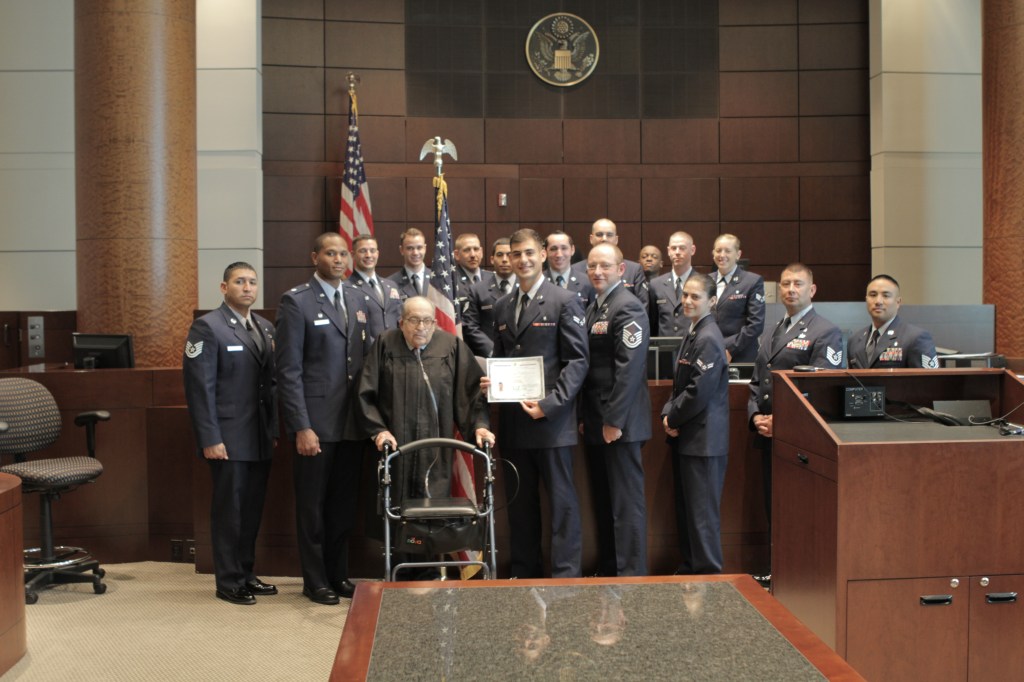
When it came time to take the civics test, he passed easily. On Oct. 17, Shakir became a U.S. citizen in a courthouse ceremony while his fellow airmen looked on.
“I want out of my military career to go someplace abroad,” he said. “Where I want to live and stay is definitely in the U.S.”