
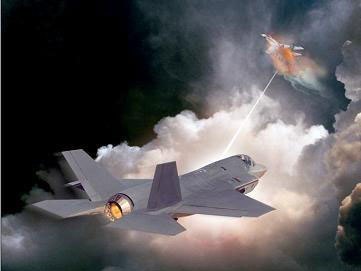
Directed energy technology could vastly increase the options that war fighters have available to them, Air Force leaders said Tuesday, arguing it’s a desperately needed update to defense capabilities.
“We have about the same weapons we had on 9/11 for our air defense,” said Lt. Gen. William Etter, commander of the Continental U.S. North American Aerospace Defense Command Region, charged with protecting the U.S. homeland.
“I would like kinetic and nonkinetic, lethal and nonlethal directed energy options that I can use,” Etter said. “I don’t always need to bring an airplane down, I need to turn it around sometimes.”
Both offensively and defensively, the Air Force must currently rely on missiles or other destructive forms of attack. But directed energy systems like electromagnetic waves could open up the options the military has available, including shutting down the electronics in vehicles, knocking out power to buildings or cell-phone towers, or using directed heat and sound to disperse crowds.
“We’re not always going to kill people in our sites; sometimes all we want is for them to stop what they’re doing,” Lt. Gen. Bradley Heithold said, commander of the Air Force Special Operations Command.
Heithold gave the example of troops on the ground who would need to either take out a specific target or rescue a hostage. Directed energy could be used to knock out cell phones so the targets can’t call for help, or to disable a getaway car.
Directed energy can also be used to protect aircraft in flight by shutting down weapons systems targeting the plane or destroying incoming missiles. Heithold said it’s a capability that is desperately needed to address threats in combat theaters.
“We still have the requirement to own the battle space for a short period of time” for special operations, he said. “I’m putting my battle planes over the objective today, it’s getting more difficult to defend them in the battle space. … I must look for new ways of defending the airplane.”
Directed energy could also allow planes to have a much greater payload, Etter noted, as the systems to fire hundreds of laser shots take up the same amount of space as a few missiles.
“It’s critical to have more than two to six rounds come off an aircraft,” he said.
And, lasers and other directed energy systems are more resilient to firing in bad weather or at night compared to conventional weapons, Etter said.
“We don’t know the time or the place that an attack could come at the nation,” he said.
Maj. Gen. Jerry Harris, vice commander of Air Combat Command, noted that the speed of lasers and other systems means stealth will be a “huge role” for the Air Force going forward, as the first pilot to spot the enemy could easily take out opposing planes without return fire.
“Right now when we talk about air-to-air engagement, we talk about it in miles and minutes,” he said. “With directed energy, we change that discussion to seconds and milliseconds.”
But there are several issues the technology must work through first, Etter said, including a better understanding of its range and potential collateral damage.
“If I shoot at this target with directed energy and it misses, does it go all the way to the moon?” he said. “If we take this shot and there’s someone on the ground with a pacemaker, is that affected?”
If there are 100 civilian aircraft in the air and only one is a threat, “can we prosecute that attack and not harm the other 99?” Etter asked.
He pulled a common laser pointer out of his pocket.
“If we can put this in something the size of a pen, we certainly can figure this out,” he said.


