

Space is for the use of all people, and the Air Force is prepared to defend any civilian or commercial assets that are threatened in orbit, just as it would on the ground, a top space official said.
“We have an obligation to provide, not just space resiliency capabilities for our defense space, but for this global commons,” said Winston Beauchamp, the Deputy Under Secretary of the Air Force for Space, and the director of the Principal Defense Department Space Advisor Staff.
“In the same way that we would take action to defend a commercial ship that is threatened by an adversary on the high seas, or a commercial airliner that was threatened by an adversary missile or fighter plane, we must do the same in space,” he told a breakfast hosted by the Air Force Association March 17.
The Pentagon already supports the civilian sector by providing crash-avoidance warnings that allow businesses to move their satellites out of the path of debris or other satellites, he said.
“There is so much innovation and investment going on in space today that needs that level of protection in terms of policy, in terms of norms and behavior, acceptance of the way we will all agree to behave and treat each other,” Beauchamp said.
He added that the Pentagon is supporting the State Department during negotiations to set up some international understanding of the rules for conduct and behavior in space.
“We already know what irresponsible behavior in space looks like,” Beauchamp said, referencing a Chinese test to shoot down an orbiting satellite. “From the 2007 test the Chinese did, we are now eight years, nine years later. We still maneuver every day to avoid debris created by that test because it was done in a fairly irresponsible way.”
The fact that an increasing number of nations and private corporations are getting involved in space operations means there is not only a greater need for cooperation, but that the Air Force also has to be prepared to defend against attacks, Beauchamp said.
When designing and building new systems, the service should “emphasize resilience instead of efficiency as we did in the past when space was a benign environment,” he said.
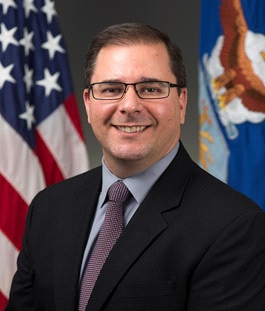
Winston Beauchamp
Photo Credit: Air Force
The domain of space is becoming as critical for the U.S. to defend as cyberspace.
“Not everybody realizes the degree to which modern life…depends upon the capabilities delivered by space,” Beauchamp said. “We all have devices in our pockets that give us access to the accumulated knowledge of the human race and we all mostly use it to complain about movies and look at pictures of cats. But in addition to that, we use it to navigate, to communicate.”
The Global Positioning System is used for navigation and even to time-stamp digital transactions like those used by banks. Satellites provide trans-continental communication that is more reliable than trans-oceanic cables. Earth monitoring satellites keep an eye on weather, and can help provide critical information on disaster relief and global warming.
Beauchamp pointed to how satellites helped the U.S. government and its allies track the spread of Ebola by watching where crops were going un-harvested as the local population became sick.
“Space has brought that transparency in a way that’s fairly ubiquitous and in fact often unnoticed and rarely attributed,” Beauchamp said.
But, he said, that’s starting to change.
“There is a resurgence in interest in space in this country that I have not seen since the days of the Moon landing,” he said.


