
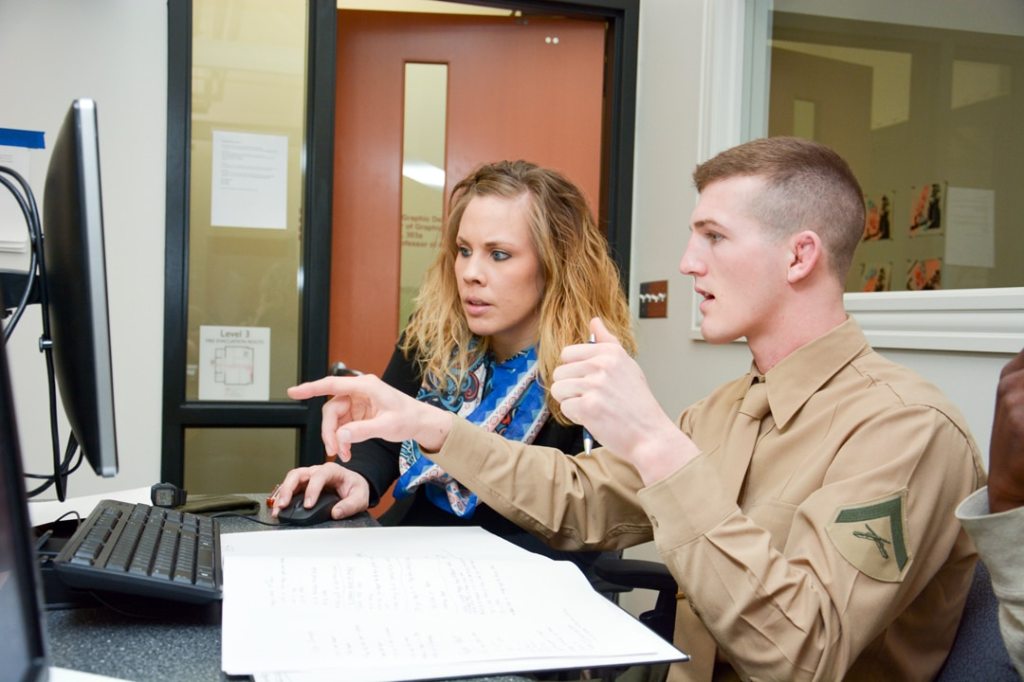
If you’re in college, you likely have encountered group learning, the educational philosophy that says students learn better when they collaborate. Teamwork is the watchword of the 21st-century classroom.
Colleges are responding to student tastes: 44 percent of students say they would rather work collaboratively than on their own, according to educational-content publisher XanEdu. Group learning aims to satisfy employers, too, 74 percent of whom say the ability to work as a team is their most sought after post-graduation skill, according to Hart Research Associates.
Do students learn better in groups? For more than a decade, advocates have touted findings by the National Training Laboratories Institute for Applied Behavioral Sciences that show students are far more likely to retain information learned in collaborative settings.
For veterans, collaborative learning may be a mixed bag.
“Among the younger students who don’t have a veteran’s maturity and life experience, there were always some people who just slid, who slacked off and took up space,” said Garrett Coffey, 28, a former Army specialist, now a systems engineering grad student at Missouri University of Science and Technology.
When teammates got sloppy in group projects, Coffey stepped up. “I am the one who says, ‘OK, we’ve had our fun, now it’s time to buckle down and get the work done,’” he said. “Military professionalism can go a long way. Other students may not show it, but they do look up to us, and when we as veterans can serve as role models, it helps them to push a little bit harder.”
How to be a role model and get the most out of a group-learning exercise? Here are six strategies.
1. Learn from everybody.
At Pace University’s Lubin School of Business, former Marine communications technician Cpl. Hernan Gallego and his fellow finance students have formed competitive teams to develop hypothetical companies. The group work makes up 15 percent of the grade, and Gallego relies on his teammates to fill in the gaps in his knowledge. “These are finance majors, marketing majors, accounting majors,” he said. “If there is something I don’t know, all I have to do is turn to a teammate, and there is someone there who can help me out.”
2. Extend yourself.
Working solo, you don’t want to make a misstep. Group work gives you the freedom to fail: You can try new things in a group, knowing that if you slip off the tracks, someone else can help steer you straight again.
“This is the time to branch out and try different things that might be less comfortable,” said Heidi M. Steinhauer, associate professor of engineering and department chair-engineering fundamentals at Embry-Riddle Aeronautical University.
“If you are someone who is most comfortable learning through reading, switch that up and do some of your research online or using videos. It takes practice and effort to take in information in a new way, and with collaborative learning, you have a teammate available in case you stumble. It’s a chance to expand your own range in places where maybe you don’t have a really strong skill set.”
3. Be real
… and allow others to be real, too.
“If you are going to take the most out of collaborative learning, be yourself, be real, be open, be willing to get to know other people, and allow others to get to know you. This creates a connection, a sense of community,” said Dr. Andrew Shean, chief academic learning officer at Bridgepoint Education, which includes Ashford University.
The flip side of this: Success in group learning means letting others express themselves.
“Are you responding to your peers based on your own bias or assumptions, or are you really considering their perspective? An individual’s upbringing, personal history, and background is going to shape the point of view. Consider not only how you engage others but also how you are improving your own thinking,” Shean said.
4. Rat out your friends.
Not everyone pulls their weight in a group, and veterans may be especially frustrated when younger, less mature students seem to be goofing off. Army Spc. John Brandone has run into this occasionally as an aviation maintenance sciences major at Embry-Riddle. He has no qualms about tattling.
“I have consistently told the teacher when people are not showing up, when they are not doing the work, not participating in the activities,” he said. “My grade was significantly higher than theirs because I kept up those lines of communication with the teacher.”
5. Embrace the process.
Unlike the military mindset — let’s get the job done — collaborative learning tends to value the journey itself. Veterans need to make that adjustment.
“A lot of veterans have trouble with the idea of an open-ended solution — they want a directed path to go from Point A to Point B,” Steinhauer said. “A lot of our collaborative assignments aren’t structured that way. There may be multiple paths to get to the solution. It’s a different way of working.”
6. Play to your strengths.
In collaborative work, different students will take on different roles. To make it productive — not to mention fun — it’s important to find your personal best fit. “For one project, we worked with a plastics company that had problems with the quality of its product,” Coffey said. “Our goal was to find ways to minimize those defects and improve the process.”
Some students looked at business issues. Coffee chose to build computer models to simulate the production process.
“I like that feeling of creating this little miniature world that gives you insight into the bigger, real world,” he said. “Other students looked at the ‘people’ aspects, or they studied best practices. In a group, you really need to go where your interests lie.”


