The five students stood on one side of a large metal door not knowing what was on the other side. This being a medical school exercise, the scenario could range from a broken leg or punctured lung to cardiac arrest or brain hemorrhage.
But then the screams began — blood-curdling howls of pain, anguish and terror.
And the students — all third-years at the Uniformed Services University of the Health Sciences — had no choice but to rush, blindly, into the room.
“It was pitch dark,” Air Force 2nd Lt. Ashley Henry of Bethesda, Maryland, said. “There had been an IED blast. Someone was already providing security but we didn’t know if the area had been cleared or how many casualties there were.”
On one side of the room lay a soldier with a massive sucking chest wound, threatening to bleed out. On the other side, a victim appeared to be physically fine but probably had a traumatic brain injury. A third seemed to have lost part or nearly all of his leg; it was mangled, misshapen and gushing blood all over the concrete floor.
It would be up to these officers, who had never worked together before, to save their lives.
“Yesterday, I killed my guy,” Air Force 2nd Lt. Howard Lee said. “Today, I was ready to pack a pelvic wound instead of using a tourniquet. … That was something I might have learned in a harder way down the road.”
This scenario, based on the tenets of Tactical Combat Casualty Care, was one of 16 events in a two-day exercise at USUHS nicknamed the Gunpowder Challenge. Unlike any other exercise at medical schools across the country, Gunpowder is designed to teach students small-unit leadership skills, teamwork, communication techniques and combat medical skills — although organizers say the latter is not the most important point.
According to Navy Cmdr. James Palma, an assistant professor of military and emergency medicine at USUHS, this medical practicum aims to reinforce team dynamics and working together under stress.
“This is to help them better understand group dynamics, review communications strategies and experience how stress actually affects performance,” Palma said.
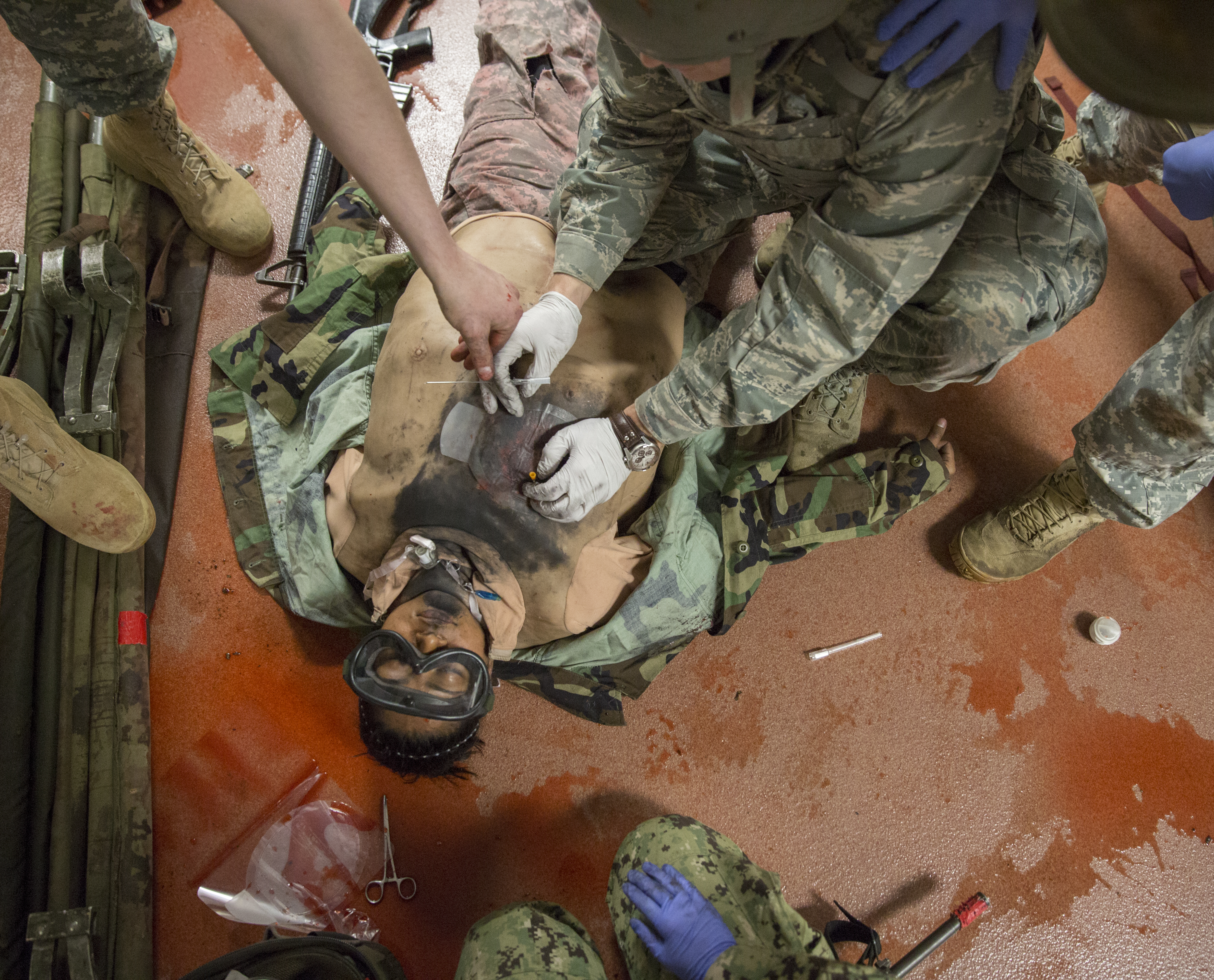
USUHS medical school students treat a volunteer wearing a specialized “cut suit” that allows them to practice emergency medical skills like inserting a chest tube or performing emergency airway surgery.
Photo Credit: Mike Morones/Staff
One of two required field exercises in USUHS’ four-year medical school curriculum, Gunpowder includes a daylong competition that pits fire teams of four or five students against one another in an intense skills competition.
From diagnosing a TBI and running with a litter to triaging and evacuating patients and performing critical medical skills like intubation, chest tube insertion and crichothyrotomy, the 170 students of the USUHS’ class of 2016 spent two days in the field March 26-27 learning how to think, act quickly and perform under damp, chilly conditions.
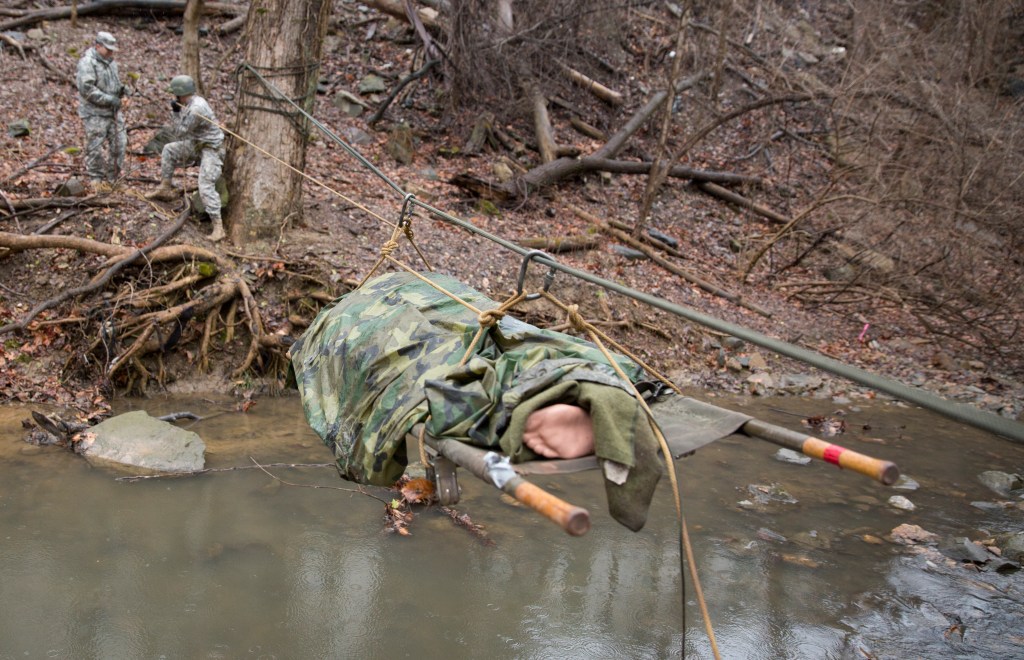
At one station, students encountered a river and were told they had to get themselves and their 200-pound patient to the other side, using little else but a few ropes and carabiners.
They had been taught the necessary skills to build a rope bridge the day before. But each team member had learned a different set of skills, so before they could start stringing the bridge, they needed to figure out what each member brought to the table.
“These students work over here at this pristine hospital, with a high standard of medical care,” said Army Lt. Col. Justin Woodson, pointing toward Walter Reed National Military Medical Center next to USUHS. “Sometimes you aren’t going to be in a top-notch facility. You won’t have the equipment you need, you can’t carry everything and foresee every situation. Sometimes you have to improvise. That’s what we’re trying to teach them.”
The students had 40 minutes to complete the task. In the morning, a group of four students, including a seven-year Air Force veteran, two ROTC graduates and a Naval Academy graduate, whooped as they ferried their dummy patient to the other side and monkey-crawled across themselves.
But a hidden point of the rope bridge exercise was also to see if the students could think outside the box.
Having been told they could use anything they found at the water crossing from the far side of an existing wooden bridge to a bend in the creek, they could, Woodson said, simply have asked to use the bridge.
“If they had just asked, sure I would have let them use it. It would have demonstrated they were forward-thinking,” Woodson said.
“I can’t wait to tell them at the closing ceremony this afternoon,” Palma said, laughing.
Gunpowder, named for the original intended site of the exercise — the Gunpowder Military Reservation north of Baltimore — offers students a taste of what to expect their fourth year, when they must participate in a five-day field exercise near Harrisburg, Pennsylvania.
That exercise, Operation Bushmaster, is designed not only to test their medical skills but to prepare these future battalion docs, flight surgeons and aerospace medicine experts for their first assignment and operational deployment, organizers say.
“I will probably never use the rope skills I learned here again, but all these exercises build an incredible critical thinking mindset — to work as a team and react in a specific way,” Air Force 2nd Lt. Andrew Kim from Annapolis, Maryland, said.
According to retired Lt. Gen. Eric Schoomaker, former Army surgeon general who is on the faculty at USUHS, the skills taught in these exercises, including the focus on leadership, stress, problem-solving and working in intense situations with unfamiliar staff, can be applied to any specialty within the field of medicine, whether it’s running a hospital, managing a radiology staff or working on a mobile field surgical team.
“The real focus here is how do you optimize the performance of the team under the most difficult circumstances you might be facing?” Schoomaker said. “Everyone of these students has to emerge from USUHS as a competent, qualified leader.”
Although Gunpowder was designed to ensure that students learn to work together, communicate and bond, it also included an element of competition. Teams received faculty feedback after every event on their ability to work together as well as their medical skills, and they were awarded points for how well they did.
Finish in the top half of the class, and they were allowed to leave for the weekend early; finish in the bottom and they had to police up the vast exercise area.
“That’s the carrot and stick,” Palma said. “But to some extent, it is supposed to be fun.”
Despite the cold and the pressure, the students did appear to enjoy themselves. Lee, the student who lost his patient the day before, was giddy after his success in the combat casualty scenario.
“Yesterday, I had tunnel vision, trying to use a tourniquet that didn’t do the job … so glad that didn’t happen in the field,” Lee said.

Retired Coast Guard Chief Warrant Officer Ray Handel, an instructor in military and emergency medicine at USUHS, provides feedback to third-year medical school students after they took part in the Tactical Combat Casualty Care event during the Gunpowder Challenge.
Photo Credit: Mike Morones/Staff