
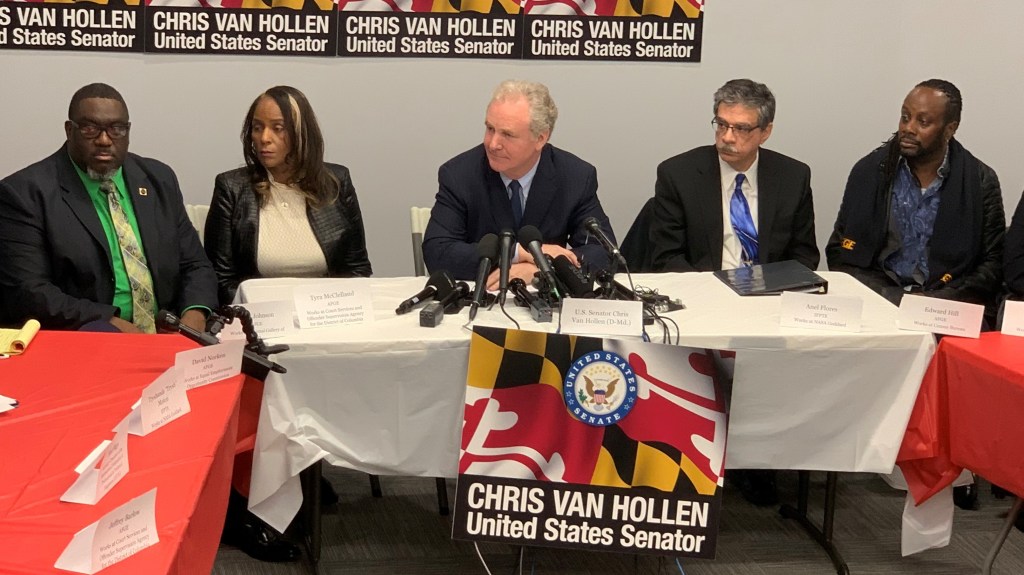
Democrats and federal employee unions are calling on Senate Majority Leader Mitch McConnell to place the House-passed government funding bills at the top of the Senate schedule when it comes back in session Tuesday afternoon.
“It is the position that I’ve got, and of a great majority of Senate Democrats, that in the United States Senate, the first order of business has to be reopening the government,” said Sen. Chris Van Hollen, D-Md., at a Dec. 7 roundtable with representatives from federal employee unions.
“We shouldn’t be doing unrelated business until we take up those bills. We could do it as soon as we get in tomorrow.”
Democratic and Republican leadership, as well as the White House, have been debating for the past couple weeks about how to end the government shutdown and pass legislation to fund the government.
Though the Democrat-led House passed measures Thursday to completely fund nearly all federal agencies entirely for 2019 and fund the Department of Homeland Security through Feb. 8, President Donald Trump has said that he will not sign funding legislation that does not include the more than $5 billion for a wall at the U.S.-Mexico border.
The House-passed bill does not include that funding.
But McConnell has said that he will not bring legislation to a Senate floor vote that the president is unwilling to sign.
“If Sen. McConnell does not allow these bills to the Senate floor, it will be his shutdown as much as it is President Trump’s shutdown,” said Matt Biggs, secretary-treasurer of the International Federation of Professional and Technical Engineers.
Currently, over 800,000 federal employees — approximately 40 percent of the federal workforce — are either working without pay or furloughed and banned from coming into work.
According to employees at the roundtable, the lack of paychecks impacts not only their ability to pay for large things like their mortgages, but also prevents them from affording smaller necessities, such as school lunches and transport costs.
“Here I am as an essential employee that has got to go to work every day, and I’m trying to figure out how to pay for my child’s lunch,” said Tyra McClelland, an employee with the Court Services and Offender Supervision Agency and member of the American Federation of Government Employees.
“Then, as an essential employee, I’ve got to figure out how to get to work. I don’t have the money to do that, either; there’s no money to get gas. Those that are eligible for Metro benefits, they won’t be eligible for them until February. So how are they going to get to work between now and February?”
According to roundtable attendees, many of the impacted feds are working paycheck to paycheck, which makes the loss of even one check hard to bear.
The shutdown also backs up the dozens of different types of cases the federal government hears and prosecutes on a regular basis, as the agencies do not have funding to proceed.
“I decide in discrimination cases that federal employees file against their agencies,” said David Norken, administrative judge at the Equal Employment Opportunity Commission and AFGE member. “At this point in time, we’re cancelling cases, we’re cancelling hearings.”
And, according to roundtable participants, even the essential employees still working without pay at many agencies aren’t enough to keep basic operations running.
“If you think of us, as essential employees, as the head, nonessential employees are the neck. So we can’t move without the neck,” said McClelland.


