
The National Science Foundation announced a set of grants and a slate of upcoming solicitations to boost its big data capabilities and forward the progress of science.
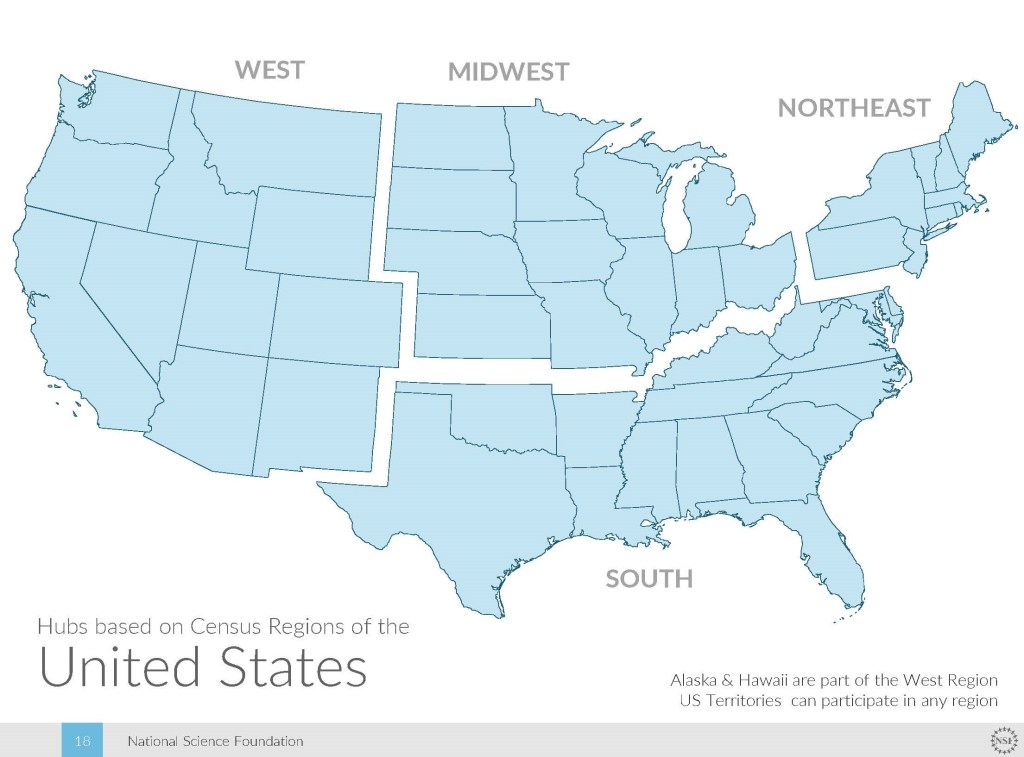
The agency announced $5 million in awards for the creation of four regional big data hubs to support important research and innovation in the public and private sector, across all 50 states.
The hubs will act as a support system for ongoing work, providing computing capabilities and other big data needs that would be difficult for independent researchers.
- The South Hub: Georgia Institute of Technology and the University of North Carolina will lead a region comprised of 16 states and D.C. The group intends to pursue research in healthcare and health-related disparities, coastal hazards, industrial big data, materials and manufacturing, and habitat planning.
- The Northeast Hub: Includes organizations across nine states, coordinated by Columbia University. Priority areas identified by this BD Hub include energy, finance, data science for education and climate and the environment.
- The Midwest Hub: A 12-state consortium led by the University of Illinois at Urbana-Champaign with a focus on agriculture; the food, energy, and water nexus; and smart cities. It will also work closely with the National Data Service, another data-centric group.
- The West Hub: Covering 13 states, including Alaska and Hawaii. It will be jointly coordinated by the University of California, San Diego, the University of California, Berkeley, and the University of Washington and will focus on priority areas including big data technologies and data-intensive discovery, managing natural resources and hazards and precision medicine.
The spokes will work on expanding partnerships with academic and commercial institutions in a given region and using the hubs’ big data capabilities to enhance research and focus areas specific to that region.
“Working in concert with the corresponding regional BD Hub, a BD Spoke would work on a particular topic that requires big data approaches and solutions,” according to the funding opportunity posted on NSF.gov. “Each BD Spoke would function similar to a BD Hub — in that it will take on a convening and coordinating roll as opposed to primarily carrying out research — but with a narrower and goal-driven scope,” as determined by each region’s strengths and needs.
Vendors interested in bidding on the big data spokes should submit a letter of intent by Jan. 12 and a full proposal by Feb. 25. Proposals must also include a letter of collaboration from on the hub coordinators to be considered.


