The Center for Domestic Preparedness is training first responders on a new tracking technology that may help them keep better control of medical events in the midst of crisis and mass casualties.
Patient-tracking technology helps emergency personnel to register patients during triage, track their whereabouts and keep tabs on their medical progress even in potentially chaotic situations.
“There are situations where patients are lost. They may be identified and moved to a hospital, but then they go to another hospital where they have more beds, and people lose track,” said Mick Castillo, technology integration coordinator at CDP. Training on the new technology should give first responders a better handle on how to keep the system running smoothly.
RELATED
Small unmanned systems find growing security role
DHS faces stiff acquisition, IT management challenges, IG says
The CDP, which operates under the Federal Emergency Management Agency, trains some 14,000 local, state, territorial and tribal students a year at its Anniston, Alabama, facility.
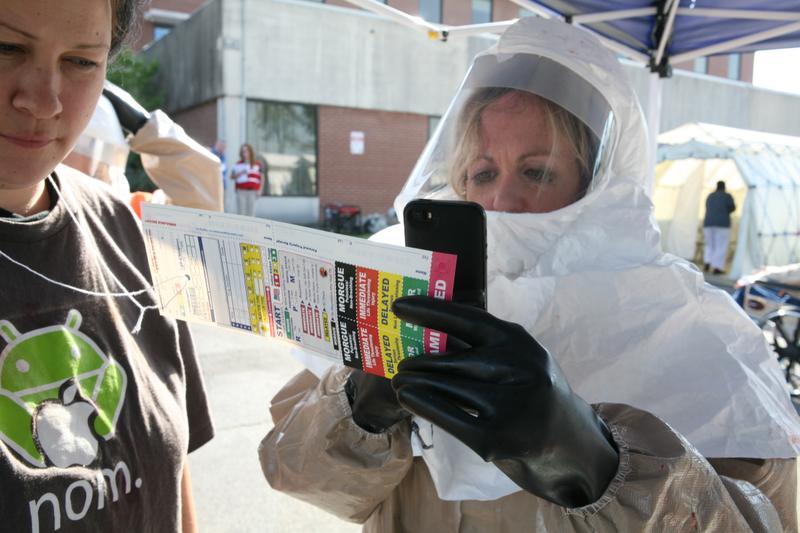
CDP has been rolling out the new tracking system from Global Emergency Resources for about three months and expects full implementation early next year. The software allows responders to use a smartphone to scan a bar code for patient tracking, and attach pictures and videos to help chart medical progress. The software also allows students to securely transmit patient information to a range of interconnected players including incident command, hospital command centers and public health officers.
The system creates a common operating picture of the incident that goes beyond an individual’s care. Hospital administrators, for example, can better track patient admissions and hospital occupancy levels.
First responders say the CDP training will give them a boost when they perform in real-life mass-casualty situations.
“I have seen triage tags before, but I hadn’t seen it as an app on a phone. It was really ingenious. Here’s something that we know works well, and it is being used in a new way,” said Amber James, an emergency medical technician in the North Peoria (Arizona) Emergency Center, a freestanding emergency room facility.
While James has trained in various settings, she went to CDP eager to learn about large-scale events. The Superbowl is scheduled to be played in February at the nearby University of Phoenix Stadium in Glendale, and local facilities could easily be overwhelmed in a mass emergency, she said.
James’ emergency facility has 10 beds, one doctor and two nurses. “It would only take one patient to put us into a mass-casualty situation,” she said.
Unlike college courses and state-offered training, CDP’s mix of classroom and hands-on learning seemed to hit the mark.
“It incorporates the doing and the hearing and the seeing, all in one,” she said. “When you actually do what you are learning, it puts it into a different context.”
At CDP, where all student training expenses are funded by FEMA, the range of activities includes hands-on training with some of the most deadly toxic threat agents. The facility works with biological materials ricin and anthrax, and also nerve agents sarin and VX, making CDP the nation’s only toxic chemical agent training facility for civilian responders.
In addition to the new patient-tracking technology, CDP has made other changes to its curriculum recently. Following the Boston Marathon bombing, for example, instructors built pressure-cooker bombs the familiarize students with the workings of such devices.
More recently, officials from the Centers for Disease Control have come on campus to augment regular staff to train students in Ebola response.