About 100 Marines deployed to Liberia to support the U.S. military’s response to the Ebola crisis are preparing to depart for Germany where they’ll be monitored for three weeks before returning to their home base in Spain.
The Marines are The four Marine MV-22B Ospreys attached to Special Purpose Marine Air-Ground Task Force-Crisis Response Africa, based in Morón, Spain. Four MV-22B Ospreys deployed to support their mission are already en route back to Morón, Spain as the unit’s mission response ding to the Ebola outbreak in Liberia draws to a close.
The Marines About 100 Marines from the task force deployed to Liberia in early October to assist with Operation United Assistance, the 2,900-troop strong, joint U.S. effort to facilitate care and stem the spread of the disease. Officials said all elements of the task force will be out of Liberia in the next few weeks as troops enter the mandatory 21-day monitoring period before returning to their home station in Morón.The development comes as the entire mission winds down; in a Dec. 3 briefing, Army Gen. David M. Rodriguez, commander of U.S. Africa Command, said most U.S. engineering and logistics projects supporting United Assistance would be completed by late December or January.
Marine pilots from the unit’s SP-MAGTF-CR-AF headquarters element arrived in KC-130J Super Hercules aircraft at a staging location in Dakar, Senegal, Dec. 3 to escort the “clean” Ospreys back to base by providing air-to-air refueling capability, said 1st Lt. Gerard Farao, a spokesman for the task force.

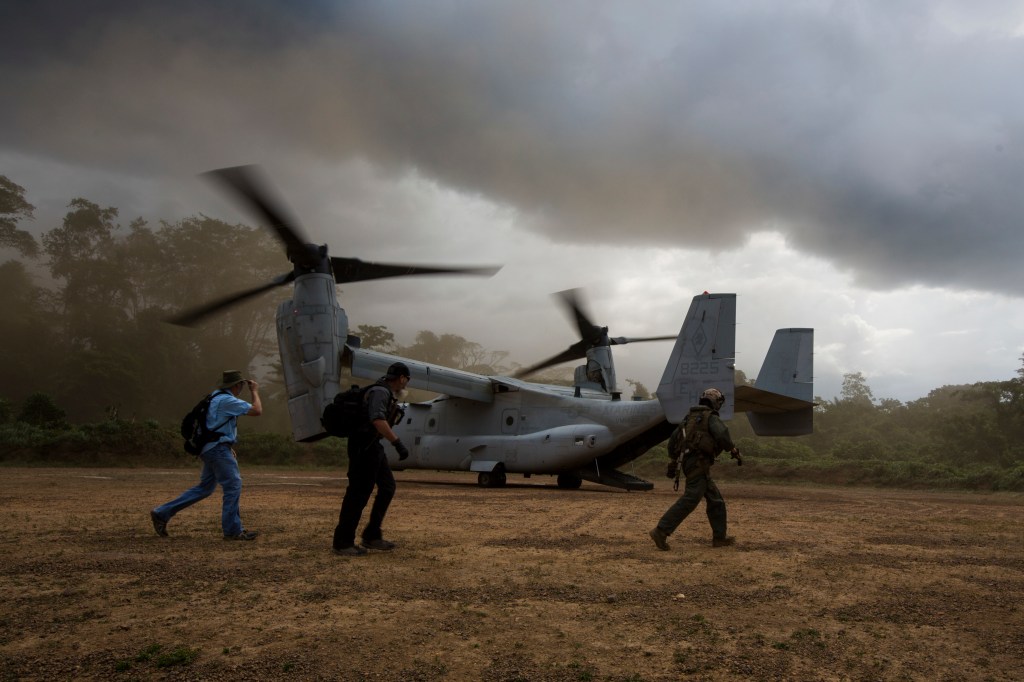
Members of Special-Purpose Marine Air-Ground Task Force – Crisis Response – Africa, offload supplies from an MV-22B Osprey while in support of Operation United Assistance in Liberia on Nov. 4. The Marines deployed to Liberia to respond to the Ebola crisis in October.
Photo Credit: Lance Cpl. Andre Dakis/Marine Corps
“Prior to returning, the aircraft have gone under a complete washdown using a cleaning solution of water, soap and bleach in accordance to [Centers for Disease Control and Prevention] guidelines,” Farao said in an email. “New pilots will be returning the aircraft and the pilots who operated in Liberia will be conducting the 21-day controlled monitoring period.”
That monitoring period, he said, will take place at U.S. Army Garrison Baumholder in Germany, he said, and will begin when the first Marines depart Liberia sometime next week.
The remaining Marine elements will depart filter out of Liberia in a similar process in coming weeks, Farao said. Following the completion of the monitoring period, the task force Marines will return to Morón to consolidate back with the unit.
The development comes as the entire mission winds down. In a Dec. 3 briefing, Army Gen. David M. Rodriguez, commander of U.S. Africa Command, said most U.S. engineering and logistics projects supporting United Assistance would be completed by late December or January.
Over the course of its two months in Liberia, task force the Marines with the crisis response force transported over more than 1,200 passengers and over 78,000 pounds of cargo to locations around Liberia, Farao said. They delivered building supplies and concrete for the construction of Ebola treatment units and basic necessities such as soap for use in treating Ebola victims at the units.
Farao said the Marines, who did not have any direct contact with those infected by Ebola, had experienced no related illness or Ebola symptoms during the deployment.