
More Marines are growing unhappy with their work and their compensation, driving “re-enlistment intent” to a three-year low and leaving the service Fewer enlisted Marines intend to sign on for another term, which could leave the Corps scrambling to retain top talent as the economy improves and troops look for opportunities outside the military.
These are among the findings of the service’s annual retention survey, which Marine Corps Times obtained via the Freedom of Information Act. Among its 4,200 re-enlistment eligible respondents, 38 Re-enlistment intent is at a three-year low, according to data collected from thousands of active-duty Marines during the service’s fiscal year 2015 EAS Enlisted Retention Survey. Thirty eight percent indicated of Marines who completed the survey said they were unlikely to sign on for another term — re-enlist. That’s up from 31 percent in 2013 and 33 percent in 2014.
Beyond Lack of job satisfaction and pay, more are influencing more Marines to leave the Corps in 2015 compared to those up for re-enlistment in years past. More Marines said their decision to leave the military was influenced by a desire are also looking to attend college or compared to years past, while others continue to seek civilian job opportunities.
Marine officials with Manpower and Reserve Affairs said troops base their re-enlistment decisions on many factors.
“It’s important not to oversimplify,” said Yvonne Carlock, a spokeswoman for the command. “…The Marine Corps offers pay, benefits and opportunities for advancement that are competitive in today’s economy.”
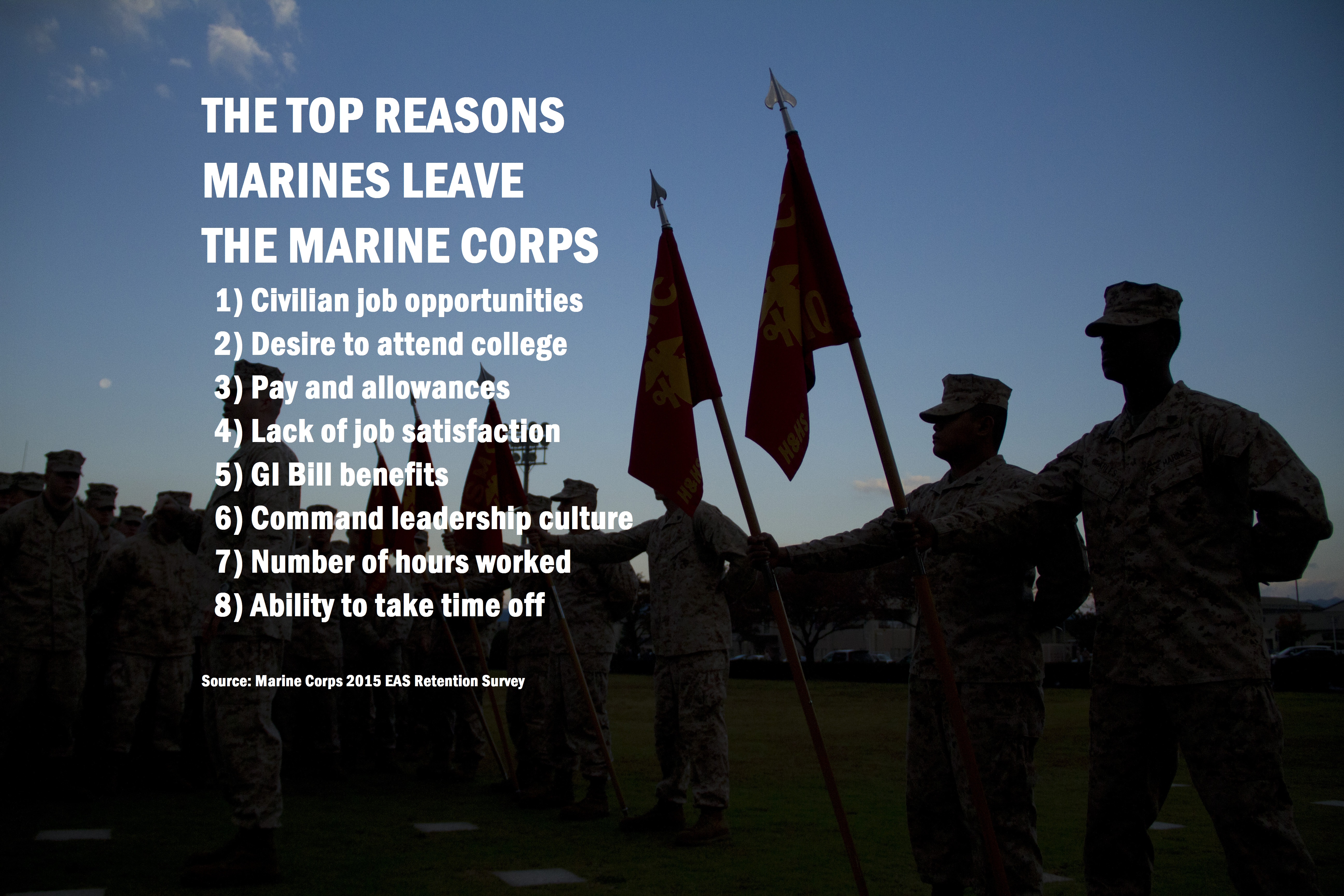
The top reasons Marines leave the Marine Corps
Photo Credit: Lance Cpl. Todd Michalek/Marine Corps
In the past, officials have stressed that this annual poll is not a climate survey. Rather, the service uses it The survey was completed by 4,238 enlisted Marines, and the results were released to Marine Corps Times via the Freedom of Information Act. Marine Corps officials use this annual survey to help formulate selective retention bonuses, which can pay tens of thousands of dollars to troops who are willing to stay in or move to vital or undermanned specialties work so it doesn’t serve as a climate survey.
But the data Still, it does provide some insight into how a significant cross section of the service ranks feels about a variety multitude of issues in any given year. And its release coincides with publication of a new The declining re-enlistment trend seems to be continuing based on a recently released Marine administrative message indicating that barely shows just over 33 percent of first-term vacancies — the Marine Corps calls them “boat spaces” — have been filled for 2016, compared to 53 percent at this the same time last year. As a result, commanders are now being directed to ramp up their efforts to encourage more Marines to re-enlist.
Career planners also are being asked tapped to understand what factors are influencing Marines’ decision to stay or go. For instance, one staff sergeant, a career planner who has been in the Marine Corps for 14 years, said his field is too slow to promote. He’s held his current rank has been a staff sergeant for seven years, he said, and has grown frustrated with the current promotion system. As a career planner, he said he’s seeing Marines in other fields in other slow-to-promote fields such motor transport and supply are leaving because they can’t move up either, he said, adding that most service members Marines are motivated by career challenges and they want to have the chance to advance.
“Marines get stuck in their careers and they have no options but to get out,” the staff sergeant told Marine Corps Times on the condition of anonymity because he is not authorized to speak with the media. He asked that his name not be used since he’s still on active duty. “If you see yourself getting promoted and in a position you dreamed of, you’re more motivated to do better and achieve more in the Marine Corps.”
Top reasons Marines are leaving the Corps
Civilian job opportunities
Desire to attend college
Pay and allowances
Lack of job satisfaction
GI Bill benefits
Command’s leadership culture
Number of hours worked
Your ability to take leave/liberty
Pride in being a Marine doesn’t make up for lacking job satisfaction, he added. Sgt. Tim Kluska, a refrigeration and air conditioning technician, getting his details. GH said that’s especially true now that the Marine Corps is no longer fighting wars.
“Marines are getting out due to lack of purpose,” he said. “They get taught in boot camp to kill, but then get to the fleet and file paperwork and work on computers — including combat support jobs, not just admin.”
First-term Marines who joined the Corps while the service was at war are instead having to do more mundane tasks things like formation, uniform inspections and other mundane tasks that come with garrison life, the staff sergeant said. Many who Since they signed up while the Marine Corps was still deploying into combat did not consider what military life would be like once that stopped, he said.
“Now they’re in the fleet and they’re doing all these little things that they never heard about before,” he said. “
But officials stress that while combat deployments have ended, tens of thousands of Marines are still deployed around the world.
“While many of today’s Marines joined with an eye toward serving in Afghanistan or Iraq, the Corps is still very actively deploying forces worldwide as part of special purpose Marine air-ground task forces, Marine expeditionary units, the unit deployment program, and sending many Marines to locations as individual augments as well,” Carlock said.
Other Marines say they are fed up with what they see as staggering wages. A the low pay troops receive over the past few years, with 1 percent raises hardly keepsing up with inflation, Marines say. Troops also “These days, who would re-enlist for a 1 [percent] pay raise?” one Marine Corps Times reader wrote on Facebook when asked what influenced their decision to stay in or leave the service. Marines grew accustomed to meaty war-time retention bonuses, the Marine career planner noted. Now some have a sense of entitlement and expect that they should be entitled to continue receiving them as long as they continue to serve, and when they don’t, they begin looking at other career opportunities.
“They have this notion that if they get out they’ll have more money out there,” he said.
Indeed, pay and allowances was the third highest reason Marines stated for influencing their decision to leave the Corps in 2015 — up from the No. 7 spot from the 2014 retention survey. Lack of job satisfaction is also on the rise, with respondents listing it as the fourth highest reason for wanting to leave the Corps in 2015, up from the No. 6 in 2014.
Still, others cite those same factors as reasons to remain in uniform. Of the top reasons Marines list for deciding to re-enlist, pay and allowances came in at No. 2 and job satisfaction at No. 4. While about a quarter of respondents said pay was a reason for leaving, more than half cited it as a reason to stay. Job satisfaction yielded similar results, with 53 percent of respondents citing it as a reason to remain in the Marine Corps and 24 percent listing it as a reason to leave.
As military leaders face declining budgets amid high operational tempo and demands on troops, they are now must looking for innovative ways to motivate Marines and other standout service members to remain in uniform. Defense Secretary Ash Carter and his personnel chief are working on a plan they call “Force of the Future plan,” which would, among other things, base more promotions on one’s merit instead of time in grade.
The career planner who’s soon leaving the Marine Corps said military leaders are on the right track with that type of approach. Offering professional opportunities can do more than bonuses to help keep people long term, he said than bonuses, which don’t last forever.
But some Marines who’ve left the Marine Corps to chase better paying civilian careers or better pay urge those thinking about getting out to consider it carefully, though. Responding on Facebook, dozens of Marine Corps Times readers said it wasn’t long after they left active duty that they began to miss the Marine Corps after leaving active duty.
“The grass on the civilian side is not, I repeat not, greener,” said former Sgt. Brandon Garabedian, who left the Marine Corps in 2007. “You lose out on real friendships … and your time in the Corps is not as valued as everyone will make you believe.”


