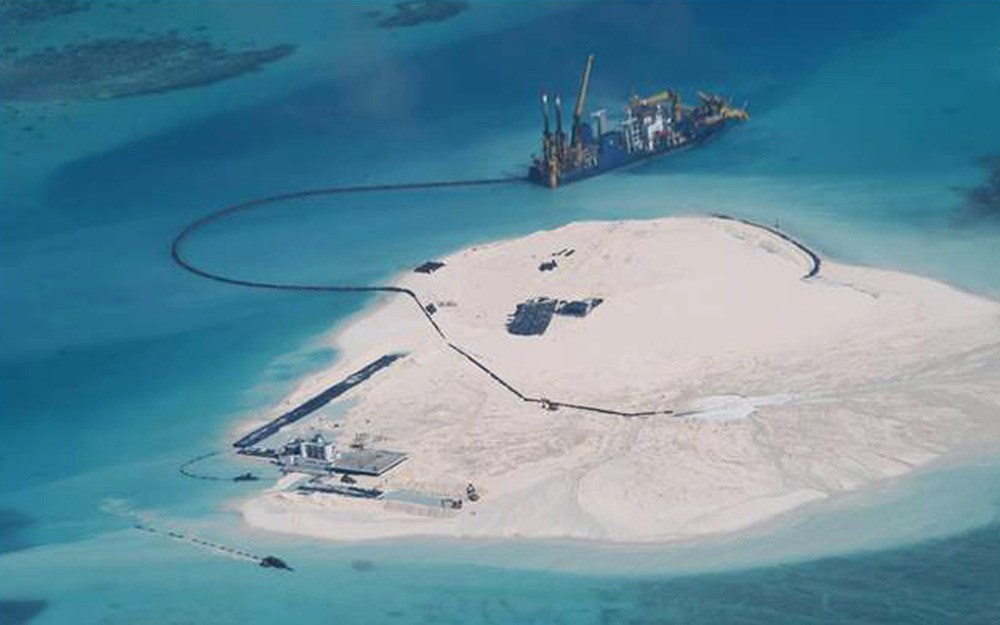
BEIJING — China may further fortify man-made islands in the South China Sea depending on threats faced by the outposts, a Chinese naval officer said Wednesday.
Navy academy researcher Senior Capt. Zhang Junshe repeated China’s stance that it has the legal right to take whatever measures it deems appropriate on the islands in the South China Sea, which China claims virtually in its entirety.
“If our on-island personnel and installations come under threat in future, then we necessarily will take measures to boost our defensive capabilities,” Zhang, a senior researcher at the institute, said at a briefing for Chinese and foreign journalists.
Pentagon officials have long said that China has failed to fulfill a 2015 pledge by President Xi Jinping not to expand development in the area, where it has built seven islands by piling sand and cement on coral reefs, equipping some with airfields.
China says the development primarily serves civilian purposes.
Five other governments have territorial claims that overlap with China’s in the strategically vital waterway.
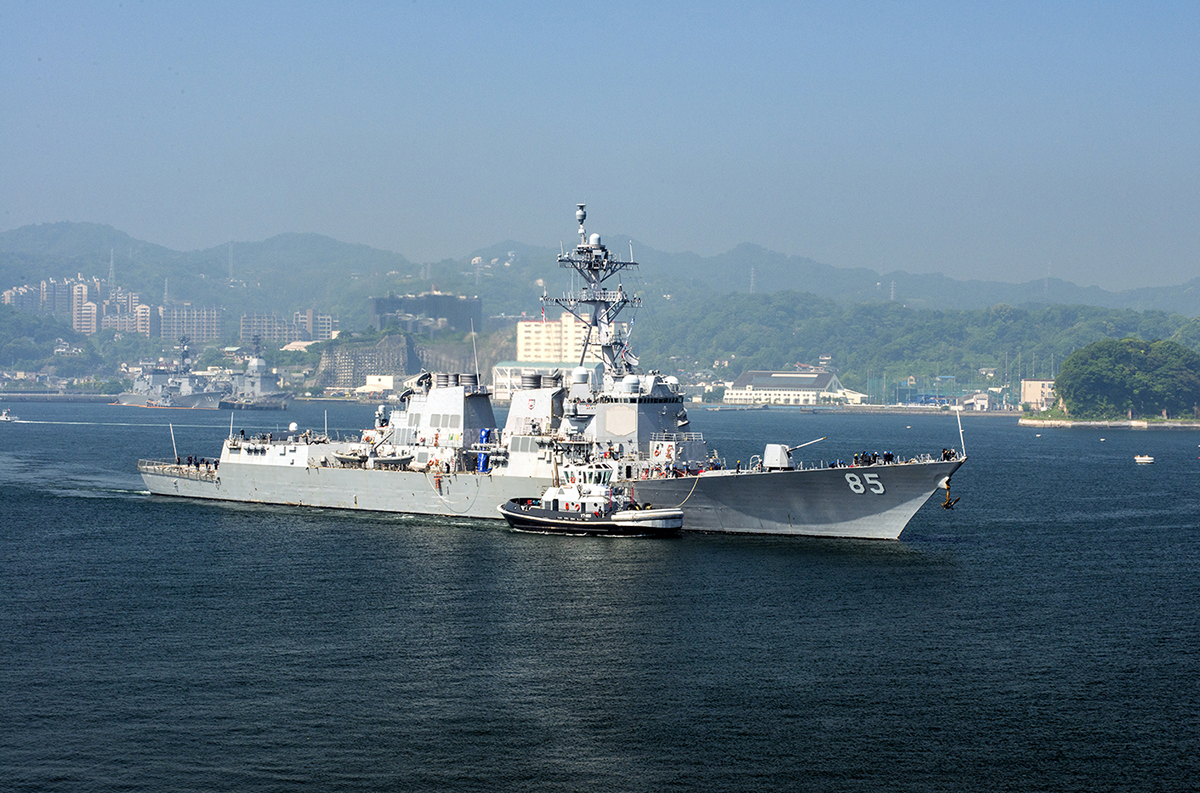
Zhang also accused the U.S. of endangering safety and security in the region, citing the U.S. Navy’s freedom of navigation operations, in which it sails close to Chinese-held islands, arousing Chinese ire.
At the same briefing, Lt. Gen. He Lei said the People’s Liberation Army doesn’t rule out establishing additional overseas bases to service its U.N. peacekeeping missions if the need arises.
He said such decisions would be based on the demands of the mission and the approval of the host nation.
Under such circumstances, “the possibility exists of building (further) support bases,” said He, who is vice president of the PLA’s Academy of Military Science and a leading Chinese participant in international defense forums.
He compared China’s modest overseas military presence to the more than 100 U.S. bases spread across the globe, and said China has no intention of ever using its facilities to project power.
China opened its first foreign military base in the Horn of Africa nation of Djibouti in 2017, where rivals such as the U.S., Japan and several European nations also have a permanent presence.
China says the base is intended to provide support for anti-piracy patrols in the Gulf of Aden and for Chinese U.N. peacekeeping missions in several African nations.
Some foreign observers see the Djibouti base as part of a strategy to enhance China’s naval presence in the Indian Ocean, where it faces regional rival India.