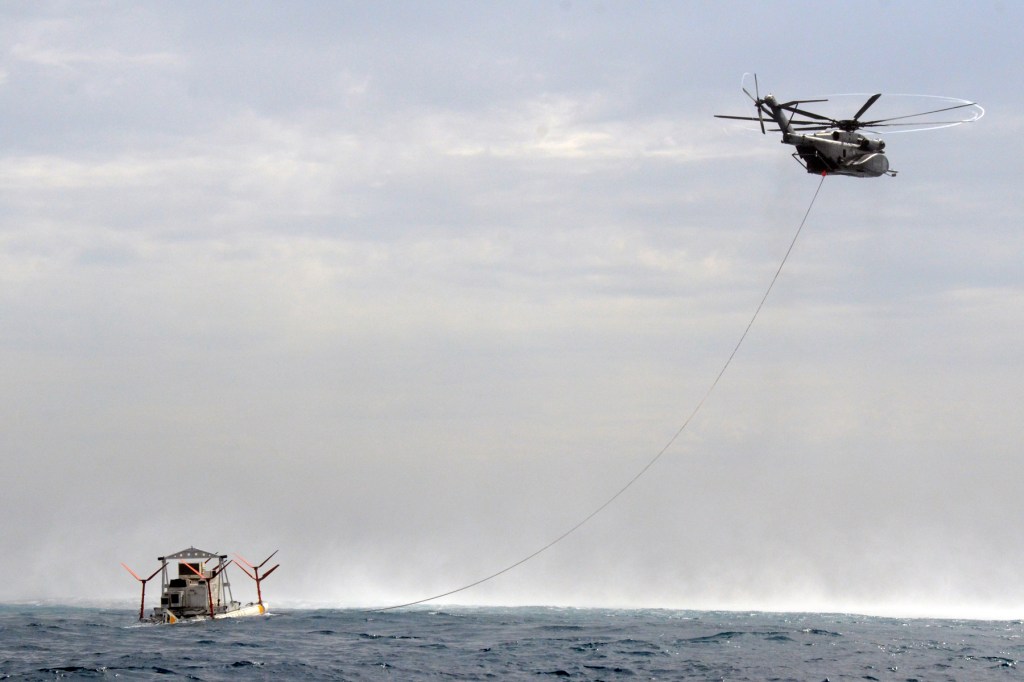
The Navy has re-established a squadron to train aircrews to operate the fleet’s oldest and most troubled helicopter, the MH-53E “Sea Dragon.”
Helicopter Mine Countermeasures Squadron 12Twelve was stood up this weekThursday after being closed for 21 years to help the Norfolk-based aircrews train on the mine-hunting helo. got back in the fight on Thursday after more than two decades. The squadron closed its doors in 1994 as part of a consolidation effort. The Navy’s fleet of 29 Sea Dragons exclusively flyew with HM-14 and HM-15 out of Norfolk, Virginia.
HM-12 will be led by Capt. Richard Davis and is now responsible for training pilots and aircrew. That role was previously held by Airborne Mine Countermeasures Weapons System Training School, which has been disestablished as part of the realignment. HM-12 will operate four Sea Dragon Airborne Mine Countermeasures helicopters with about 250 personnel.
The unique minesweeping helicopters have endured fatal crashes, safety inquiries and inspection overhauls in recent years. Though the Navy planned to phase out the MH-53E beginning in the mid-2000s, the lack of a viable replacement means it will remain in the fleet for at least another decade.
Investigators said chafing between electrical wire insulation and the surface of an aluminum fuel transfer caused an electrical arc to breach the transfer tube and ignite the fuel inside. The heavy black smoke disoriented the crew; the helicopter crashed into chilly waters about 18 miles off the coast of Virginia Beach.
Inspections later found that all 29 of the Navy’s remaining Sea Dragons had the same defect.
That was the fourth Sea Dragon crash in less than two years; the previous three occurred in 2012. In June of that year, a bird assigned to HM-14 overheated in flight while deployed to South Korea. The resulting fire crashed the helo. In July, HM-15 suffered the first of two Class A mishaps in as many months, the most serious mishap category. The first was a crash southwest of Muscat, Oman, that killed two crew members. Investigators said poor planning and ignored safety procedures contributed to the crash. Engine failure on takeoff led to a hard landing in August in Bahrain. The squadron’s commanding officer and command master chief were fired the next month.
Staff writer Meghann Myers contributed to this report.