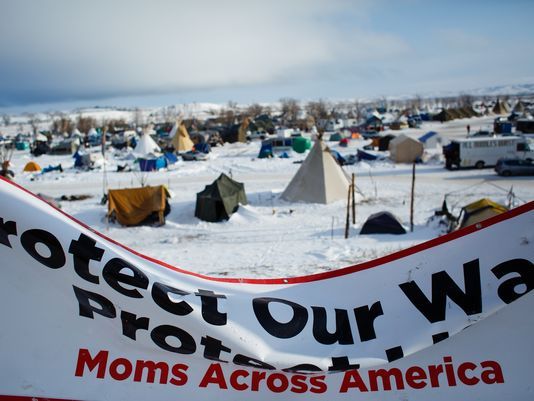
OCETI SAKOWIN CAMP, N.D. — Tasheena Cloud said Saturday that she and the hundreds of other veterans who have been filing into this protest camp near the Dakota Access pipeline will remain peaceful when they put themselves between law enforcement officers and passionate demonstrators in coming days.
But she said she has no idea how police and the North Dakota National Guard will respond.
“I don’t know what to expect,” she said. “I just know I’ll put myself in harm’s way.”
In the snowy prairies of North Dakota, the Oceti Sakowin Camp has become the longest-running protest in modern history, as thousands of American Indians and environmentalists seek to halt completion of the 1,172-mile pipeline.
In the coming days, the demonstrators will be aided by military veterans who have come to give occupiers a respite and call attention to what they say are human rights violations committed by local law enforcement. Demonstrators have described being attacked by security dogs, sprayed with tear gas, shot with rubber bullets and blasted by water cannons.
Police officials have defended their tactics but promised to keeping the veterans’ demonstrations peaceful.
“A lot of people are coming here expecting to see a confrontation,” Cass County Sheriff Paul Laney told reporters Saturday, “and it’s not going to happen.”
Cloud, 32, of Wisconsin said she cried watching images of security dogs attacking pipeline opponents. And she was disgusted when police doused protesters with water cannons in subfreezing temperatures here.
“I feel humiliated as a veteran,” said Cloud, who was deployed three times in her eight years serving in the Navy. “I went to war. I protected this country. For this to be happening at home, it’s embarrassing.”
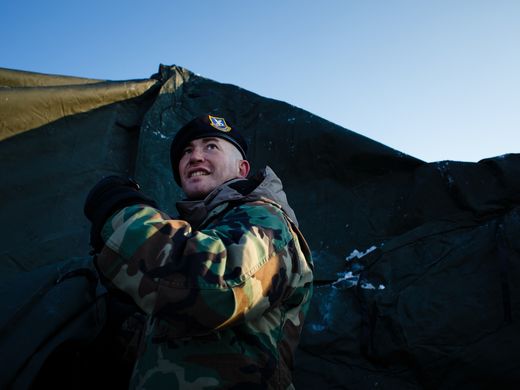
Army veteran Andrew Jansen of Colorado Springs helps put up a shelter tent for other veterans in the Oceti Sakowin Camp near the Standing Rock Reservation on Saturday, Dec. 3, 2016 near Cannon Ball.
Photo Credit: Brian Powers/The (Des Moines, Iowa) Register
A SPIRITUAL MOVEMENT
Members of the nearby Standing Rock Sioux tribe began the occupation of U.S. Army Corps of Engineers land, arguing that the pipeline’s crossing underneath the Missouri River threatens their drinking water, as well as that of millions of Americans downstream.
The tribe’s dissent has quickly grown into a spiritual movement for indigenous peoples from across the world, and the camp has for months housed the largest gathering of natives in modern American history.
The corps did not authorized the occupation and has told protesters they must leave the camp by Monday for their own safety, as brutally harsh winter conditions set in.
The group Veterans Stand for Standing Rock was formed by screenwriter Wes Clark Jr. and former Marine Michael Wood Jr. Clark’s father, Wesley Clark, is a retired general and former supreme allied commander of NATO in Europe.
Organizers predict some 3,000 veterans will amass at the camp by the time official demonstrations are expected to begin Monday.
Clark declined to be interviewed, but he wrote on Facebook that veterans here are following in the footsteps of Civil Rights giants Martin Luther King Jr. and Mohandas Ghandi. A four-page operations order he posted outlining the week’s actions rings of military jargon and warns veterans they may face mace, tear gas, rubber bullets and police batons on the front line.
“In the ultimate expression of alliance, we are there to put our bodies on the line,” that document reads, “no matter the physical cost, in complete nonviolence to provide a clear representation to all Americans of where evil resides.”
On Saturday, law enforcement officers said they held productive discussions with leaders of the veterans group. Police have agreed to retreat and move their militarized road blockade further away from the camp, so long as demonstrators agreed to keep their distance and stay off of private land in the area.
“We had a good discussion and walked away with a mutual commitment to maintaining peace … mutual respect for one another and ensuring adequate space between law enforcement and protesters,” said North Dakota National Guard commander Gen. Alan Dohrmann.
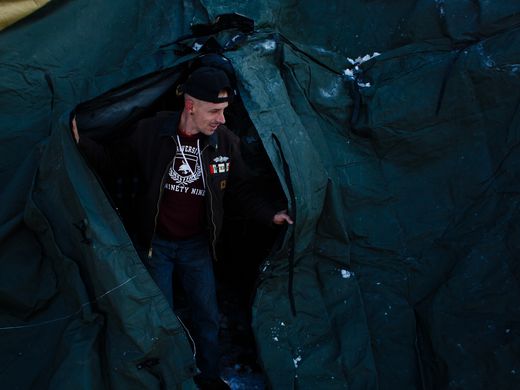
Veteran Derrick Bamden, 33 of San Marcos, helps put up a shelter tent for other veterans in the Oceti Sakowin Camp near the Standing Rock Reservation on Saturday, Dec. 3, 2016 near Cannon Ball.
Photo Credit: Brian Powers/The (Des Moines, Iowa) Register
‘YOU’VE GOT TO BE KIDDING ME, THIS IS AMERICA’
Retired Army Maj. Gen. Spider Marks, a member of the pro-pipeline Midwest Alliance for Infrastructure Now, says the veterans at the camp do not represent all military veterans. Many vets work on the pipeline construction crews, he said, as well as in the ranks of local enforcement. And he noted that the pipeline company has followed the law and regulations in its work.
Marks, a decorated retired general with 30 years of experience in the Army, said he supports veterans’ First Amendment rights to participate in lawful protests.
“Protest is one thing, riots are illegal,” he said. “There will be inevitably some form of a confrontation. I just pray that veterans don’t get mauled and try to make a stand here.”
Marks recently visited the front lines of the protest just north of the Oceti Sakowin Camp. Near a bridge on North Dakota Highway 1804, law enforcement officers have erected concrete barriers, razor wire barricades and amassed several military vehicles to keep protesters from approaching them or pipeline workers. The general said the scene reminded him of the heavily guarded compounds he lived in during deployments to Iraq.
“That’s what’s most embarrassing,” Marks said. “I thought, you’ve got to be kidding me, this is America. We’ve got to protect our workers.”
Marks doubts that this week’s events will draw 3,000 veterans as advertised. He believes many in the camp are “professional protesters” and said the movement there has “nothing to do with Native American rights.”
“There is probably a very core element of them that are anarchist,” he said, “that just want to be a pain in the neck.”
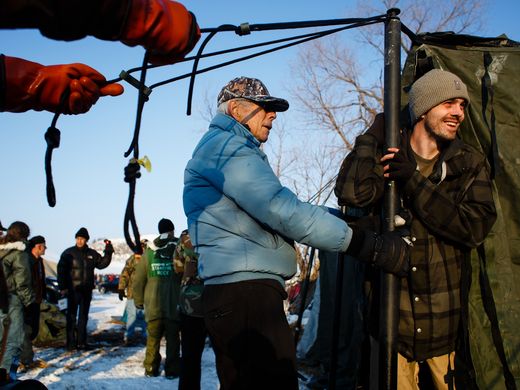
Veteran Tim Lester of Bend, Ore., left, and Daniel Perry, 33 of Milwaukee, right, help put up a shelter tent for other veterans in the Oceti Sakowin Camp near the Standing Rock Reservation on Saturday, Dec. 3, 2016 near Cannon Ball.
Photo Credit: Brian Powers/The (Des Moines, Iowa) Register
‘WE’RE ALREADY WON’
At dawn on Saturday, about 150 people huddled close together near the icy Cannonball River for a daily water ceremony.
They bobbed up and down and swayed back and forth to keep warm as temperatures hovered in the 20s.
The men and women sang, prayed and chanted “water is life” in English, Spanish, sign language and the native Lakota language. Others watched on in silence.
Speakers stood on wooden pallets placed atop the frozen mud of the river bank. They preached about their connection to the elements. One prayed to the four directions. Another talked about the spotlight the veterans would bring to their cause.
“The whole world is watching now,” one said.
As the sun peered out from a ridge opposite the river, dusty flakes of snow fell on the multiple layers of flannel, fleece and parkas wrapped around occupiers. Beatrice Menasekwe Jackson, a Native American from Michigan, said she performs a water ceremony like this each morning no matter where she is at the time.
“We have all the prayer we need to stop this pipeline from ruining our lives,” she said, as shepherds, retrievers and huskies bounced around in the snow banks behind her.
Jackson, 67, said she wished she could confront every pipeline worker to tell them how important the water is. She is frustrated with the pipeline company, but not deterred.
“We have to win,” she said.
“We’re already won,” a man chimed in.
She looked behind him, where a few camp fires slowly lifted rings of smoke into the foggy skies. Her view was a nearly endless tapestry of teepees, motorhomes and tents.
He’s right, she agreed: “They just don’t know it yet, huh?”
Contributing: Danielle Ferguson, (Sioux Falls, S.D.) Argus Leader