Many veterans seeking to further their education after service are labeled “nontraditional students.”
Tom Hruby is a nontraditional fullback.
Hruby served in the Navy for nearly a decade, first as a SEAL – a “lead breacher,” or explosives expert – and finally with the Naval Special Warfare Preparatory School at Naval Station Great Lakes, Illinois. As his career wound down, the Chicago native began looking at post-service options.
“I was going to try to finish my education,” he told Military Times. “As I looked, I started thinking maybe I’d try to play football as well. The more I looked into it, the more I thought, “Why don’t I give it a try at Northwestern?”
The former SEAL walked onto the Big Ten football team at age 31 and never walked off – he carried the American flag onto the field before the Wildcats’ 2014 clash with Michigan, the first game he was cleared to play by the Navy, and has been a powerful locker-room presence ever since. Head coach Pat Fitzgerald kept it simple: ” He’s an American hero.”
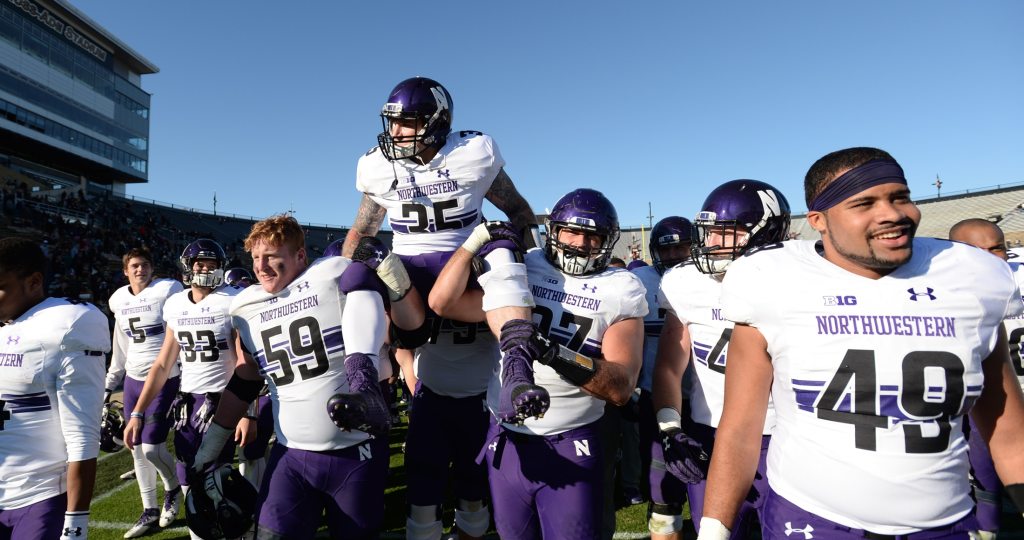
Hruby left the Navy as an E-6 in 2015. On Saturday, the day after Veterans Day, Hruby’s teammates carried the veteran off the field following a 45-17 rout of Purdue. Earlier that day, they’d tried to bestow an even larger honor – with the game in hand midway through the fourth quarter, Hruby had three carries from inside the 10-yard-line, the last coming on 4th-and-goal from the 1.
Hruby fumbled behind the line. Not exactly a storybook ending, but that didn’t stop images of him on his teammates’ shoulders from circulating throughout social media and through multiple college football highlight packages.
Military Times spoke with Hruby on Tuesday about his path from service to the gridiron, how he’s raising a family as a full-time student, and what lessons a combat-deployed SEAL can teach to – and learn from – a college football locker room. Questions and answers have been edited for length and clarity.
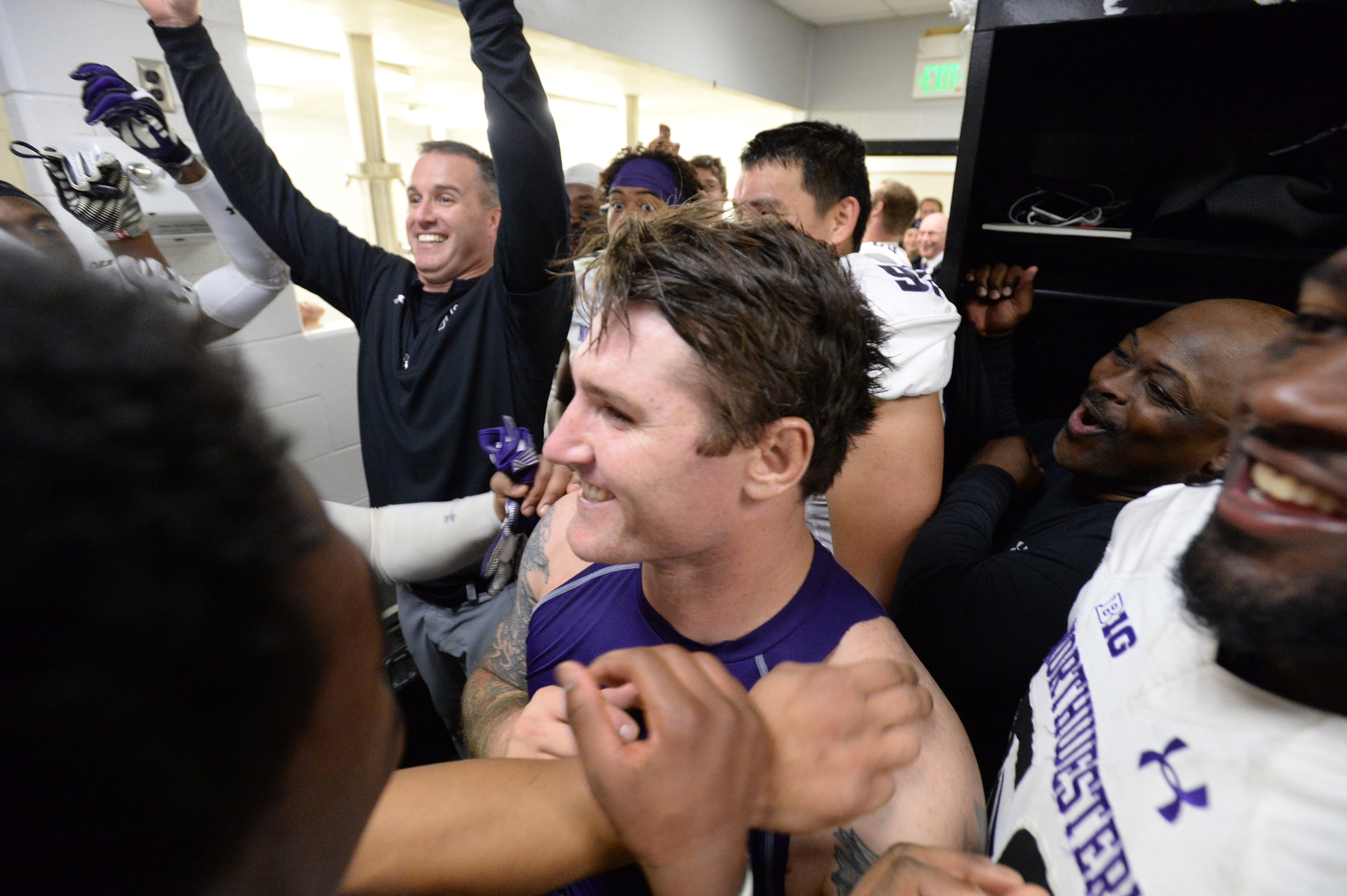
Tom Hruby walked on to the Northwestern University football team in 2014, at age 31, while still an active-duty sailor.
Photo Credit: Stephen J. Carrera/Northwestern Athletics
Q. You decided to step away from active duty last year. There’s a financial hit – how did you decide you could make it work?
A. First of all, the GI Bill. But also, over the last two or three years in the Navy, I just really started putting every dollar I had away. I invested in a couple homes – bought them, fixed them up, sold them. I put away a pretty good amount of money that has been able to sustain me. … But of course, I had to weigh the pros and cons financially, of whether I could afford it.
Q. How did you first become aware of this opportunity at Northwestern?
A. There was a guy at Great Lakes with me, Chief [Petty Officer] David Goggins, he did some motivational stuff, some team-building stuff here [at Northwestern], so I came down here one day, and I got introduced to Coach Fitz [Pat Fitzgerald] and the team, and I gave them the offer that if he was willing, I would come out and try for the team, see how I could do. And they said, “Well, let me see your transcripts.” And they looked at my transcripts and they said, “Well, I don’t know if we’re going to be able to get you in here. …” [laughs]. So I started making phone calls, started studying for the SATs, I wrote a bunch of letters, got letters of recommendations from a bunch of people, and the rest is history.
Q. How long had it been since you’d put on a pair of shoulder pads?
A. Fourteen years. 2000. Actually, 1999 – it’s high school, so the season ends before the new year, so December of 1999 to August 2014.
Q. You’re used to wearing uniforms, but what was it like to get back into that football environment?
A. It was fantastic. I still enjoy it. I love the ritual of it, I enjoy the preparation. … I like that nervous energy. I enjoy having that kind of pressure on you. I’ll be honest, I was as nervous going into those first couple of days of practice as I’d ever been.
Q. How did you take to the early conditioning workouts? How did they compare to what you’d done in the military?
A. That was the way I proved myself right from the start, was just letting everyone know what kind of shape I was in, how relentless I could play. How willing I was to do anything that they asked. Whatever position it was, wherever they needed me. Find a spot, outwork everyone. I had to make sure that I found a way to prove myself early on.
Q. When you were at Great Lakes, what kind of workouts were you doing to keep in shape?
A. I would do a little bit of CrossFit, but I would usually do weights. Heavier weights, fewer reps. But hanging out with Goggins, I would do a lot of endurance stuff. Like on the VersaClimber, we would do 20,000 feet on the VersaClimber. Stuff like two hours on a Concept row machine, 135[-pound] squats, but 100 reps without putting the weight down, without ever racking it. Pullup pyramids: Five every minute, on the minute, and do that for 60 minutes. A lot of hill runs. We had a nice turf field, so I’d get out there and we’d run drills.
Q. How do you join a college football brotherhood? Are some of the younger players looking to you for life advice?
A. They’re always coming to me for advice on life, all kinds of issues. Most of them are probably smarter than me, so they’re not coming to me for advice on schoolwork. But yeah, they know that I’ve been around, seen a lot, done a lot. … I spend a lot of time, as much as I can, with my family. I commute to Indiana daily, almost. So that takes a lot of my time. In order for me to spend as much time with my family as I can, I have to limit the amount of time I spend here.
Q. What’s the relationship been with the coaching staff like? You may have a couple of years on some of these assistants.
A. I feel like that’s another area where I’ve influenced a lot of guys – being a little bit more respectful. Understanding the point of view of the coaches and what they’re trying to do. You remember, at 18, 19, 20 years old, you can get pretty snarky, you know? You can build a lot of dissent pretty quickly. And that’s something I’ve tried to squash. … With the [graduate assistants], yeah, I’m older than all of them. I think I have the most kids of anybody with the program. Except for maybe the athletic director, Jim Phillips. He has five.
This is awesome.
Northwestern’s Tom Hruby, who is a retired Navy Seal, was carried off the field on Veterans Day weekend. (via @CodyCejda) pic.twitter.com/xIqZ10gtaE
— ESPN CollegeFootball (@ESPNCFB) November 12, 2016
Q. Veterans Day weekend, you get carted off the field. The photo goes everywhere. Was that a surprise?
A. Yeah, they kind of threw that one on me at the end of the game. I had no intention of doing that. It’s definitely not my thing. But that game, I got in, they handed the ball off to me on the 1-yard line, and I’m embarrassed about all this – the whole team, coaches and everybody, found a way to get me an opportunity where I could do something like that. And I’m just disappointed in myself that I didn’t come through. … I was really hoping that if I got into the end zone, I could tell this story, and I want it to be more about uplifting guys that are overseas. Guys that are coming back and trying to figure out what to do with their lives. They’ve got those similar obstacles. … I was hoping that story could inspire some guys to take the extra effort. Especially the guys who are active duty, so they know there are other options out there, if they pursue it.
Q. What is your take on the Army-Navy rivalry? Does Army have any shot to end this streak?
A. Army has no shot. Navy dominates Army, I don’t want to say in every way, but in every way. … Just kidding.