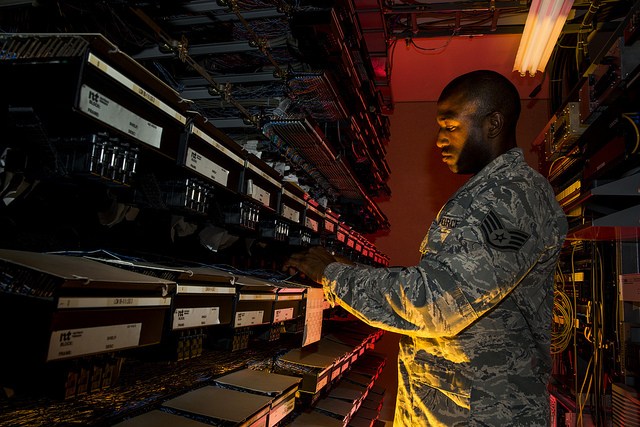
As cyber threats increase and become more sophisticated, airmen in the Cyber career field find themselves operating in a fast-paced environment just trying to stay two steps ahead.
“That’s one of the challenges — the pace of the threat, the sophistication that we see day to day on our networks … it’s accelerating,” Maj. Gen. Burke Wilson, newly appointed commander of the 24th Air Force and commander of Air Forces Cyber, Joint Base San Antonio-Lackland, said in a Sept. 2 interview.
For months, the Air Force has been aggressively lining up airmen for the U.S. Cyber Command-operated Cyber Mission Force teams: 1,715 airmen will be part of the Defense Department initiative to recruit 6,000 personnel to be part of 133 joint mission teams.
But even as CMF teams were being carved out, Wilson said the Air Force had an advantage — with its Cyber operators building their experience by working directly with major commands.
“We started seeing requests [for Cyber missions] come in before CMF; we saw requests coming in from the field through Air Force channels, places like Air Mobility Command were asking for assistance from places like 24th Air Force,” Wilson said.
Always in need of more
Cyber training has dramatically expanded in the last 18 months at Keesler Air Force Base, Mississippi, Wilson said. And he expects the throughput, especially for the 1B4 cyberspace defense operators enlisted career field, to more thantriple in the next year or two.
“The throughput by the end of calendar 2015 [for 1B4] will be around 400 to 450 folks, and that’s pretty dramatic — that’s all in support of the Cyber mission force teams,” he said. The 1B4 career field could see 680 positions, up from 200 in 2011, he said.
In addition to working on CMF teams, airmen will support mission systems throughout the Air Force, Wilson said.
“The requests are piling in — we’re seeing the capacity to provide more support,” he said. “Somebody sees you do some work say in PACAF for instance, and word travels fast, and next thing you know a request comes in from USAFE for the same kind of support, so the word is running that the teams are doing great in terms of defensive posture.”
Cyber training begins with a 23-week undergraduate Cyber training course for officers and a 17-week Cyber defense operations course for enlisted personnel at Keesler. The qualification training and courses are being fine-tuned as emerging threats present themselves, Wilson said.
“We’re teaching them about networks, how to defend networks, what types of network traffic move, how do you look at data flows, etc. etc.,” he said. “Some of the mission systems training, that’s something you’ll see in more of the advanced training.”
This includes ramping up training for some Cyber protection teams: Airmen are familiarizing themselves more with mission systems at air operation centers, space control centers, mission control centers, or the satellite control network, Wilson said. “It’s not necessarily requests to bolster the defense of the Air Force networks, it’s really mission systems command-and-control systems. And that’s healthy for the team.”
While the CMF teams are expected to be fully implemented in fiscal 2016, “we’re maybe 12 to 18 months behind the original schedule in terms of fielding those forces,” Wilson said, “but all of the services are having the same issue.”
Training programs have expanded, and getting people certified is taking longer than expected. “If you look at the glide slope of how we were projecting to build up teams about a year and a half, two years ago, we’re a little behind that, and sequestration didn’t help — it kind of put some of the expansion on hold during that period.”
Partnerships
Wilson said he’s excited to work with the newly forming 25th Air Force, or as most know it, the Air Force Intelligence Surveillance and Reconnaissance Agency. Airmen in the 1N2X intelligence career field, for example, could find themselves in this partnership.
Air Force ISR already employs 1B4 and 17D cyber airmen within their mission set.
Cyber airmen race to stay ahead of new threats