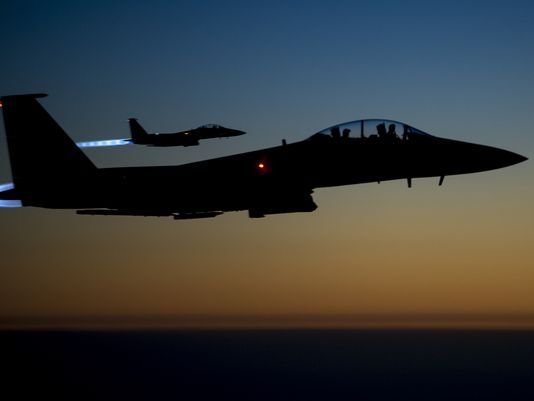
Rep. Martha McSally pressed the chairman of the Joint Chiefs of Staff Gen. Martin Dempsey on whether the air war against the Islamic State is being hamstrung by concern about killing civilians.
“If we’re trying to avoid one civilian casualty in not hitting a legitimate target, we’re allowing the Islamic State to continue to commit atrocities and murder against the people on the ground,” McSally said during Wednesday’s House Armed Services Committee hearing.
McSally, a Republican from Arizona, told Air Force Times that she heard that pilots are often not allowed to drop ordnance on “legitimate targets” in Iraq and Syria because commanders are overly concerned about killing civilians.
“Nobody wants to kill civilians and the law of armed conflict dictates that we need to minimize civilian casualties,” said McSally, a former A-10 pilot. “We certainly don’t target civilians. But we use military force in order to achieve a military objective and minimize civilian casualties. If we are deciding not to hit a legitimate target because there may be a civilian casualty, now we’ve turned that on its head.”
She said she has also heard that the process of approving a target is so “convoluted” that U.S. aircraft have had to return to base because they ran low on fuel while waiting for permission to attack.
“I’m just trying to get to the ground truth because we don’t to have the tyranny of the anecdote be driving our oversight and criticism of the policy,” she said. “I want to know exactly what the facts are.”
During Wednesday’s hearing, she read from a recent op-ed by retired Air Force Lt. Gen. David Deptula, which compared the air war against the Islamic State to the Rolling Thunder campaign during Vietnam.
“While unintended casualties of war are regrettable, those associated with airstrikes pale in comparison with the savage acts being carried out by the Islamic State,” she read from the op-ed, which was published by the Washington Post on June 5. “What is the logic of a policy that restricts the use of air power to avoid the possibility of collateral damage while allowing the certainty of the Islamic State’s crimes against humanity?”
She asked Dempsey how many U.S. aircraft are coming back from strike sorties with their munitions still onboard because they were not allowed to attack a target out of concern about killing civilians or because the target approval process takes too long.
“What’s that number?” asked McSally. a former A-10 pilot.. “How many are we not hitting that are legitimate targets because of this extreme constraint that we’re putting on for collateral damage?”
Dempsey stressed that he “couldn’t disagree more” with Deptula’s argument that concern for causing civilian casualties was making the U.S. air campaign against the Islamic State ineffective.
“In my judgment, this is not the limiting factor,” Dempsey said.
But when pressed by McSally on how many targets the U.S. is not hitting, Dempsey said he wanted to provide those figures in a classified setting to avoid tipping off the Islamic State how to avoid being attacked.
The ultimate decision on whether to attack a target is made by the commander on the ground, he said.