
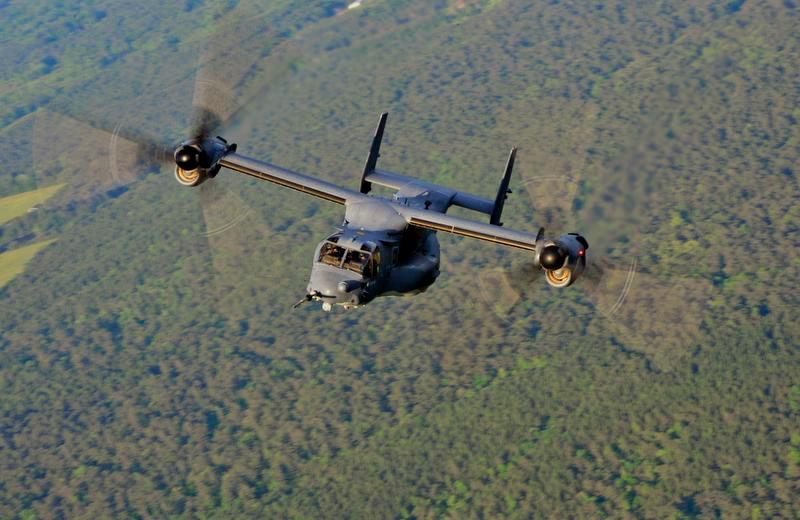
NATIONAL HARBOR, Md. – In response to two of its CV-22 Ospreys being shot up over Juba, South Sudan, in December, critically injuring two service members, the US Air Force Special Operations Command (AFSOC) has added optional armor to the flooring of the aircraft and may also incorporate forward-firing weapons.
AFSOC commander Lt. Gen. Bradley Heithold told reporters on Monday that armor panels developed for the bird could add 800 pounds of weight if the full “blanket” is used, but crews have the option to use the armor sheeting or not.
The two CV-22s were so vulnerable in the attack because the crews didn’t expect the area around the mission to be “hot,” so were surprised by the 119 rounds fired at the aircraft.
The optional armor, which is being fielded now, can be put on in pieces to protect only certain parts of the aircraft, but any extra armor will create tradeoffs, Heithold said, either in how many troops can be carried or how far the aircraft can fly before refueling is necessary.
AFSOC is also working with industry to develop a forward-firing gun, he said.
“We’ve been challenged on this since the inception of this airplane,” he said. “We’re looking at various solutions that will be simple — not exquisite — solutions that fire forward so that I can keep heads down” going into a landing zone.
“It’s not going to be a real exotic, expensive solution” he insisted, echoing comments made by Lt. Col. John DiSebastian, SOCOM’s C-130 and CV-22 program director at a special operations conference in Tampa, Florida, this past May.
“If you’ve got a $1 million widget you want to put on the Osprey — [SOCOM has] 50 of them. We can’t afford a $50 million program,” he said.
“But if you’ve got a $100,000 or a $50,000 widget that can improve the sustainment, capability or ops of the aircraft, then bring that to us.”
Heithold also said his command has run into some unexpected costs in training Osprey crews, and that the mission-capable rates in garrison are lower than the command wants them to be.
“We’re flying the darn airplanes different than they thought we were going to fly them,” he said, “which puts a demand signal on the blades which is way more than anybody ever thought.”
While “we are beating them up” in training events that mimic the rigors of real world operations, he said, in operations around the globe, “the CV-22 is all we asked it to be.”
While AFSOC currently has 50 Ospreys in its fleet, and he doesn’t expect the number to rise anytime soon, Heithold is pushing for three or four more aircraft to act as an attrition reserve. High operating tempo is wearing out some aircraft sooner rather than later, he added. ■
Email: pmcleary@defensenews.com.
Complete coverage
Read all of our stories from the Air Force Association conference


