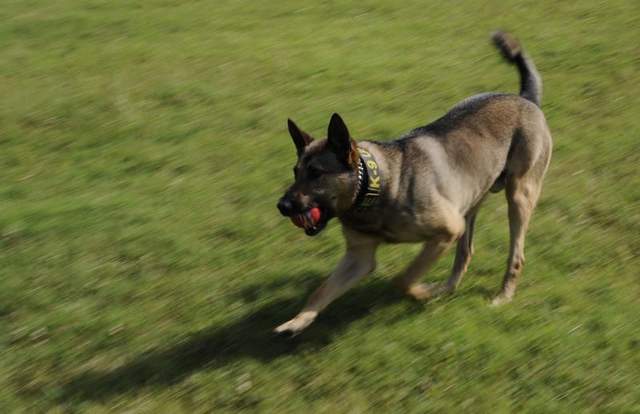
A military working dog who died at Barksdale Air Force Base in Louisiana last month succumbed to heat stroke after his handler accidentally left him in the backseat of a patrol vehicle, officials said.
Caro, an explosives-sniffing German shepherd who had deployed to Iraq, died Aug. 9, said 2nd Lt. Christopher Sullivan, a Barksdale spokesman.
“A thorough investigation found that Caro’s death was due to handler negligence,” Sullivan wrote in an email. “His handler, a member of the 2nd Security Forces Squadron, unintentionally contributed to the death of the [military working dog] by leaving him alone in the vehicle for approximately two hours after the shift was completed.”
Sullivan said Caro’s handler admitted to the circumstances surrounding the dog’s death and “expressed deep remorse.” He was removed from his job and “faced appropriate disciplinary action,” Sullivan wrote.
The Air Force cannot release the name of the handler or the discipline he faced due to privacy laws, Sullivan said.
Barksdale confirmed Aug. 15 that officials there were investigating the death of the dog but declined to say how he died pending the outcome of the probe.
“Working dogs are part of our military family, and they are an invaluable member of our team. A lot of these dogs have provided services that saved service members’ lives,” Barksdale spokeswoman Maj. Sharon Branick said at the time.
Members of the 2nd Security Forces Squadron and other Barksdale airmen gathered last month for a memorial service for Caro, Sullivan said. Security forces members also funded a special burial for the canine.
Caro, 7, was accepted to the military working dog program in 2008. The dogs and their handlers are trained at the 341st Training Squadron at Joint Base San Antonio-Lackland, Texas, according to the squadron’s website. Military canines perform a number of tasks for the Department of Defense and other government agencies, including patrols, searches and detection of drugs, explosives, arms and ammunition.
In response to the dog’s death, the Barksdale security forces commander directed “a full program review,” Sullivan said in an email. “Policies and procedures to incorporate additional precautionary checks have been instituted and special devices were purchased to automatically sound an alarm and roll down the windows when a vehicle’s interior reaches a certain temperature.”