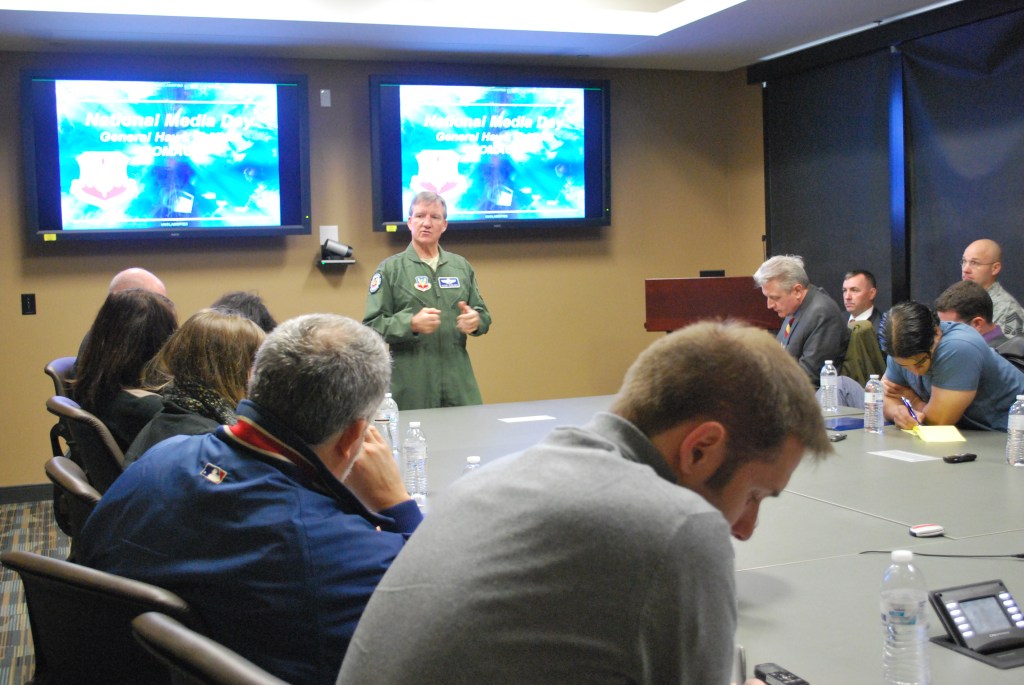
Langley Air Force Base, Virginia — The demand for intelligence, reconnaissance and surveillance missions has increased across combatant commands from a tolerable level in the last few years to more frequent and in-depth requirements in recent months.
The Air Force is leading intelligence gathering in these very fluid missions over Iraq and Syria, as well as Afghanistan and the Pacific, said Gen. Herbert “Hawk” Carlisle, commander of Air Combat Command, in a briefing Monday Nov. 17. But no matter how much they missions gather — with the Air Force is supplying more than over 80 percent of joint-force ISR — commanders still want more.
“We have more mission than money, manpower or time today,” Carlisle told reporters in his first public remarks since becoming ACC commander on Nov. 4. “The real question is how do we prioritize this capability and that capacity to meet the highest demand. What the COCOMs and the national command authorities need to tell us, or what I need to tell … these guys is, ‘I need you to do the next most important thing for the nation, not the next thing that shows up in your mailbox.’”
Carlisle said that pBalancing the ISR demand and combatant commanders’ needs will be one of the challenges, among others, Carlisle said he will address with commanders in his new post.
In the current fight against Islamic State militants, the Air Force’s ISR role is impeded because there are no remains restricted without supporting troops on the ground in hostile areas between Syria and Iraq. CHANGE OK? One problem in particular, Carlisle said, is identifying activities on the ground.
“If you’re looking at the ground and watching folks moving on the ground, to tell a Shia from a Sunni, — it’s pretty hard to do,” Carlisle said. “Unless ISIS is actually flying a flag that says ISIS across the top if it … these guys are trying to determine with everything that we have available given the restrictions that are placed on us ,… how do we positively identify where we’re going or who we’re going to hit?” he said.
But airmen are The silver lining remains with the men and women committed to the fight, Carlisle said. Compared to While the Air Force may have had more people doing ISR work 10 years ago, the post-9/11 warfighters today’s ISR teams TODAY’S ISR TEAMS? have are exposed to greater resources, and are more exponentially MORE? educated and trained in their career fields and on the systems they work with to further the ISR mission.
Airmen working on the Distributed Common Ground System, or DCGS weapon system, the Air Force’s primary ISR intelligence, surveillance and reconnaissance collection system, produce intelligence information from the data collected in the skies in just minutes. Air Force DCGS core site is capable of robust, multi-intelligence processing, exploitation and dissemination (PED) activities, to include sensor tasking and control.
“The ability to provide the warfighter the ability to transfer capability depending on where the greatest need is — whether it’s a nuke going off in North Korea or it’s ISIS or it’s Afghanistan or it’s the Horn of Africa — the agility of this system is amazing,” Carlisle said.
While the information “The [information] doesn’t really mean a whole lot unless you do something with it,” he said,. “Wwhat [these airmen] do and the way they produce a product that is so incredibly good, it just means the demand continues to go up.” CHANGE OK? YES
Air Force ISR mission grows with threats from Islamic State