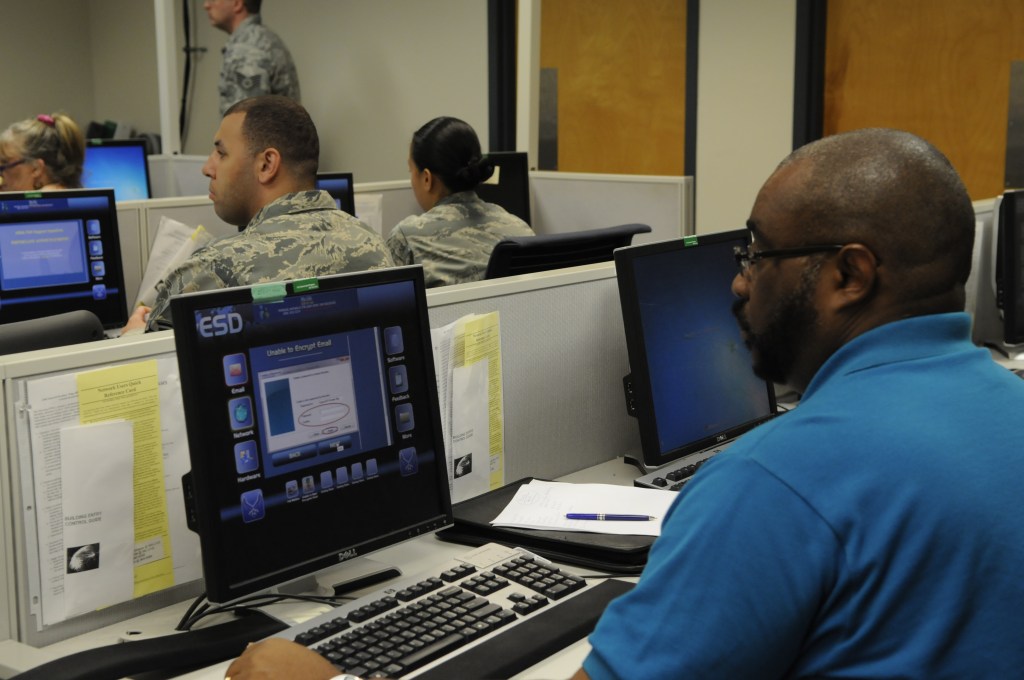
Airmen will no longer have to wait on the pick up a phone to report a basic computer bug — now computer glitches can be reported and potentially solved solved REPORTED AND POTENTIALLY SOLVED?virtually through a self-service application right on their desktops.
The Virtual Enterprise Service Desk, or vESD, allows for users to submit tickets for email, desktop, laptop or mobile device problems — which the device’s software system attempts to internally repair. Depending on the issue, As a bonus, the glitch job can often OFTEN be repaired the same day as the ticket is submitted depending on the issue.
The push for the new virtual system — which began rolling out last month across the Air Force — aims to save airmen time. Users in the past would have to wait anywhere between 20 minutes and to an hour just to speak to a Enterprise Service Desk technician, said Col. Chad Raduege, commander of the 690th Cyberspace Operations Group, said in a release. The call center’s automated phone system also became overwhelmed by thousands of calls, leading to technical inefficiencies, the release said.
“Coupled with the ESD’s backlog, our return to service time took up to seven days. That’s unacceptable,” Raduege said.
Users open their vESD icon, answer a series of questions, and the software goes to work. The software A virtual ESD tech THE SOFTWARE? will then run a “health check” on the computer based on the user’s inputs and will attempt to repair the issue. If it can’t resolve the problem, the vESD will automatically initiate a trouble ticket and route the complaint it immediately to the appropriate office at one of the network operations squadrons or the local communications squadron or flight, the release said.
“About 70 percent of all tickets are minor issues that could be resolved through this type of automation,” said Lt. Col. Mark Reith, commander of the 690th Network Support Squadron, said in the release. “Today the average wait time is five to 10 minutes, and users should expect an average return to service time of about half a day.”
Local communication squadrons will continue to also play an important role, however. They will have additional authorities to work on local priorities, and . Butthey will be available to help users in extreme cases, such as when a computer is completely broken or off the network. — armed with additional IT permissions, squadrons may be able to work the IT support for the users depending on the circumstance. CHANGE OK? YES
“About 70 percent of all tickets are minor issues that could be resolved through this type of automation,” said Lt. Col. Mark Reith, commander of the 690th Network Support Squadron, said in the release. “Today the average wait time is five to 10 minutes, and users should expect an average return to service time of about half a day.”
The online system was born out of two online tools intended to improve user experience. The transition began with Joint Base San Antonio-Lackland, Texas, and Peterson Air Force Base, Colorado, and will be implemented across remaining major commands in stages.
Removing the call center option gives Air Force technicians breathing room to recapitalize resources toward more critical tasks, such as being part of teams that work on information technology IT malfunction prevention, the release said. While the ESD system is not going away, it is being retooled to be more proactive.
The online system was born out of two online tools intended to improve user experience.The transition began with Joint Base San Antonio-Lackland, Texas, and Peterson Air Force Base, Colorado, and will be implemented across remaining major commands in stages.
“The vESD app is the final piece of the new IT support model, and it comes just in time before the Air National Guard migration into [the Air Force Network],” Reith said.