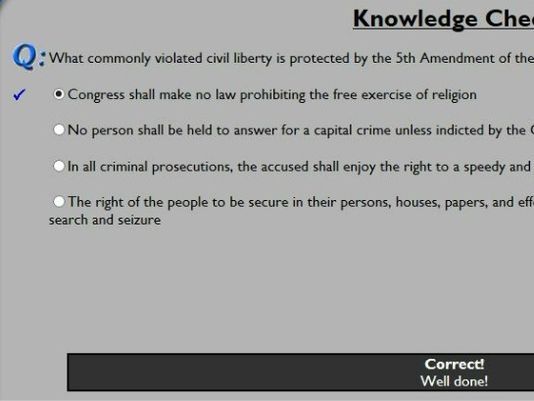
The Air Force has fixed an error glitch on a computer-based test that drew the ire of a civil liberties group, which claimed the Air Force was implying that it preys on Christians.
Dozens of people complained to the Military Religious Freedom Foundation that a security administration test confused the First and Fifth Amendments, group founder and CEO Mikey Weinstein told Air Force Times on March 5.
An Air Force captain sent Weinstein a screenshot of the test, which asked which “commonly violated civil liberty” is protected by the Fifth Amendment. The only answer the test would accept was, “Congress shall make no law prohibiting the free exercise of religion,” which actually falls under the First Amendment.
“The approved solution of the Air Force is that your free exercise rights are under attack — and let me assure you that they don’t believe they’re under attack by anybody other than civil rights organizations like the Military Religious Freedom Foundation,” Weinstein said on March 5.
The error was detected and fixed within a week of going live, said Rose Richeson, an Air Force spokeswoman.
Air Education and Training Command was alerted to the error through the Advanced Distributed Learning System help desk, Richeson said in an email to Air Force Times.
“The version of the Total Force Awareness Training course containing the error was recently updated and had only been available to users since Feb. 26,” Richeson said. “A correction was beta tested and implemented Mar. 4, within a week of the initial report.”
On Monday, Weinstein said it was “great news” that the test had been fixed, but he feels it is a half-measure.
“There doesn’t appear to be any investigation; there will be no punishment; it was just ‘I guess mistakes will happen,’” Weinstein told Air Force Times.
Weinstein also disputes the Air Force’s time line for resolving the issue, saying he received a complaint from a senior Air Force officer about the error on March 5 – one day after the Air Force says it was fixed.
“They hardly get a gold star for doing something that we would expect an average seventh- or eighth-grader whose been introduced to civics to understand,” he said.