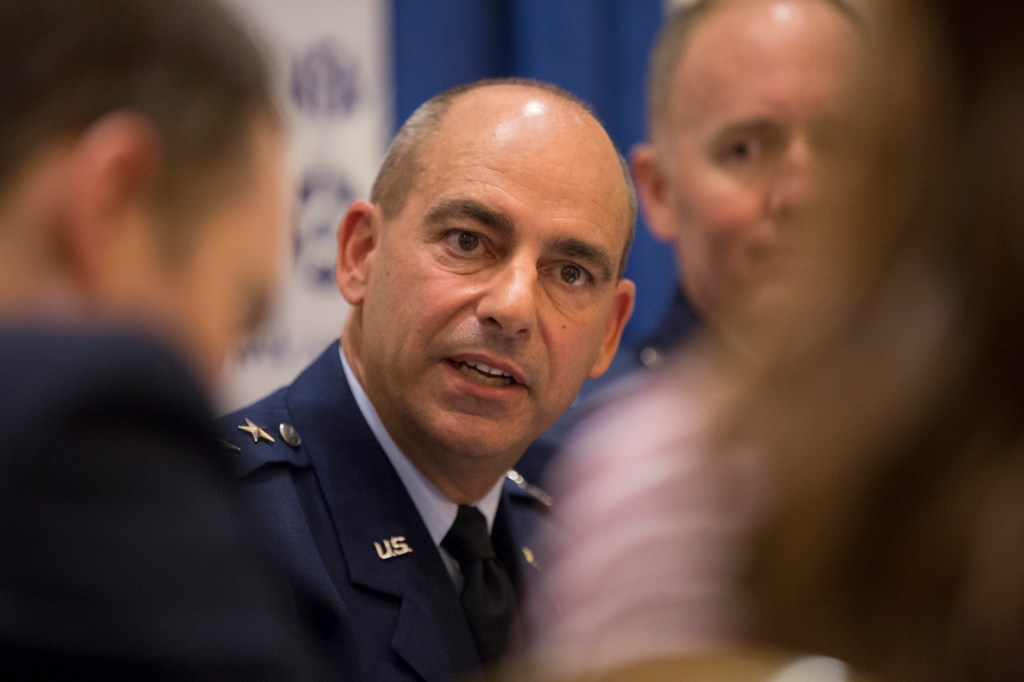
The F-35 could deploy overseas as soon as it reaches initial operating capability in 2016, said Maj. Gen. Jeffrey Harrigian, director of the Air Force’s F-35 Integration Office.
“When you’re at CENTCOM, you don’t request a specific jet, you request the capability,” Harrigian said Monday at the Air Force Association’s Air and Space Conference. “When we declare IOC, the F-35 will be on the list of capabilities that will be available.”
The decision of when F-35s will be deployed lies with Gen. Hawk Carlisle, who leads Air Combat Command, Harrigian said.
The service is still on pace to field a squadron of F-35s by the IOC goal of Aug. 1, 2016, Harrigian said, adding that it would likely include between 12 and 14 aircraft, 30 pilots and 240 maintainers and support personnel.
The first squadron will start off with three missions, Harrigian said: close air support, interdiction of enemy aircraft, and suppression and destruction of enemy air defenses.
“At the end of the day, this is ensuring that we bring to the warfighter a capability that’s a modern capability that allows us to enter into those contested arenas,” he said.
The Air Force currently has 74 F-35As, Harrigian said, and pilots have a combined 19,500 flight hours. Across the entire program for all services, more than 2,000 service members are trained as maintainers.
Harrigian said the F-35 will meet its goals for IOC, but that increasing both the number of planes and the number of operations after that date could pose problems.
“Readiness … has been a huge issue for us,” he said. “We’ll have to work through what’s available and what is the requirement that the combatant commander has.”
Retired Col. Leigh Method, the senior adviser for the integration office, said the key is maintaining long-term operational capacity for an aircraft expected to be in service for at least the next 50 years.
“We need a whole lot of maintainers to do that,” she told Air Force Times. “You can’t just hire a 15-year master sergeant; you’ve got to grow a 15-year master sergeant. We don’t have 15 years’ experience on this platform.”
While the Air Force has trained the number of maintainers needed for IOC, Method said the service is looking into the future and trying to address any challenges that might affect personnel levels.
Another issue is finding international bases for the F-35 that can be used for resupply and depot maintenance, part of the “Global Sustainment System” the Air Force is attempting to set up.
Currently the service is evaluating 17 candidate locations in multiple allied nations, Harrigian said.
The general said he believes the F-35 will be a key piece of U.S. air power going forward.
“The threat is not sitting on its hands,” Harrigian said. “They continue to evolve, and so we need to make sure that as we look at those specific threats, we’re bringing capabilities that keep ourselves ahead of that curve.”