
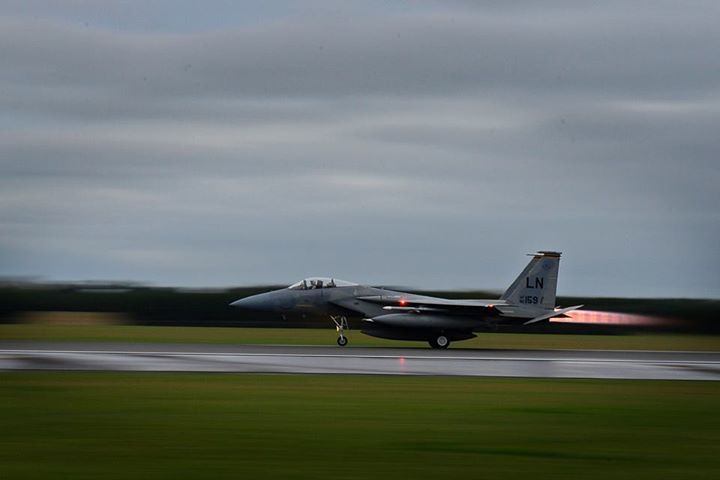
Six F-15Cs from the 48th Fighter Wing based at Royal Air Force Lakenheath, England, landed Friday at Incirlik Air Force Base, Turkey, to protect Turkish airspace, according to U.S. European Command.
Media outlets had speculated that the F-15Cs would be used to protect U.S. planes over Syria from Russian aircraft, which are conducting a separate air war against rebels fighting the regime of Syrian President Bashar Al-Assad, but a spokeswoman for U.S. Air Forces in Europe said the F-15s will not be used in Syria.
“The mission of the F-15C deployed to Incirlik is to conduct combat air patrols in Turkish airspace and to demonstrate our resolve to defend the sovereignty of Turkish airspace,” Maj. Sheryll Klinkel said in an email to Air Force Times.
On Oct. 30, a senior Defense Department official told reporters that the U.S, would deploy about a dozen F-15s to Incirlik: a mix of F-15C and F15E designs. It has not yet been announced where the F-15Es will come from.
The senior defense official also said that the U.S. plans to “thicken” the air war against the Islamic State.
Twelve A-10s from the 75th Fighter Squadron out of Moody Air Force Base, Georgia, arrived at Incirlik on Oct. 20. The F-15s and A-10s are replacing six F-16s from Aviano Air Base, Italy, which arrived at Incirlik in August to carry out airstrikes against the Islamic State.
Recently, A-10s and an AC-130 Spectre gunship helped fighters from the U.S-vetted and supplied Syrian Arab Coalition push back the Islamic State group near Al-Hawl, Syria, said Army Col. Steve Warren, a spokesman for Operation Inherent Resolve.
“Coalition aircraft supported this advance with 17 airstrikes, destroyed ISIL [Islamic State group] vehicles, fighting positions, weapons systems and killed 79 enemy fighters,” Warren told reporters at a Wednesday news briefing.
Having aircraft in Turkey allows the U.S. to fly more sorties against the Islamic State group, said Maj. Tim Smith, a spokesman for U.S. Air Forces Central Command.
“You take a nine-hour sortie, and you cut your drive time in half, and you can spend an increased percentage of your time actually covering the target area,” Smith said in an email to Air Force Times on Friday. “So that helps us with a little bit of flexibility. And so this is why with the additional capability, some additional ISR [intelligence, surveillance, reconnaissance], we’re able to do a little bit more out of Incirlik. That will also increase our target element. That will increase our strikes.”
On Thursday, Lt. Gen. Charles Brown, head of AFCENT, told National Public Radio that the U.S. will put more pressure on the Islamic State group in Syria.
“We’re actually trying to increase the number of strikes we’re doing across all parts of northern Syria,” Brown said in an interview with NPR.
Brown said he has heard the frustrations of pilots flying combat missions against the militants, who say the rules of engagement are so restrictive that they often return from missions without dropping any bombs.
“As a young aviator, I think I would probably have maybe some of the same frustrations,” he told NPR. “But if you look at it from a bigger picture — if you go back over the past few months — we’ve actually increased the number of strikes. So I don’t think that’s an issue anymore.”


