While the nation’s attention is focused on the fight against the Islamic State, U.S. troops in Afghanistan are still heavily engaged in a shooting war.
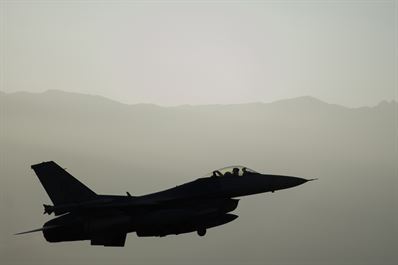
F-16s with the 421st Expeditionary Fighter Squadron are currently in Afghanistan providing close-air support to both U.S. and Afghan troops, said squadron commander Lt. Col. Michael Meyer.
Deployed from Hill Air Force Base, Utah, the F-16s are airborne 24 hours per day to tell U.S. and Afghan troops on the ground what’s over the next ridge and drop munitions on insurgents when needed, Meyer told Air Force Times on Friday.
Last month, two F-16s were called on to assist a convoy of U.S. and Afghan troops under attacked, Meyer said.
“They came under some pretty effective fire,” he said. “Our fighters … they did an outstanding job of escalating force – going from doing things like shows of force, to try to rectify the situation, to go ahead to both employ strafing and bombs to neutralize the threat.”
The primary role for U.S. troops in Afghanistan is to train, advise and assist Afghan troops and police. Many times, U.S. troops partner with Afghan security forces to go on missions, Meyer said. The frequency with which those forces need close-air support varies, he said.
“Sometimes it’s more than others,” Meyer said. “So, there are times when we are doing quite a bit and then there are times when it’s pretty quiet.”
Meanwhile, the U.S. Air Force’s mission in Afghanistan includes targeting terrorist groups, such as al-Qaida, which threaten both Afghanistan and the homeland, said Meyer, who was not able to provide details of operations against such groups.
“Let’s just say that we have certainly been involved in counterterrorism missions in Afghanistan and continue to support that mission whenever and wherever we can,” he said.
Neither the Taliban nor other insurgent groups in Afghanistan have an air force, but they can pose a threat to U.S. aircraft, Meyer said.
“I would categorize this airspace, or this air war, as a ‘fairly uncontested environment’ … but even a very unsophisticated weapon can cause a big problem for us if it hits us in the right place, so we certainly take appropriate measures to mitigate that,” Meyer said.
On Oct. 3, the crew of an AC-130 gunship believes it was fired on by a surface-to-air missile. U.S. officials in Afghanistan have not said if the Taliban are armed with shoulder-fired anti-aircraft missiles.
Meyer said his pilots are “always on the lookout” for shoulder-fired missiles, which are formally known as Man-Portable Air Defense Systems.
“We certainly train and are prepared for that level of threat here,” he said.
Other threats that F-16 pilots face come from Afghanistan’s mountainous terrain, which can be especially dangerous when pilots are flying in bad weather, Meyer said.
“It’s one of the most challenging environments to fly in,” he said. “The mountains out here – they’re actually very beautiful – but for the pilot, when you’re flying through the weather and all those kinds of things, they can be scary.”
The squadron traces its lineage to World War II, when it received the P-61 Black Widow, the first U.S. night-fighter.
“We take great pride in our heritage as being the first night-fighter squadron, the Black Widows,” Meyer said. “That’s what we do here. We’re airborne 24/7. We spend a lot of time [flying] at night and we’re just as capable at night as we are during the day. When a lot of other assets can’t fly – based on weather, typically, or any other environmental challenge – we’re still there, because we have the capability to do that.”