
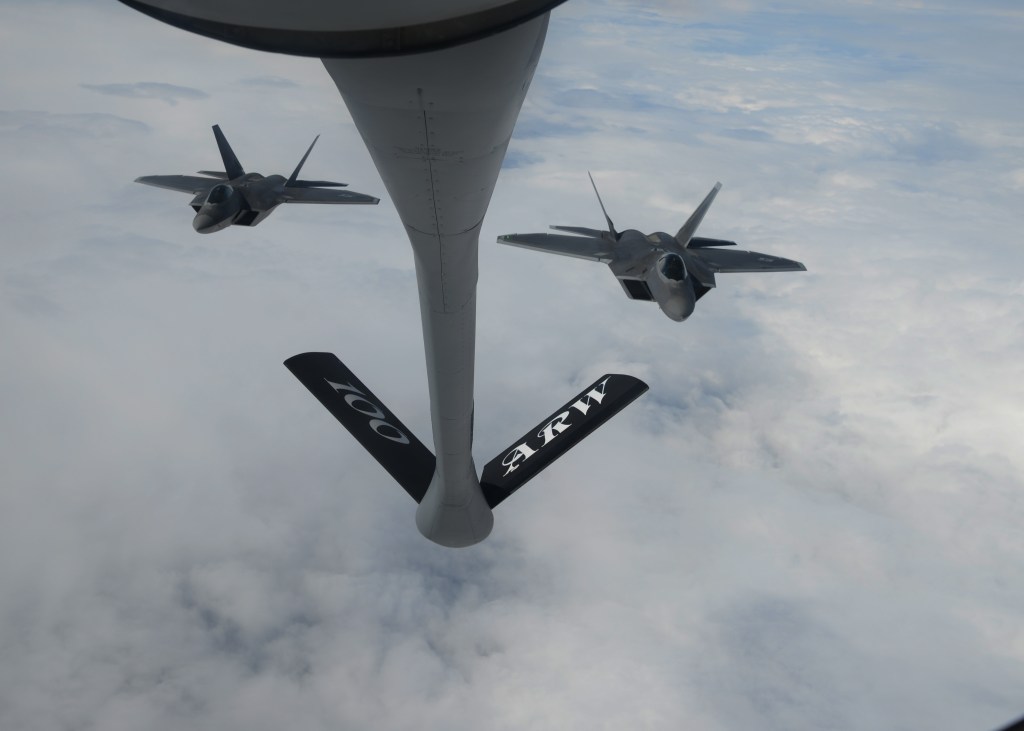
A dozen F-22s from Tyndall Air Force Base, Florida, have returned stateside after almost a month of exercises throughout Europe, according to a base spokesman.
The 12 Raptors, one of the largest contingents of F-22 fighters to deploy to the region, arrived at RAF Lakenheath, England, in early April, two of the jets and about 20 airmen then made their way east to Mihail Kogalniceanu Air Base, Romania, as well as Šiauliai Air Base, Lithuania. Tyndall deployed 12 jets, one of the largest contingents of F-22 fighters to the region; however, only two jets and around 20 airmen made their way from Lakenheath onward.
European lLeaders touted the presence of the Air Force’s most sophisticated aircraft and its presence in the region, saying it because it demonstrated how “t in the region.
“The United States is honoring its commitments and is ready to protect our region with all the most modern measures,” Lithuanian President Dalia Grybauskaitė said on April 27.
Countries close to the borders of Russia have become increasingly been apprehensively since Russia annexedation of Crimea from Ukraine in 2014.
In addition to reassessing their military strategies, they’ve been begging the U.S. to send more forces, and, indeed, divisions ever since the annexation of Crimea from Ukraine in 2014. Russia’s resurgence has even forced Washington to rethink troop levels in Europe, eyeing a larger, permanent force that would help deter an unexpected fight with Russian aggression forces.
It’s likely the Air Force will move forward with more with quick deployments to the region for this reason,. The so-called known as “Rapid Raptor” deployments to move a lot of 5fifth-generation jets “into an area without a lot of spin-up” but enough to make its mark, Maj. Justin Anhalt, an F-22 requirements officer and program element monitor, told Air Force Times on March 8.
In August, the Air Force The first deployment of deployed four F-22s to Europe came last August as part of the European Reassurance Initiative, for the first time ever as part of the European Reassurance Initiative — a Pentagon effort designed to allay European partners’ fears. about Russian aggression in the region.
But even sending two Raptors to Sending two F-22s to Europe, for example, is much more likely to generate make headlines than a handful of F-15s.
“It’s a big deal, because you have a tactical asset that also makes a strategic effect,” Anhalt said.
During their most recent deployment, the F-22s worked to “maximize training opportunities, affirm enduring commitments to NATO allies, and deter any actions that destabilize regional security,” according to U.S. European Command.
“It’s important we test our infrastructure, aircraft capabilities and the talented Airmen and allies who will host these aircraft in Europe,” said Gen. Frank Gorenc, the commander of U.S. Air Forces in Europe and Air Forces Africa, at the beginning of the aircraft’s deployment. “This deployment advances our airpower evolution and demonstrates our resolve and commitment to European safety and security.”,” he said at the beginning of the aircraft’s deployment.
The deployment to Romania put the Raptors right along the Black Sea, where Russian jets have been increasing their intercepts of U.S. and allied aircraft and ships.
The Air Force has not said whether it will send F-22s back to Europe in the near term for more exercises, however, the service is intently focused steadfast on “advancing air-to-air threats — emerging air-to-air threats — that will challenge both the U.S. ability to gain and maintain air superiority, and our coalition partners and how we can help them out,” Anhalt said.
Oriana Pawlyk covers deployments, cyber, Guard/Reserve, uniforms, physical training, crime and operations in the Middle East and Europe for Air Force Times. She was the Early Bird Brief editor in 2015. Email her at opawlyk@airforcetimes.com.


