
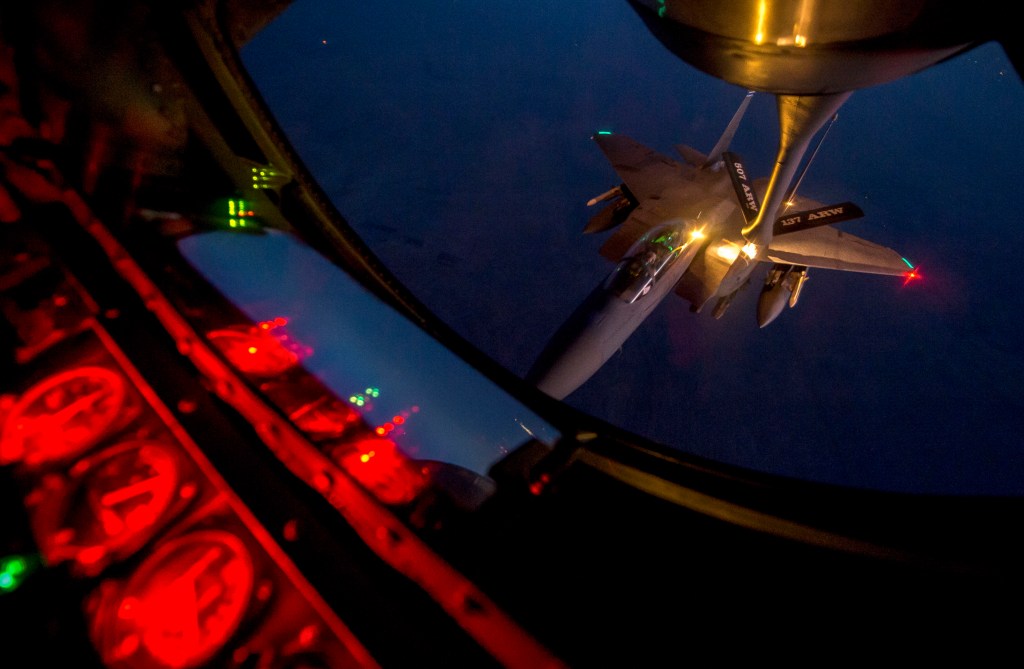
Dispatching air support well ahead of a ground fight has been a critical maneuver in advancing the air war against the Islamic State group, the head of Air Forces Central Command said Thursday.
“The model that we use … in the combined joint operating area, as the air component, we’re able to strike ahead of the ground movement, so that’s my goal,” said Lt. Gen. Charles Brown, the head of the air war against the Islamic State group, also known as ISIS.
At any given time, there are more than 150 coalition flights operating over Iraq and Syria, which can serve as the overwatch before Iraqi or Kurdish forces move in to take back Islamic State-held cities or territories, Brown said during his video briefing to reporters at the Pentagon.
“If I know where the next fight’s going to be, then what I want to be able to do is actually soften up that with strikes. … And we found that if we do that, the resistance that the ground forces face seems to be less for a number of reasons,” he said.
Strikes ahead of a close fight take ISIS fighters off the battlefield, and impedes them from building defensive positions, IEDs and other explosives that could cripple Iraqi or Kurdish foot soldiers on the move, Brown said.
The strategy could prove effective as the U.S. is aiding allied ground forces on three fronts — Fallujah and Mosul in Iraq, and Raqqa in Syria — to diminish the ISIS stronghold in each location.
Brown said there have been increased, dynamic airstrikes in Fallujah in the last week, and the intelligence, since the start of expedited, military operations began Sunday, suggests positive momentum to reclaim the last remaining ISIS stronghold within Anbar province.
“Overall, the coalition has conducted about 800 airstrikes in the vicinity of Fallujah,” Lt. Col. Chris Karns, spokesman for AFCENT, told Air Force Times. One of the more recent strikes, Karns said, involved “two F16s, two F-22s and two Typhoons,” which provided ground support, destroyed a weapons cache and hit a mortar team.
Since Wednesday, coalition aircraft conducted four strikes around Fallujah, targeting three Islamic State units, two tunnels, four vehicles, an artillery piece, a weapons cache and three fighting positions, according to a statement from U.S. Central Command.
The Fallujah mission has not entirely steered the U.S.-led coalition from Mosul, where officials for months urged the the Iraqis to prioritize retaking the northern Iraqi city.
Coalition forces struck a handful of targets in Mosul, which included three ISIS tactical units, five headquarter locations, a media center, a communication headquarters, two vehicles, a weapons and a supply cache, CENTCOM said Thursday.
Near Raqqa, where aircraft on Friday dropped thousands of leaflets urging residents to flee the city, U.S. special operations forces have been photographed along with Kurdish fighters.
“We want ground forces to maneuver with as little resistance as possible,” Brown said. “But there’s still more to be done.”
Oriana Pawlyk covers deployments, cyber, Guard/Reserve, uniforms, physical training, crime and operations in the Middle East and Europe for Air Force Times. She was the Early Bird Brief editor in 2015. Email her at opawlyk@airforcetimes.com.


