Regarding retired Gen. Roger Brady’s May 11 letter to the editor, “Insubordination on A-10”:
What Gen. Brady is overlooking is the crucial role of oversight in the American military. Military leaders, including general officers, are accountable to the people of the United States for their actions. One way to ensure that the American people are aware of improper behavior in the military is to give every service member the right to communicate with his or her representatives in Congress.
Congress did exactly that in 1988, when it enacted the Military Whistleblower Protection Act, which prohibits anyone from restricting a service member’s ability to speak to Congress about any subject, or from punishing the service member for the communication after the fact.
When service members bring their concerns to the attention of Congress, they are not being insubordinate; they are ensuring that the American people have enough information to properly oversee the military. No one, not even a general officer, may prevent them from speaking to their congressional representatives.
Capt. Adam Marvin, Arizona Army National Guard
Phoenix
————–
The assumptions that Air Force leadership always has complete and correct information, and provides error-free direction, are wrong. The assumption that any criticism of Air Force leadership can be inappropriate is also wrong.
All three assumptions are dangerous, foolish and detrimental to a healthy Air Force. The third is possibly unconstitutional as well.
I agree that debate about [retirement of the A-10] is emotional, but believe that Congress should not accept Defense Department recommendations without suitable oversight.
Lt. Col. Michael Burski (ret.)
Lancaster, Pa.
————–
I enjoyed a fantastic career in the Air Force. I served through the ranks and was a propulsion flight chief of the largest jet engine repair facility in Europe. I dealt with the complex issues of budget, logistics manpower, dependent support, and the local generals every day.
[Brady] states that airmen “have neither the responsibility nor the perspective required to determine how best to meet the Air Force’s myriad global missions within the resources available.” Balderdash. The average flight chief is intimately familiar with the use of assets, material, monies and manpower to effect mission completion, he or she and their troops are the people who “get it done.”
I am not and most senior noncommissioned officers in the Air Force are not poorly educated minions incapable of independent cognizant thought. I hold four college degrees and have more than 420 semester hours, I attended night classes throughout my career, while still maintaining an average 60- to 80-hour work week. In 1994, every one of the 12 top NCOs in my flight held a college degree.
Leadership’s job is to provide the assets needed to enable the enlisted force to do what they do best. I can tell you from years of experience that no matter what a flight chief puts in a report, it will be “wordsmithed” by the lieutenant, then the major and colonel, before it’s unrecognizable and forced into the mold desired by the general.
I watched repeatedly in my career various reliable needed weapons systems be degraded by the decisions of leadership to enable the “retirement” of said systems to meet the grand scheme of the leadership. They want the F-35 and are willing to sacrifice everything for it, it’s a carefully choreographed action that first cuts funds for spares, repairs, and airs (air time). Funding is kept insufficient until the need for cost-prohibitive action is needed to save the weapons system, which eventually is offered up for salvage.
The KC-135 fleet is a prime example: Don’t do scheduled maintenance and save millions in 10 years, now pay mega-millions to repair the damage done from neglect.
I am partial to the A-10. I saw firsthand the carnage we smote upon our enemy in the First Gulf War.
Senior Master Sgt. Arthur Blodgett Jr. (ret.)
Landaff, N.H.
————–
Insubordination is today seen as behavior contrary to the concept of “followership” espoused in military academic studies of retired Gen. Brady’s generation of Air Force leaders.
The more rational view — held by many in the officer corps of multiple services— is that followership is an ill-camouflaged attempt at conformity, personal loyalty and blind obedience.
Insubordination, as referenced in the A-10 letter, seeks to institutionalize the followership doctrine of what was taught to most service members in the 1970s. That is, in order to be a good leader, one must first be a good follower.
It is amazing and disheartening to see this followership doctrine still held in reverence by senior leaders today.
Air Force Reserve Maj. S. Puckett (ret.)
Palm Harbor, Fla.
————–
In military tactics, close air support is defined as air action by fixed- or rotary-winged aircraft against hostile targets that are close to friendly ground or naval forces, and which requires detailed integration of each air mission with fire and movement of these forces.
Roger Brady’s letter is using the textbook definition of CAS, which is any ordnance dropped that must coordinate with the ground forces. That could be a B-52 dropping dumb bombs over 10 miles away. His comments do not reflect the weapons for close CAS (within 100 meters).
When you mention Vietnam in this context, the “enlightened” give you a condescending response on the order of: “That was then and this is now.” What they don’t address is that the enemies of this country continue to go to school on the North Vietnamese Army’s tactics of “hugging” the U.S. forces in close combat. Of course, they do that to negate the use of most aircraft weapons and artillery.
The two most effective weapons for close CAS were napalm (fire bombs) and strafing. Napalm could be used to within 25 meters of friendly troops in an emergency dropping parallel to friendly lines. Napalm also had a negative effect on the enemy’s morale. Seeing your comrades incinerated tends to do that.
I once had a F-16 colonel tell me that, now that we had smart bombs that were accurate to within 20 meters, we didn’t need to get down low to strafe. I informed him that dropping a smart 500-pound bomb within 100 meters of the friendlies would kill most of the friendlies. Many of those still living would wish they were dead.
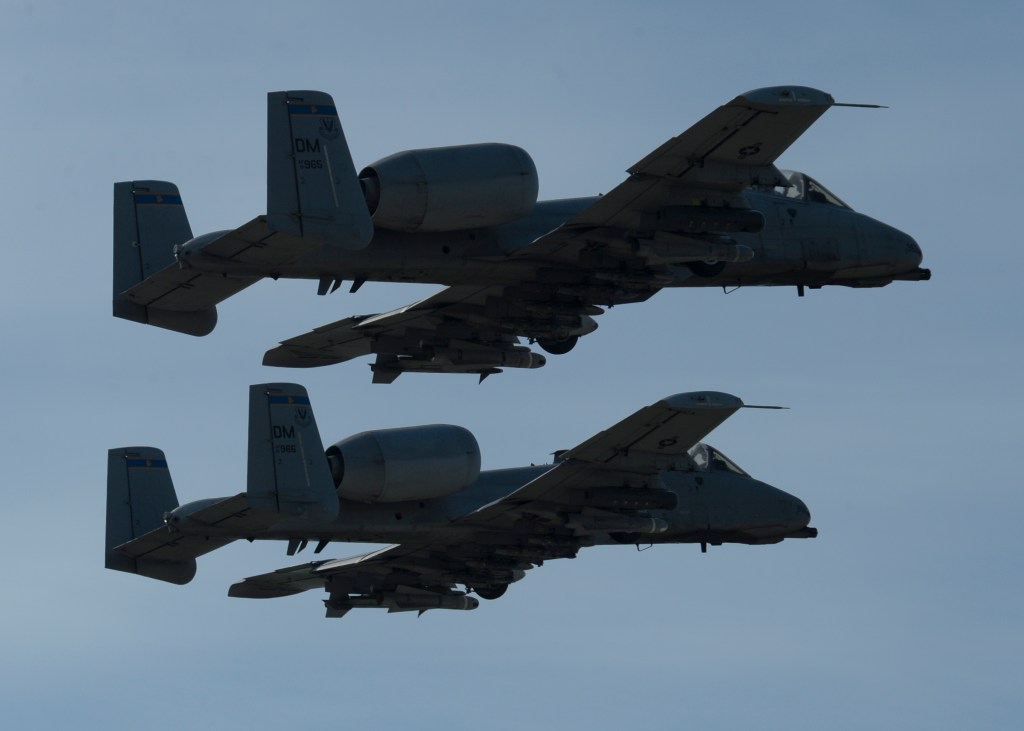
Now that napalm is politically incorrect, the gun is the only weapon that can be used for very close CAS (within 100 meters). Marine Air exists as a supporting arm for the infantry. The Marine F-35B does not have a gun. That means that the Marine F-35s can’t do close CAS. Furthermore, the F-35B can’t support a downed wingman for the same reason — no gun. Retiring the A-10 before there is a suitable replacement would do a disservice to the Army and Marine troops who need close CAS.
I have almost 30 years’ experience in close air support. Roger Brady’s statements that airmen don’t have the “perspective required” and are “insubordinate” are wrong. Service members who are talking to their elected representatives, are trying to support American soldiers, Marines and Special Forces.
Air Force Reserve Lt. Col. David Marshall (ret.)
Panama City, Fla.