The Army taught David Aragon to repair electronics on battlefield gear and jump out of helicopters. He deployed to the Middle East. He took courses toward an engineering degree and went full time with the Colorado Army National Guard as a recruiter. He raised three sons, the oldest now a Special Forces medic.
By 2007, he was signing up “every human being imaginable to go fight the war on terror.” The Iraq surge came and went, followed by drawdowns. The now-retired sergeant major served as chief of recruiting for the state, and expressed the shift in the recruiting mission in civilian terms:
“How do you take a company that has had an incredible budget and resources, be cut off more than 50 percent of what your budget is, and then have to downsize a company?”
Retiring as an E-9, it came as a blow to find out his military duties — including that kind of high-level management experience — didn’t impress civilian employers. He needed a bachelor’s degree.
With credits from three colleges, including 85 hours from Metropolitan State University of Denver going back to 1992, he enlisted a prior learning specialist to help him find the credits in his Joint Services Transcript for an individualized degree.
The effort paid off, with a new job as staff assistant to the associate director of Denver’s VA Eastern Colorado Health Care System.
Once Aragon’s JST credits were applied, he needed two more classes to graduate with a Bachelor of Science in Cross-Curricular Programs and Management.
Read on to reveal hidden credits in your JST. Request your transcript at https://jst.doded.mil.
FIRST, THINK
- What’s your goal? When you’re trying to factor in military credits, you need to have a plan, said Danielle Forrest, the prior learning specialist at MSU Denver’s Center for Individualized Learning who helped David Aragon bring together all his credits for his degree. Do you want a specific degree — or a fast one?
- Is this right? Aragon had a long academic record, but for junior troops with little real classroom time, some say military credits — especially granted automatically on admission — can do more harm than good. Here’s when to say ‘no.’
WHO’S ELIGIBLE
The Joint Services Transcript is available to most current troops as well as veterans, said Laurine Anderson, JST project manager. Anderson and Taheesha Quarrels, military evaluations program manager for the Defense Activity for Non-Traditional Education Support, walked us through these steps for uncovering hidden credits in your JST:
AIR FORCE: ONLY IF …
Because the Air Force’s education programs, including the Community College of the Air Force, are accredited, airmen’s courses don’t need the equivalency recommendations given on the Joint Services Transcript. A requested JST will be prepared, however, for Air Force personnel who took courses from another service. For Air University and CCAF transcripts, go to au.af.mil.
MOST SERVICE MEMBERS: YES
- Key contacts: Your first stop should be the education counselor on your base or post, said Quarrels. If your priority is to maximize your training, your local education contact — or a virtual education counselor — will have the intel on which degrees match up best with your military job.
- Log in: For current troops, the services’ college portals can start you on the path to finding schools with pre-approved programs that make the most of your military learning. The Servicemembers Opportunity Colleges Degree Network Systems help translate service members’ military education into a degree. The Defense Department is revamping the service-specific SOC Degree Network tracks into one universal network. Start by going to:
- Army: goarmyed.com
- Navy: navycollege.navy.mil
- Marine Corps: mcaex.net
- Coast Guard: uscg.mil/Hr/cgi/active_duty/go_to_college/default.asp
- Get tested: Do you know you’ve mastered a subject but don’t have courses that could translate to credit? Active troops are eligible to have credit exams paid for, including College-Level Examination Program and DoD’s DSST subject tests. Go to dantes.doded.mil.
- Be vigilant: If your last transcript was an AARTS or a SMART, it’s worth requesting a JST. As you advance in uniform, it will help you track credit recommendations form the American Council on Education, which evaluates many — many — military experiences for credit-worthiness.
- Speak the language: Direct equivalency is the fastest route to credit, and if you’ve stayed current in your Defense Language Proficiency Tests, that could count toward general education requirements or language courses.
- Border crossing: Colleges are coming up with new ways to account for service all the time. David Aragon’s overseas service qualified him for a waiver of his university’s global diversity requirement.
MOST VETERANS: YES
- Key contacts: One of the best things to happen on civilian campuses has been the rise of the veterans services coordinator. Their space is the hub for vets’ resources, and they come to know the best strategies for success at a given school.
- Break the code: Look for clues to maximizing your transcript by decoding the parts of the JST. Some places to seek out undiscovered credits:
- Other learning experiences: Coded 1-4, these “experiences” include courses and training that for one reason or another never got evaluated by ACE. But a college may be willing to give you credit.
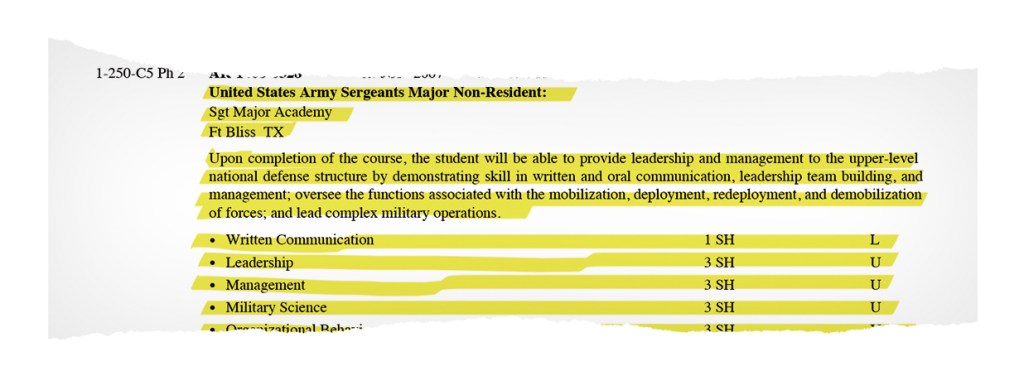
- U/L: While most troops’ military credits will count toward lower-division courses — “L” — some are recommended for upper-level credit.
- Bring in a specialist: If you’re lucky, your college will have someone like Danielle Forrest at MSU Denver who regularly approaches the academic departments about transferring credits to count toward a degree. This expert will know whether your college offers a portfolio workshop, which may allow you to complete a project to demonstrate your knowledge; or offers the type of individualized degree that got David Aragon his bachelor’s.
WHAT YOU’RE NOT SEEING
If you took a course but it’s not on your transcript, ask the JST office to investigate. You could end up solving the problem for your whole class if a roster was neglected or there was another administrative error.