
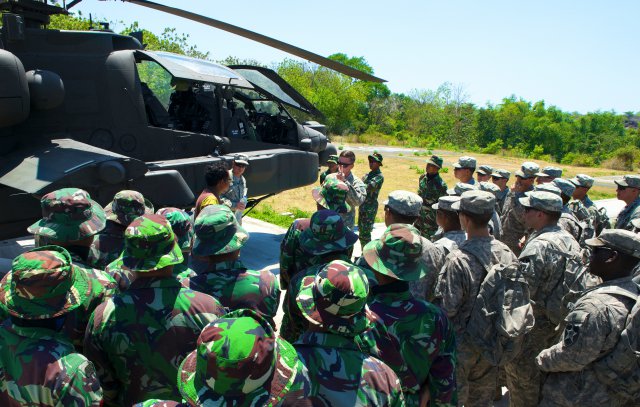
The Army’s role in the Pacific is projected to grow in the coming months to meet the increasing needs of the U.S. military and foreign allies.
“We’re very active right now throughout the region, the Army is behind us and [U.S. Pacific Command is asking for us, and so are the countries in the region,” said Gen. Vincent Brooks, head of U.S. Army Pacific. “As a result, we are finding more and more opportunities to do things throughout the region.”
Brooks’ comments were made Sunday night during the 2014 Association of the United States Army Annual Meeting and Exposition in Washington, D.C.
Full Coverage From Defense News’ AUSA Digital Show Daily
The four-star acknowledged that budget constraints make it harder to meet the increased demands.
“We have to have more faces, in more places, without more bases,” said Brooks, who took command in July 2013. “That’s the opportunity and the challenge for us.”
Brooks said he knows there is “angst in the ranks” because of budget fears.
“We’re not sure, our soldiers aren’t sure, what’s going to be there for them,” he said. “Can they even have the career like the one they’re enjoying right now if we have to reduce in size? Will they have another look at reduction, or can they get about the business of serving?”
Despite these concerns, the majority of Brooks’ speech, given to AUSA chapter presidents, was optimistic about the future of the Army in the Pacific. He took time to highlight some of the service’s successes this year to include:
■ The Army’s new 21-day jungle school in Hawaii.
■ The team of soldiers who climbed Mount McKinley in Alaska, testing new Army gear.
■ The first iteration of “Pacific Pathways,” a two- to three-month deployment that sent an Army unit to several Asian countries.
■ And the increased use of Army watercraft, to include training with foreign militaries and transporting U.S. Marines.
For this last mission, Brooks said soldiers have been brought in from Fort Eustis, Virginia, to operate ships, and the soldiers have loved it.
“If you think about someone who is a warrant officer or a junior NCO who’s in a watercraft military occupational specialty. They might get to do something down in Tidewater,” Brooks said. “It’s an entirely different thing to say, ‘We’re going to put you on a plane, we’re going to Japan, draw out the watercraft, and then you’re going to set sail for two and a half months. Do well. Watch out for typhoons, watch out for earthquakes. Watch out for insurgents. Watch out for pirates. Keep it running. You can handle it.’ “


