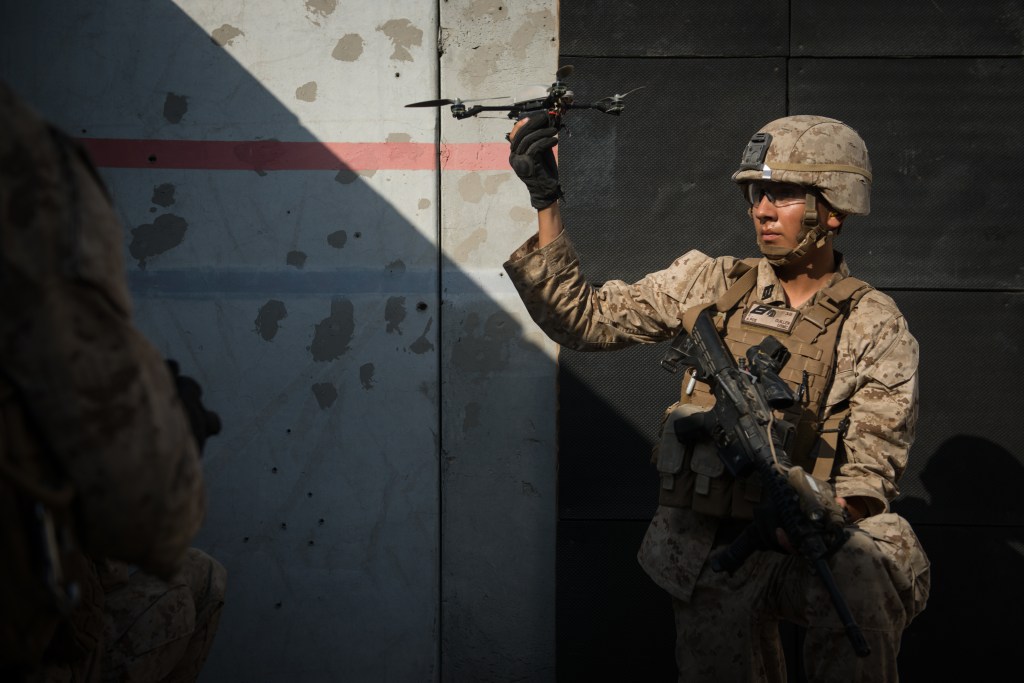
While the threat posed by terrorists’ use of unmanned aerial systems has been known for some time, it was fully realized this month when two Kurdish peshmerga troops were killed and two French paratroopers were wounded by a weaponized drone flown by the Islamic State group in Iraq. The U.S. has been taking note of the threat and developing countermeasures, but this challenge will continue to grow in the coming years, according to a new report, especially as inexpensive commercial off-the-shelf devices become more capable.
The report, published by the Combating Terrorism Center at West Point, is titled ” Remotely Piloted Innovation: Terrorism, Drones and Supportive Technology.” It describes terrorists’ use of UAS and documents why this technology is attractive, among other topics.
“Future off-the-shelf drones will be able to carry heavier payloads, fly and loiter longer, venture farther from their controller and be able to do so via more-secure communications links,” the report says. “The increased speed of small drones and advancements in sensors and drone add-on technology (such as infrared and night vision cameras), will compound the problems for counterterror organizations.”
With additional complications such as decentralized manufacturing processes that can be facilitated by 3-D printing, allowing for easier production and repair, the report offered that these advancements work for defensive measures as well. “[N]aturally…[this] means that the tools to counter, disable or defeat drones will become more capable too.”
UAS provide a number of benefits, according to the report, and terrorist groups use them in five primary ways:
- Surveillance
- Conducting strategic communication
- Smuggling or transporting materiel
- Disrupting events or complementing other activities
- As a weapon, which includes instances of aircraft being piloted directly to a target, delivering explosives and weapons being directly mounted to a UAS.
Besides Hezbollah, the Islamic State group and Jabhat Fateh al-Sham, formerly known as Jabhat al-Nusra, al-Qaida’s official affiliate in Syria, no other terror groups or terror-linked individuals are believed to have successfully used a weaponized UAS to date in an operation, the report asserts. While the Palestinian group Hamas has reportedly flown a weaponized UAS, though unsuccessfully, ISIS is currently the only group to have successfully weaponized a UAS to kill.
During an Oct. 12 briefing with reporters, Col. John Dorrian, spokesman for Operation Inherent Resolve, confirmedthat the ISIS UAS that killed two and wounded two exploded after it had been shot down and while being inspected.
While the report, and much attention, focuses on Islamic terrorist groups based in the Middle East, it notes that there is an ideological diversity in organizations that have expressed desire to use UAS. “While the majority of cases are heavily skewed towards those inspired by radical conceptions of Islamic ideology (from both Sunni and Shi`a schools of thought), terrorist use and interest in drones also includes entities motivated by apocalyptic, right-wing and irredentist ideologies,” the report states. “This suggests that future terror use of this technology will not be limited to groups of one type of extremist ideology, but will instead involve many such groups.”
A reportpublished by the British-based Remote Control Project identified several organizations other than terrorists that have used or desired to use drones such as lone wolves, corporations, activists, insurgent groups and organized crime outfits.
The news isn’t all bad, however. The report notes that while terrorists for several years have expressed interest in using UAS, few have successfully deployed them in any meaningful way.
The report pointed to three factors to explain difficulties in the successful weaponization of these platforms:
- Limitations associated with range, endurance and payload of commercial off-the-shelf devices
- Specific choices by terrorists
- Countermeasures developed by states to defeat hostile UAS
UAS have typically been used by terrorist groups for surveillance and strategic communications, the report said, adding that it is in these areas that terrorists have made the most significant gains.
Terrorists have used UAS to document war footage, which, accordingto Thomas Joscelyn, senior fellow at the Foundation for Defense of Democracies, has been an effective and dramatic method of depicting their operations in order to sell their story for recruitment and propaganda purposes.
The report advises the United States to begin, if it has not already, to systematically catalog cases of UAS use by terrorists to inform regulatory decisions.
Acknowledging the parochial aspect of UAS use within broader terrorist strategy, the report asserts “[t]errorists’ use of drones is only one dimension of a much broader issue, as remotely controlled and autonomous/smart technologies can also be used on land and at sea. Equal attention, and projected thinking, should be given to evaluating terrorists’ innovation in these areas as well, as, for example, emerging technologies like self-driving cars create new opportunities.”