Across the Defense Department, components are implementing the joint regional security stacks designed to better protect military networks and navigating best ways to use commercial cloud options as part of a shift toward the Joint Information Environment. But at the moment, the Marine Corps isn’t one of those components.
The Marines have opted out of implementing JRSS, at least for the 1.0 and 1.5 versions. The service also is pursuing its own private cloud options. However, that doesn’t mean the service isn’t running afoul of broader DoD IT modernization plans.
“When they were developing JRSS increment 1 and 1.5…I had my folks, and we got with [the Defense Information Systems Agency] and the [DoD] CIO office and we did the business case analysis,” said Brig. Gen. Kevin Nally, Marine Corps CIO. As it turned out, what the Marine Corps already had in terms of its own security stacks “is better than and cheaper than JRSS version 1 or 1.5…but the Marine Corps will be a big player in JRSS 2.0.”
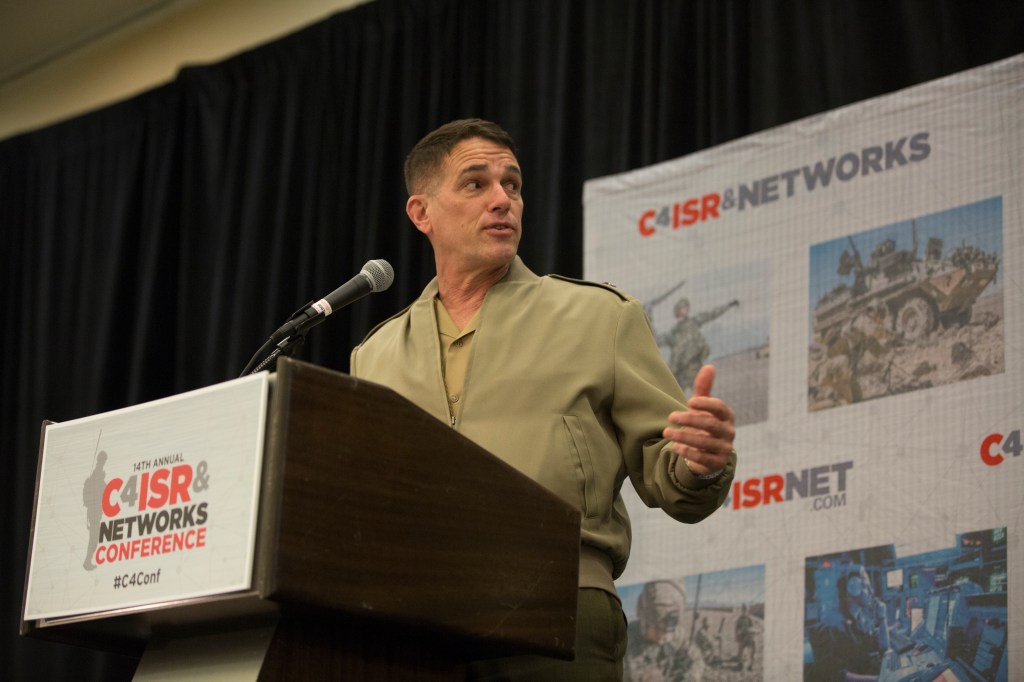
Nally spoke May 14 at the AFCEA Naval IT Day in Vienna, Virginia.
In the case of cloud, the Marines also are looking internally rather than externally for data storage solutions, Nally said, noting that the service has no plans to move to a public or commercial cloud option.
“It’s a data issue, it’s a security issue and it’s a money issue. We’ve done numerous business case analyses, and we can do it cheaper than a commercial cloud can do it,” Nally said. “We have Marines doing it. We have some contractors, but we have Marines doing the work and government employees.”
Nally noted that another reason the Marines are leery of commercial cloud options is the lack of visibility into vendors’ network operations security centers.
“I want to see where my data is stored. I want to see what your tactics, techniques and procedures are and how you protect it. And by the way, if I decide to pull my data out of your data center, how do I know I got it all?’” he said. “Most of them are like, ‘you don’t need to see your data. It’s virtualized. It’s all over the place.’ Well, if they won’t let me in their network operations security center, I’m not interested.”
Instead, the Marines have launched its own private cloud facility in Kansas City, Missouri, under a broader Marine Corps unification plan that also will collapse five separate networks into one. So far, there are about 54 applications in the Kansas City cloud, with plans to add nearly 150 more in the coming months, Nally said.
The transition to the private cloud is a mandate – otherwise, commanders have to provide justification, he added.
Nonetheless, Nally’s plans for Marine Corps IT aren’t written in stone – he said at the event that he will retire in July.