The vice chief of Staff for the Army has identified five objectives to guide development and employment of unmanned systems in the air and the ground, as the service takes a hard look at how it will operate in future battlefields.
Situational awareness
Gen. Daniel Allyn, in a keynote presentation at the Unmanned Systems Defense conference on Wednesday, emphasized that unmanned systems must increase situational awareness, as these platforms can go where manned systems cannot, increasing the agility of the individual soldier and units.
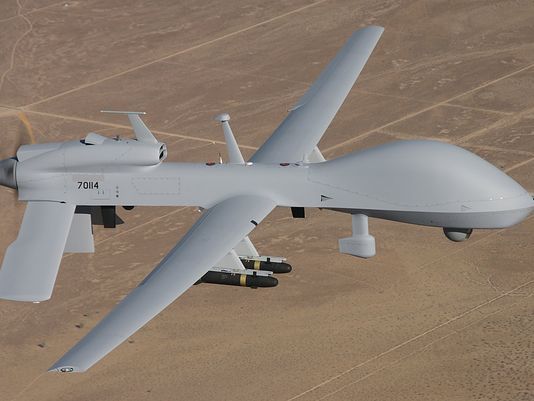
Allyn said that in 2018, the Army will use Improved Gray Eagles (IGE), the service’s variant of the MQ-9 Reaper drone used by the Air Force. This capability, he said, will triple the range of existing systems and increase payload capability to support soldiers at extended distances. The Army began procuring the IGEs in 2015.
The Army is also developing multifunctional electronic warfare (EW) payloads for these systems to sustain information dominance in future battlefields.
Lighten the load
The Army general also said unmanned systems must lighten soldier’s physical and cognitive loads.
The Army, he said, is focused on capabilities like the squad multipurpose system transport — an unmanned system that can carry a squad’s worth of equipment with multifunctional flexibility to make key contributions.
The service also is developing a common UAS ground control station. This breakthrough technology, he said, will enable a common interface for multiple types of unmanned systems, meaning both RQ-7 Shadow and Gray Eagle operators, who today use different displays, will enjoy commonality, reducing operator workload and increasing interoperability with the Army and in joint operations.
The other services are also looking into this capability for the same purpose.
Better mobility, improved efficiency
At the conference, Allyn also called for unmanned systems that can sustain the force with increased distribution, throughput and efficiency. These systems must be capable of moving material to the battlefield while providing commanders a broad array of distribution options, he added.
One of the major efforts in this regard, Allyn said, is the leader-follower capability. This capability could enable four vehicles for every manned vehicle to reduce the threat to soldiers, increasing commanders’ range of options, and improving sustainability and endurance. This is set to field in the 2024 time frame, he said.
This leader-follower technology is currently being tested via the Army Warfighting Assessment at Fort Bliss in Texas.
Control functionality
Future unmanned systems must facilitate movement and maneuverability, he said. The Army is laying the groundwork for scalable control, which will allow UAS operators and recovery teams to operate away from supported units and transfer control of systems once in flight to other solider and units in need of assistance. This will enable ground combat units to positively control the UAS assets, prioritizing efforts as needed in support of a broader array of mission objectives. It will also free up the UAS operator, always in short supply, he noted, for other missions.
Force protection
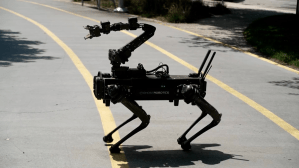
Allyn also said future unmanned systems must be able to protect the force. Unmanned systems already play a role in securing bases, he noted, and likewise unmanned systems are used regularly by explosive ordinance disposal teams to assess and interrogate improvised explosive devices (IED), preventing thousands of casualties since 2001.
In the future, however, route clearance and interrogation systems must provide route clearance teams with an unmanned, semi-automated capability to interrogate, excavate and classify deeply buried IEDs, he said. This system, along with the other manned transportable systems, will increase soldiers’ standoff in the ability to detect and neutralize IED threats, he added.
Allyn also said the U.S. has taken notice of UAS use by Russia in the Ukraine conflict.
“We don’t sit back idly as they operate. We’re not only assessing what they’re doing, but we’re assessing how that impacts our ability to fulfill our alliance obligations” he said, adding that the Army is looking at capabilities that require a boost.
One of the ways these UAS operate in this conflict are with much more tactically integrated EW capability and connectivity to their unmanned systems than what the U.S. Army has, he said. As such, the Army is assessing what that means for the future, how it will adapt operations to mature that capability, and what it needs to counter adversaries’ capabilities and dominate the environment should that be required.