The New Horizons spacecraft that reached Pluto today has a dazzling array of sensors on board, including the cameras that are transmitting breathtaking images and other devices that are gathering data for scientists to learn more about our solar system’s most distant known member.
The craft’s payload was developed under the direction of the Southwest Research Institute, according to NASA. The Institute, NASA’s Goddard Space Flight Center, the Johns Hopkins University’s Applied Physics Laboratory, the University of Colorado, Stanford University and Ball Aerospace Corp. all contributed to the package, which totals seven sensors.
The sensors include:
1. Alice: The Southwest Research Institute’s instrument is an ultraviolent imaging spectrometer intended to gather data on Pluto’s atmosphere. It will identify component gases in the atmosphere, and also determine whether Pluto’s moon Charon has an atmosphere.
2. Ralph: Contributed by Ball Aerospace, Goddard and Southwest, Ralph features seven sensors similar to those used in digital cameras, and one infrared sensor. Its role in the mission is to create maps of Pluto, its moons and other objects in the Kuiper Belt, a region of small objects similar to the asteroid belt but much further from the Sun.
3. Radio Science Experiment (REX): REX is a signal-processing system that, working in conjunction with an Earth-based transmitter, will also seek to analyze Pluto’s atmosphere. While Alice measures composition based on spectography, REX will measure the bend in the radio waves from the Earth station as they pass through Pluto’s atmosphere.
4. Long Range Reconnaissance Imager (LORRI): Essentially a telescope connected to a digital camera, LORRI’s job is to provide photos of Pluto, Charon and other objects. These serve as both visual data and navigational aids. Johns Hopkins University’s APL contributed the instrument.
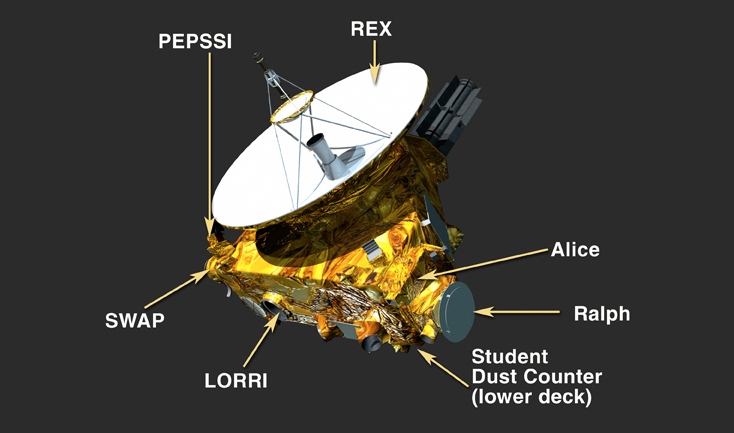
The New Horizons probe is about the size of a piano, and holds seven sensors.
Photo Credit: NASA
5. Solar Wind at Pluto (SWAP): By measuring how much the solar wind is disturbed by its interaction with Pluto’s escaping atmosphere, SWAP will aid scientists determine the “escape rate” of atmospheric material from Pluto.
6. Pluto Energetic Particle Spectrometer Science Investigation (PEPSSI): This sensor’s role is to detect the material that escapes Pluto’s atmosphere, a similar goal as SWAP, above, but using a different method.
7. Student Dust Counter: Designed and built by University of Colorado students, the dust counter will detect microscopic dust grains to provide information on the density of such material, which is created by collisions between larger objects.