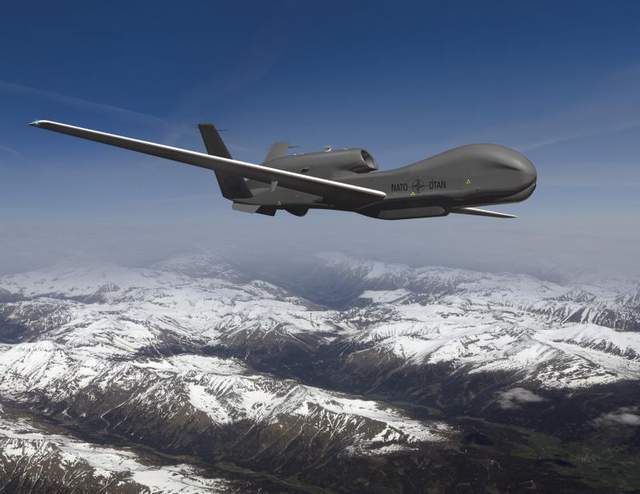
The Air Force wants to spend $208 million on research, development, testing and evaluation for the Global Hawk UAV which, combined with the Navy’s $227 million, makes the platform one of the largest UAV investments requested in the 2016 budget.
According to its justification document, the Air Force seeks the funding for four projects: The RQ-4 Block 30 project, the RQ-4 Block 40 project, the RQ-4 Ground Segment/Communications System project, and the MP-RTIP project.
The Block 30 project uses upgraded Synthetic Aperture Radar (SAR) and Electro-Optical/Infrared (EO/IR) sensors known as the Enhanced Integrated Sensor Suite (EISS), and the Airborne Signals Intelligence Payload (ASIP) sensor. The activities the Air Force wants to study include mission planning development and testing, enhanced weather capability development and testing, airspace and interoperability enhancements and updates, airframe upgrades, sensor upgrades, risk reduction and integration, ice protection system development and testing, and resolution of issues with Diminishing Manufacturing Sources.
The Block 40 project also relates to sensors, in this case the MP-RTIP radar. This project includes the development of enhanced weather capability development and testing, maritime mode utilization, mission planning development and testing, airspace integration activities including Mode 5 Automatic Dependent Surveillance-Broadcast (ADS-B), ice protection system development and testing, airframe and sensor enhancements to the Block 40 fleet.
The Ground Segment Modernization/Communication System Modernization project focuses on mission control, launch and recover and the networking resources required to simultaneously disseminate intelligence while remaining compliant with Department of Defense cybersecurity network requirements to operate on the Global Information Grid.
Because the 2015 budget reinstated the Block 30 projects, the requirement for ground stations operations significantly increased, according to the Air Force, which in turn increased the need to address diminishing manufacturing sources.
The requested funding would also cover continued work on MP-RTIP, designed as a family of modular, scalable sensors to support sustainable network centric operations with integrated Command and Control, Intelligence, Surveillance and Reconnaissance capability.
Another UAS that fares well in the budget request is the MQ-9 Reaper. The Air Force, for example, is seeking $184 million for modifications to the Reaper to make it more effective in its dual role as an ISR asset and as a hunter-killer.
See the chart below, based on data from VisualDoD, for a snapshot of some key unmanned systems and the military’s intentions for them.