The Army is testing a new channel-sharing capability that it says could substantially reduce the cost of providing military commanders with location information about friendly forces.
The Army Blue Force Tracker-1 and Blue Force Tracker-2 systems combine command and control software, satellite transmissions, GPS capabilities and other elements to construct a picture of troop positions. By sharing BFT-1 and BFT-2 signal on a single satellite channel, something that is not presently being done, the service could see 60 percent savings in satellite channel costs, said Paul Mehney, director, public communications, U.S. Army Program Executive Office C3T.
The service has conducted channel-sharing tests in recent months, culminating in a January operational test at the Communications-Electronics Research, Development and Engineering Center (CERDEC) Intelligence and Information Warfare Directorate (I2WD) Flight Activity, located at Joint Base McGuire-Dix-Lakehurst, N.J.
Following on that successful demonstration, program officials say they are planning for a limited fielding to a National Guard unit in late 2016.
BFT-1 and BFT-2 are used by nearly every ground and aviation vehicle across the Army. While they fulfill the same essential function — to track and report on troop whereabouts — each operates under its own satellite lease program and communicates via its own dedicated satellite channel, Mehney said. The present effort to communicate via a single, shared channel aims to pare back that redundant operational and sustainment expense.
Blue Force Tracking has been a staple in Iraq and Afghanistan, and a Northrop Grumman Mission Systems white paper describes the network upgrades in BFT-2 a “quantum improvement in situational awareness” over the previous iteration.
But performance has come with a price, in the need to operate separate channels for the -1 and -2 versions of the system. Industry observers say it now makes sense for the service to try to squeeze some greater efficiencies out of the system by using a channel-sharing approach.
In addition to consolidating satellite expenses, a successful channel-sharing effort could help to keep infrastructure replenishment expenses in check, said Stan Sloane, president and CEO of Comtech Telecommunications Corp., which in April announced it had won $20 million initial funding on a contract to support Army BFT.
“They are looking for ways to leverage existing investments, rather than pay to wholesale replace them,” he said. “Doing this is a good demonstration of that logic. It protects the investments in existing systems by making them more interoperable.”
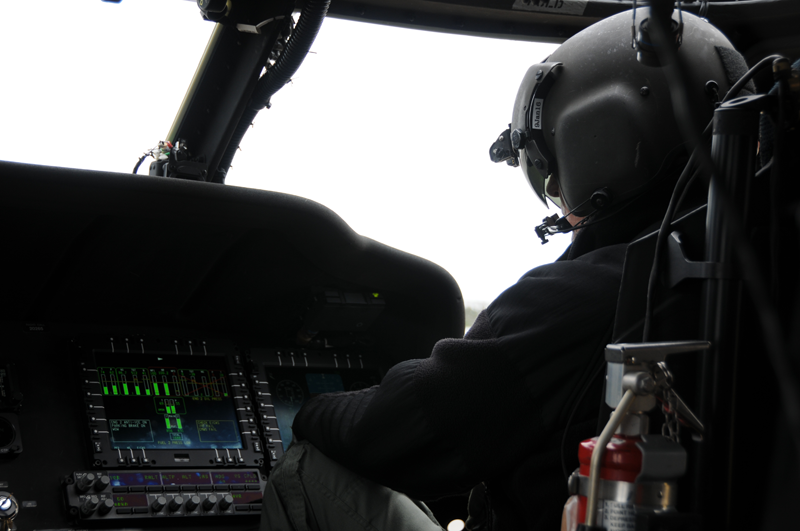
The I2WD demonstration set out to prove that channel sharing could be a practical alternative to the present siloed approach. To that end, program managers installed the demonstration systems not just on ground vehicles but also into a more challenging aviation platform. Because rotor blades can interfere with signal and transmission, the aviation component of the demonstration was potentially more difficult to achieve.
“Developers believed that if successful transmission was received on the rotary wing aircraft, then it could be achieved on other less complex platforms as well,” Mehney said, adding that the channel sharing system performed successfully in the aviation component of the demonstration.
In addition to potential cost savings, program mangers says, channel sharing also should make BFT easier to use. By eliminating the need to shift between different hardware and software setups when working in either the -1 or -2 configuration, planners hope to simplify network management.
Looking ahead, planners say this single-channel approach will be built into the next iteration of Blue Force Tracker, now known as BFT 2.5. That system also is slated to incorporate an improved antenna design, more powerful processors and more sophisticated modems.
While still in development, BFT 2.5 is expected to undergo operational demonstrations this fall, with the service planning to conduct market research for the next generation of transceivers starting in mid-2017.