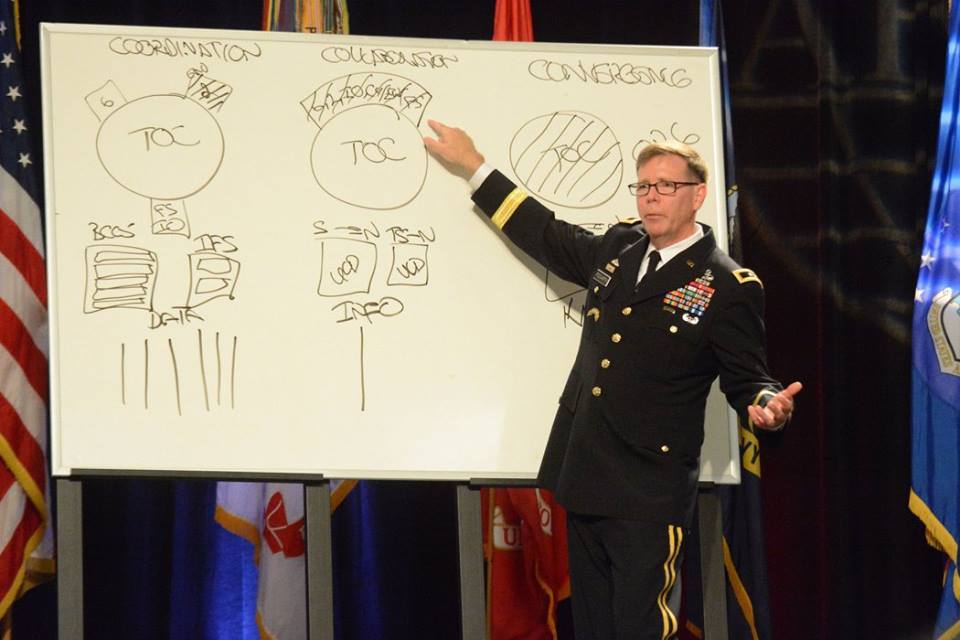
Day 2 of AFCEA’s TechNet Augusta, held in the Georgia hometown of Fort Gordon, the 7th Signal Command and the Army Cyber Center of Excellence, saw a drill-down on the topics at hand. That included frank discussions on intelligence staffing and operations, the evolution of radio communications in the theater and dominance in cyberspace. The central tie between all of those themes? The dire need for joint communications.
Or as MG John Baker, commanding general of 7th Signal Command (Theater), bluntly put it: “If we’re not communicating, then we’re just camping.”
Here’s five key snippets from Day 2’s discussions that centered on solving the military’s problems in cyber operations and communications on the move.
1. Shrinking resources, uncertain environments, tug-of-war over responsibilities, roles and authorities, and fast-moving technology might feel like emerging challenges, but they’re actually not.
“At least for the years I was involved in cyber operations, [these challenges] have been true for much of it,” said Bill Crumm, who spent 30 years at the National Security Agency, including three years as director of signals intelligence operations. Taking on those hurdles, however, set the stage for intelligence operations strategy in the new millennium.
2. The struggle to staff up cyber intelligence also isn’t new.
At NSA, Crumm’s goals were “retention, retention, retention…I wanted them to begin and end their careers in cyber,” he said, adding that mentality remains critical today.
3. Tactical radios are part of convergence, too — critical to speed and continuity of operations.
“We’re going to come into the theater, we’re going to build up, we’re going to train, we’re going to get ready for operations and we’re going to perform the operations,” said COL Jim Ross, program manager for tactical radios at Army Program Executive Office Command Control Communications-Tactical. “We’re going to be ready to go as soon as our boots hit the ground, where ever we go, and that requires communications enabled en route.”
4. The U.S. is losing the technological edge, and the Army really needs data scientists to help (but they’re a little skeptical they’ll find it).
The time of “when the U.S. possessed superiority in the cyber domain” is gone now, Baker said in a series of sobering assessments of cyber capabilities.
5. But it’s not all bad news: The Army’s convergence of its cyber operations, schoolhouses and training doctrine are a boon for Army and joint cyber defense and offense.
“My vision for the [Cyber Center of Excellence] and team Gordon is that we develop a highly skilled workforce and effectively collaborate with relevant stakeholders to develop and lead integrated cyber, electronic warfare and signal capabilities for the Army and the joint forces,” said MG Stephen Fogarty, commanding general of the CCoE and Fort Gordon. “My three imperatives for the next year are to drive convergence, to change the culture and build a modern [cyber training] campus.”