
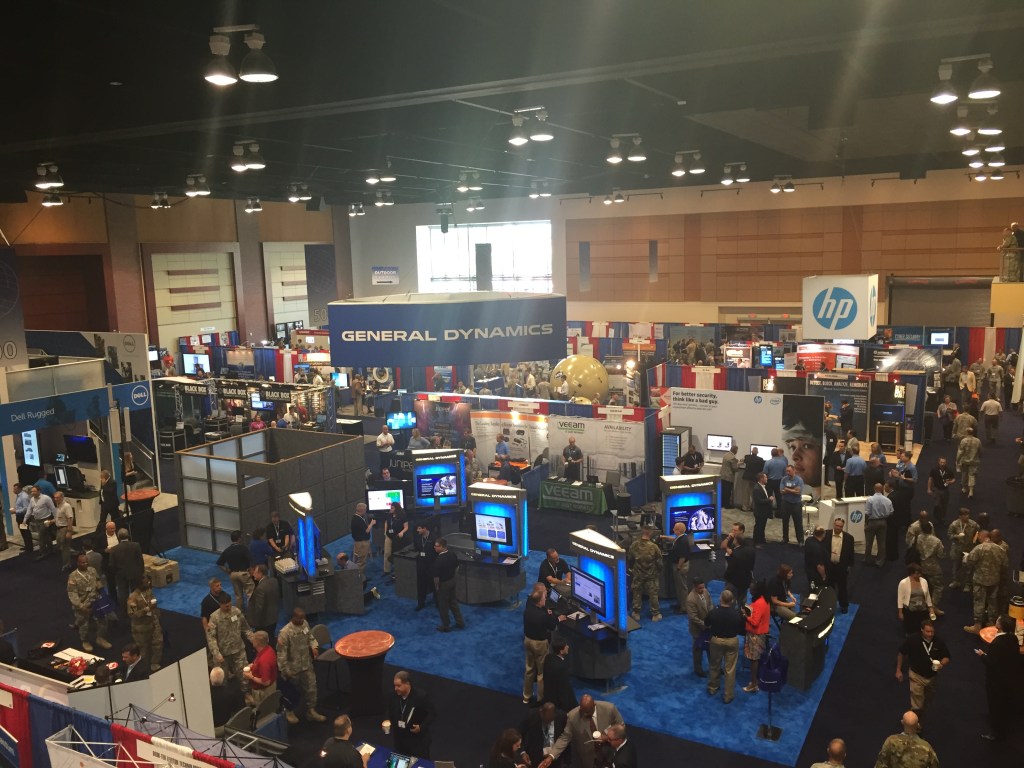
The theme for this year’s TechNet event in Augusta, Georgia, is “cyber convergence,” an idea hit on many times throughout the first day of the event. Keynote speakers MG Stephen Fogarty, commanding general of the Army Cyber Center of Excellence and Fort Gordon, and LTG Edward Cardon, commanding general of Army Cyber Command, both leaned in on the concept of converging operations for holistic cyber offense and defense.
Here are six key takeaways attendees heard the first day, Aug. 25, at TechNet Augusta.
1. Cyber is a team sport.
“Cyber operations have to be deconflicted and interoperated between intelligence, electronic warfare,” and other operations, Fogarty said. That includes convergence between the “holy trinity” of Army Cyber Command, the Army Cyber Center of Excellence and the Army Cyber Institute.
2. We need cyber schools.
Convergence means new ways of conducting cyber operations — and that means new ways of educating and training the soldiers who will be conducting those operations. Expanding the current schoolhouses to address the changing requirements will be critical, Fogarty said.
3. Those new ways of doing things won’t be easy.
Fogarty and Cardon both acknowledged that converging operations and changing the mentality to tackle cyber will be an exercise in culture change. But they were both confident in the Army’s ability to push through.
4. Convergence is more than just lip service about collaboration.
“Our previous constructs [targeting cyber] have failed,” Cardon said. “It’s an Army problem, a joint problem, a national security problem.”
5. But collaboration — within the Army, but also across DoD, the intelligence
“We are technologically convergent but operationally divergent,” Cardon said.”We’re at an important juncture in the Army.”
6. “Hyper-asymmetric war” is upon us.
So is “punctuated equilibrium,” Cardon said in a flurry of high-tech-sounding buzzwords. Stay tuned.


