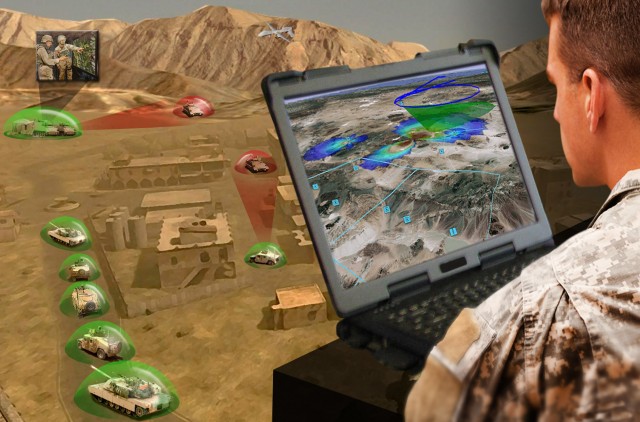
The Army, along with coalition partners in the Pacific, have developed a plan for cooperative management of the electromagnetic spectrum. As a result of a so-called distinguished visitors’ day, which took place in July, the Army said it had demonstrated interoperability in spectrum sharing with South Korea, the culmination of six years of work to provide spectrum managers with situational understanding of spectrum requirement and plans within an area of operations.
The Army highlighted this unique development as a critical achievement given that often times individual nations develop their own spectrum sharing tools and programs, conducting joint operations without interoperable tools is difficult.
“We go into countries and have to coordinate with the host nation, and planning can be complicated. The future amounts of data that we will need to coordinate frequencies is large, and the collaborative effort we saw today is useful and will help,” said Roland Sheffer, a German foreign liaison officer attending the demonstration day. “It’s not only the military demand that we cope with but the civilian demand is even larger than ours. To find the gaps and make sure we don’t interfere with the average daily life in the country we go to is really important.”
Yuriy Posherstnik, Coalition Spectrum Management technical project officer for the CERDEC Space and Terrestrial Communications Directorate, noted how U.S. spectrum managers don’t have situational understanding of spectrum requirements for coalition partners in the same area of operation currently, leading the Army to identify the need for an increase in interoperability and situational understanding, the Army said.
Posherstnik said that the lack of planning, spectrum-management software tools and interoperability between the U.S. and South Korea led to the partnership.
Russia’s advanced and sophisticated use of electronic warfare in Eastern Europe has drawn much ire and attention from the military community. China, however, in the Pacific has also sought to bolster its capabilities in the electromagnetic spectrum.
“China is improving information and operational security to protect its own information infrastructure, and is also developing Electronic Warfare (EW) and other information warfare (IW) capabilities, including denial and deception,” the U.S. Department of Defense’s annual report to Congress on the military and security developments of China read. “China’s ‘information blockade’ likely envisions employment of military and non-military instruments of state power across the battlespace, including in cyberspace and space. China’s investments in advanced EW systems, counterspace weapons, and cyberspace operations — combined with more traditional forms of control historically associated with the [People’s Liberation Army] PLA and [Chinese Communist Party] CPC systems, such as propaganda and denial through opacity — reflect the emphasis and priority China’s leaders place on building capability for information advantage.”
Moreover, the report said that the PLA’s EW strategy focuses on radio, radar, optical, infrared and microwave frequencies along with adversarial computer and information systems viewing EW as a “vital fourth dimension to combat that can be key to determining the outcome of war, and should be considered equal to traditional ground, sea, and air forces. The PLA sees EW as an important force multiplier.”
CERDEC and the Army’s two-phased collaboration with South Korea included addressing technical aspects of building data exchange and implementing data exchange between coalition partners’ tools. “CERDEC and the Republic of Korea investigated and developed an interoperable message exchange format for force structure, equipment data, frequency requests and frequency assignments,” Posherstnik said, using an alternative name for South Korea.
In the second phase, the U.S. and South Korea implemented the DoD- and NATO-compliant Standard Spectrum Resource Format Pub 8 data exchange format to allow the exchange of network plans by exporting them through the DoD-approved XML format and proving an interoperability mechanism exchanging spectrum data between partners’ tools.
Part of the coalition interoperability capabilities involved generating mapping displays, developing import and export functionality between each nations’ spectrum management tool, developing modular and tool-agnostic data translation application programming interface, implementing operational scenarios, and demonstrating the capability to import and export operational scenarios with both nations, the Army said.
South Korea, U.S. unveil interoperable spectrum management capabilities