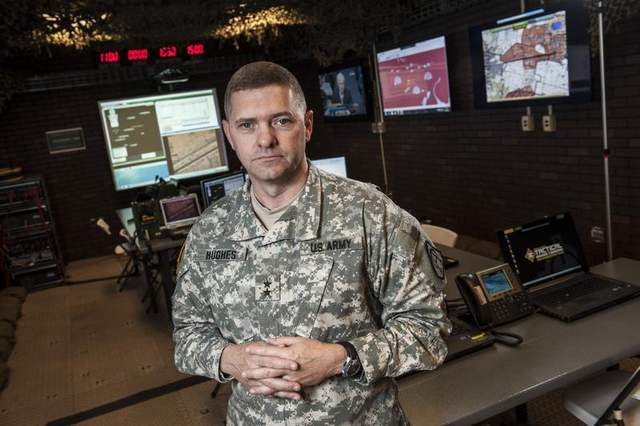
MG Daniel Hughes wants to make it easier for soldiers to use devices on military networks, a process which has not always been simple.
“When you pick your cellphone up you don’t turn around and say, ‘I’ve got to connect to the Verizon cell tower down the street,’” said Hughes in an earlier interview. “I do not want soldiers to have any of those steps.”
Hughes, program executive officer for the Army’s PEO Command, Control, Communications-Tactical (PEO C3T), said the task of simplifying the network is daunting in light of security requirements.
“When we look at the password you have to type in on an HMS Manpack or on a Rifleman radio, [we need to ask whether] it is too complex for a soldier in the middle of combat and in the middle of the night, in freezing weather or in the rain, to do? How hard is it?” he said. “Can we get biometrics to do that so a soldier swipes two fingers on it and it works? We are looking at what the cellphone industry is doing right now with the simplicity of, say, a Samsung GALAXY 5 or an iPhone. How can we apply that and have the same level of security that we need for the Army’s tactical network for the future, but yet to make it easy enough for a soldier to not have to remember a 16-digit password?”
Hughes, along with more than a dozen top military leaders, will speak on Feb. 4 at AFCEA NOVA’s 14th Annual Army IT Day. Themes include the status of network modernization, the PEO EIS and PEO C3T procurement schedule and many other topics.