The U.S. military is going through “exponential times” in communication and networking. said RDML (ret) James Rodman, a former chief engineer for the Space and Naval Warfare Systems Command,
Hosting a panel discussion at West 2015, Rodman said that people in the military have seen communications go from “single-channel, single function radios to a globally linked, a globally networking force using technologies that, I guess, only ‘The Jetsons’ would have imagined 40 years ago.”
Click here for all of our coverage of West 2015.
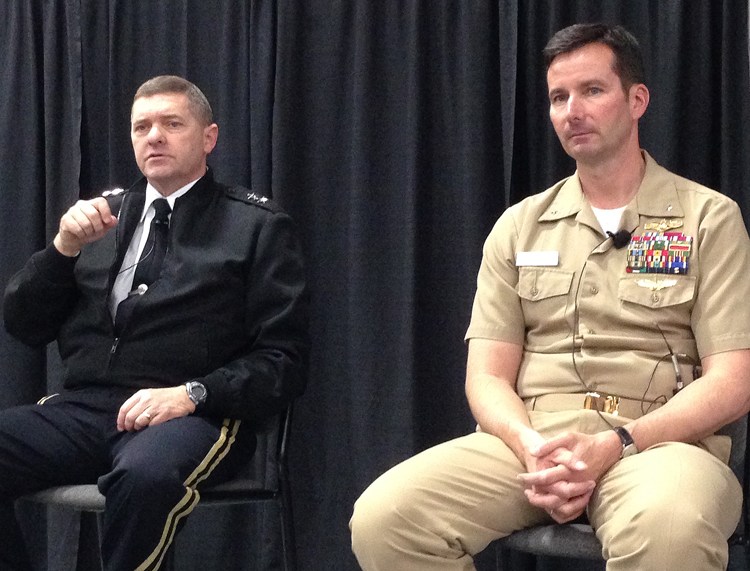
The panel included MG Daniel Hughes, program executive officer for C3T, and RDML Christian Becker, PEO for C4I and Space Systems.
Hughes, whose office is developing the two-channel HMS Manpack radio that can use the Mobile User Objective System (MUOS) waveform in addition to Soldier Radio Waveform, said that key to inter-service success with a program that is not officially a joint project is putting aside “service equities” and just focusing on getting the capability delivered without worrying about taking credit.
By connecting to MUOS, the two-channel Manpack will enable soldiers to operate in smaller units and dispersed over a greater area. “We’re taking the network down to the individual soldier in the Army,” Hughes said. “It allows that 18-year-old to call for help when they need it.”
The final RFP for the Manpack radio is expected to be published in the summer.
Hughes was not always so confident in the future of software-programmable radios. “Six or seven years ago, I was starting to lose faith that we could actually get there,” he said. Since then, the devices have demonstrated the necessary computational power to run various waveforms and be updated on a regular basis.
The HMS Manpack’s routing and retransmit capability is more than an advanced capability. “It changes doctrine,” Hughes said.
In Operation Desert Storm, Becker added, the metric was how many sorties required to destroy a target, but after industry starting applying GPS to strike capabilities, the metric became how many targets a single sortie could destroy. That demonstrates the transformative capability of satellites and comms systems, he said.
“We flipped the metric,” Becker said.
Despite all the current demonstrations of MUOS, how it will actually be used in the field will ultimately be left to the next generation of warfighters. “I think the company commander of 2020, the platoon sergeant of 2020, who is in high school today, is going to have a different expectation of how to execute command and control,” Becker said.