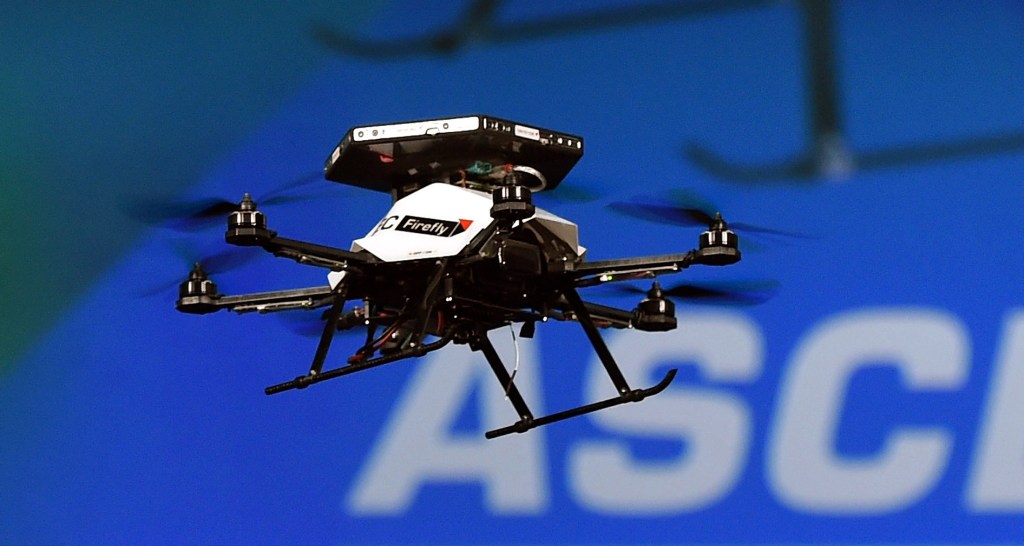
The Defense Advanced Research Projects Agency is opening the doors to a wider swath of partners to participate in its miniature unmanned aerial systems program, Fast Lightweight Autonomy (FLA), designed to enable UAS to operate autonomously in highly cluttered urban environments at high speeds much like the flight of a bird or insect.
In a notice released in late September on the government’s Federal Business Opportunities website, DARPA said it is considering opening flight tests under FLA, which was first announced in late December 2014, to entities not directly funded by the program as to demonstrate capabilities or products related to program objectives.
Potential attendees will address their system’s performance against FLA metrics:
– Speed: 45 mph
– Autonomy power: 20 watts computing plus TBD sensing
– Terrain: complex, urban, cluttered
– Prior knowledge: enough to indicate goals, but low resolution and stale
– Range: 0.6 miles
– Duration: 10 minutes
– Communications: zero
– GPS: not available or denied
DARPA provided examples of three potential courses that attendees might be asked to test their capacities on to “demonstrate robustness of the system.” These include:
– An indoor course simulating a cluttered environment with multiple object obstructions at varying angles and heights with horizontal widths ranging from roughly 4 feet and 10 feet, heights ranging from near 10 feet and 30 feet, and traversed runs ranging between 50 feet and 250 feet, as well as a total flight distance ranging from approximately 600 feet and 2,000 feet.
– An outdoor course simulating natural terrain full of trees and topographic changes in elevation or hills, man-made structures such as fences or buildings, and multiple changes in flight direction that should not exceed 50 feet above ground level and not more than 2,000 feet in distance per run.
– A transition course to simulate moving from outdoor to indoor environments through apertures. The solutions should be capable of navigating from the point of launch — which will occur approximately 250 feet from a man-made structure with natural terrain features and building apertures of roughly 10 feet by 10 feet — through an aperture, then onto a cluttered indoor environment previously described.
DARPA has previously described the FLA program as looking to explore “non-traditional perception and autonomy methods that enable new classes of minimalistic algorithms for high-speed navigation in cluttered environments,” the first notice said. “Through this exploration, the program will develop and demonstrate the capability for small and fast unmanned air vehicles (UAVs) to fly autonomously through complex, cluttered environments.”
DARPA’s hope is that the program will engender new capabilities to provide soldiers eyes on highly cluttered urban environments that previous systems could not traverse, such as inside structurally damaged buildings.
Additionally, DARPA’s original notice pointed out that most UAS are reliant on predetermined GPS waypoint navigation; however, in today’s environment in which adversaries try to degrade these capabilities, UAS could be rendered ineffective. FLA devices would be able to fly quickly through these cluttered environments — at speeds around 45 mph — without GPS navigation, similar to bird flight patterns. “Birds and flying insects are able to perform well without using predetermined waypoints or an external position reference system,” DARPA said.
DARPA published video of a recent demonstration in which a commercially available quadcopter achieved speeds of 45 mph in an indoor, cluttered environment.
DARPA opens small UAS program participation