WASHINGTON — GOP presidential candidate Sen. Rand Paul on Thursday laid out a foreign policy vision built both on a “robust” US military and a commitment to use it sparingly.
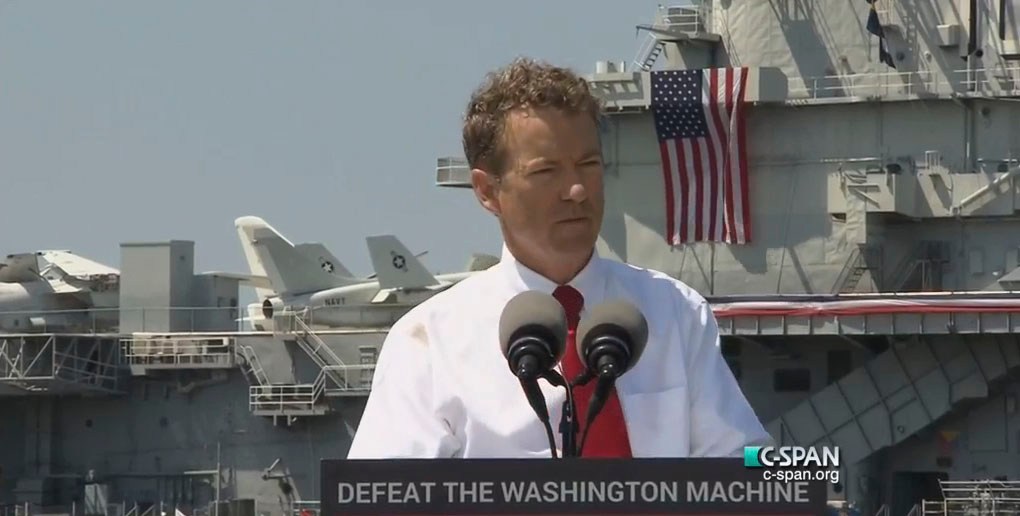
The Kentucky Republican, known mostly for his libertarian philosophy, used rhetorical flourishes and jabs at both political parties to lay out his foreign policy and national security approach during a speech in Charleston, S.C. His pitch, delivered with the USS Yorktown aircraft carrier as his backdrop, was a return to the approach employed by for President Ronald Reagan, which Paul described as “peace through strength.”
Paul’s campaign-trail description of how he would run America’s foreign policy and national security was perhaps best summed up by a line from late in the speech when the candidate described a United States “strong enough to deter foreign aggression but wise enough to to avoid unnecessary intervention.”
Since emerging on the national scene, Paul has been a major critic of the George W. Bush and Obama administration’s post-9/11 military operations in the Middle East. He continued that line of criticism in his first major foreign policy policy and national security address since announcing his candidacy earlier this week.
But he did so while walking a tightrope. During his political career, Paul has at times called for smaller annual Defense Department budgets. Though he since has altered those calls, Paul clearly wants GOP primary voters to know he believes in a lethal US military.
He called for “a national defense defend robust enough to deter” and “nimble enough to defend our vital interests.” That would be paired under Ccommander in Cchief Paul with a foreign policy “that encourages stability, not chaos.”
Some of Paul’s critics and opponents, including some of his more interventionist Senate Republican colleagues, have said he is too much of an isolationist to be commander in chief as the US faces the Islamic State, al-Qaida, a resurgent Russia, China and other threats.
Paul’s message Thursday for those critics was to declare under his presidency, “if war unavoidable, America will fight with overwhelming force and we will not relent until victory is ours.”
“As commander in chief our objective is peace,” Paul said, but warned the world to not “mistake our desire for peace with passivity.”
But, at several points, he hammered home his aversion to large-scale ground operations like those that Iraq and Afghanistan became in the early 2000s.
“I envision a national defense unparalleled, undefeatable and unencumbered by overseas nation building,” Paul said, adding elected officials owe it to military members to “know when war is necessary and when it isn’t.”
For the latest national security news from Capitol Hill, stick with CongressWatch
He vowed to mull “questions of war with a profound deliberation,” then took a swipe at Obama’s ISIS fight by promising he would “never take the nation to war without the cConstitutional approval of congress.”.
Candidate Paul’s campaign slogan is “defeat the Washington machine.” And he took plenty of swings at the nation’s capital.
He criticized politicians who “frivolously” and “cavalierly” call for the United States to go to war.
“War is not a game and should not be used for political advantage,” he said. “Too many in Washington haven’t learned that lesson.”
Like most presidential candidates of any party in the early weeks and months of a campaign, Paul’s remarks were shy on specifics. For instance, he talked only about a “robust” military and did not call for larger annual Defense Department budgets nor mention a specific funding level.
But he was clear about thing: “The enemy is radical Islam.”
Such groups lie squarely in the category of threats against which Paul said he would not hesitate to use military force: “enemies dead-set on hitting America.”
The middle portion of the speech veered away from foreign policy and national security and toward his domestic-focused stump speech.

The candidate told a supportive crowd that “we sit on a powder keg” of an $18 trillion debt. He hit Republican and Democratic presidents for spending and borrowing too much.
“We borrow $1 million every minute,” he said, declaring that rate “threatens not just our economy but our security.”
In one of many applause lines, Paul then said: “We need to stop spending money that we don’t have.”
The Kentucky eye doctor also called for a cConstitutional amendment that would require a balanced federal budget each year. And he warned against borrowing so much from China.
“We cannot project strength by borrowing money from China to send it to Pakistan,” he said.
Paul also wants to slash US aid to countries where people chant “death to America.”
“I say it must end,” Paul said. “I say not one penny more to these haters of America.”
email: jbennett@defensenews.com
Twitter:@bennettjohnt