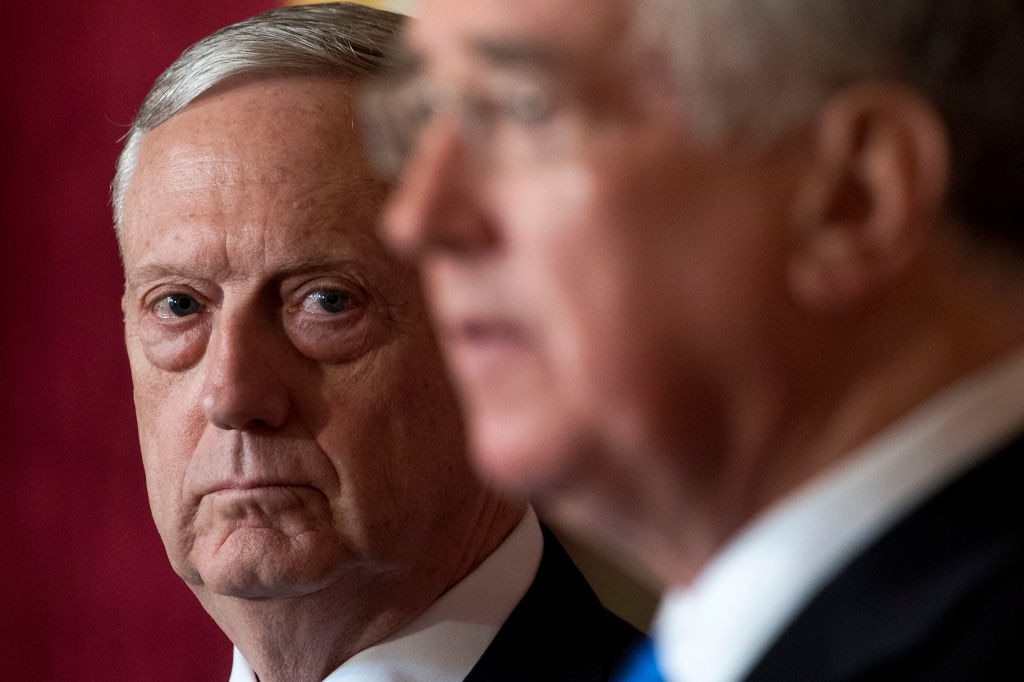
WASHINGTON — The United Kingdom is keeping a close eye on any policies that it could construe as “protectionist” from the United States, with Britain’s top defense official noting his country could turn to the World Trade Organization if the Trump administration attempts to create new policies on steel imports.
Michael Fallon, U.K. secretary of state for defense, also said there has yet to be any impact from the falling pound on procurement programs, but acknowledged his government is reviewing decisions made in its last major defense strategy document to account for potential challenges.
As part of public comments made at the Center for Strategic and International Studies on July 7, Fallon said Britain is “watching very closely, there’s no secret about that, any tendency towards protectionism that might that might discriminate against British companies in particular, including British companies involved in the United States defense chain as well.”
During a roundtable with reporters, Fallon acknowledged that Britain is specifically eyeing protectionist policies on steel as one area of concern. In April, U.S. President Donald Trump signed an executive order issuing a study on whether imports of steel are harming U.S. national security interests, a report that is expected to be complete in the coming weeks.
Concerns that the U.S. may look to limit steel imports — a move that would likely be welcomed by Trump’s domestic political base — is very much on the mind of European nations, to the point where European Commission President Jean-Claude Juncker said July 7 that the European Union could respond “within a few days” to attack American whiskey imports as retaliation.
“I am telling you this in the hope that all of this won’t be necessary,” Juncker was quoted as saying in The Guardian newspaper. “But we are in an elevated battle mood.”
Large-scale trade disputes can be resolved through global forums, a messy solution countries try to avoid — but one that Fallon brought up, unprompted, when discussing protectionist policies in the U.S.
“We believe, in essence, that America is a free trading country,” Fallon said. “But more than that, there are mechanisms, there are forums, like the World Trade Organization, to deal with these specific disputes where there are allegation of subsidy and so on.”
Fallon has previously called upon U.S. defense companies to add more British companies into their supply chain, saying large American firms have to “do more” if they wish to sell equipment to Britain.
As of yet, Fallon said there have not been any “signs that jobs aren’t coming to Britain that would otherwise have come to Britain,” adding that concerns new American policies might hurt U.K. jobs is “a little premature.”
Budget relook
Fallon also downplayed talk that Britain’s pound, which has been weakened against the dollar since England vote almost a year ago to leave the EU, known as Brexit, will cause issues with defense procurement.
The pounds-to-dollar exchange rate is particularly important for the British Ministry of Defence, which has agreed to buy high-dollar value items such as Lockheed Martin’s F-35 Joint Strike Fighter, Boeing’s P-8 maritime surveillance aircraft and General Atomics’ MQ-9 UAV, among others. Some analysts have warned that the U.K. could be overcommitted to the tune of £20 billion (U.S. $25.8 billion) over the next 10 years unless the MoD can deliver large efficiency savings.
Those agreements were largely worked out before the Brexit vote, and the U.K. budgeted with a higher pound value. However, asked specifically if there have been any short-term procurement impacts from the pound falling, Fallon said: “No.”
“So far as the exchange rate is concerned, I think it is too early to see where the dollar-sterling rate is going to settle down,” he said. “Like any large organization, we take precautions against movements in the currency, but it’s too early to say where that rate will eventually settle down.”
At the same time, the secretary acknowledged that decisions made in the 2015 Strategic Security and Defence Review, or SSDR, need to be assessed with the post-Brexit world in mind.
“It’s quite reasonable, I think, to look at the review and see whether it still holds good in the light of Brexit, from 2019 onwards,” Fallon said. “The review is based on the spending period envisioned under the previous parliament, [2015 through 2020]. We’re now in a new situation in Parliament, ’17 through ’22, enough to recalibrate the end of those programs.”
However, Fallon stressed that did not mean the U.K. was gearing up for a new SSDR.
Andrew Chuter in London contributed to this report.