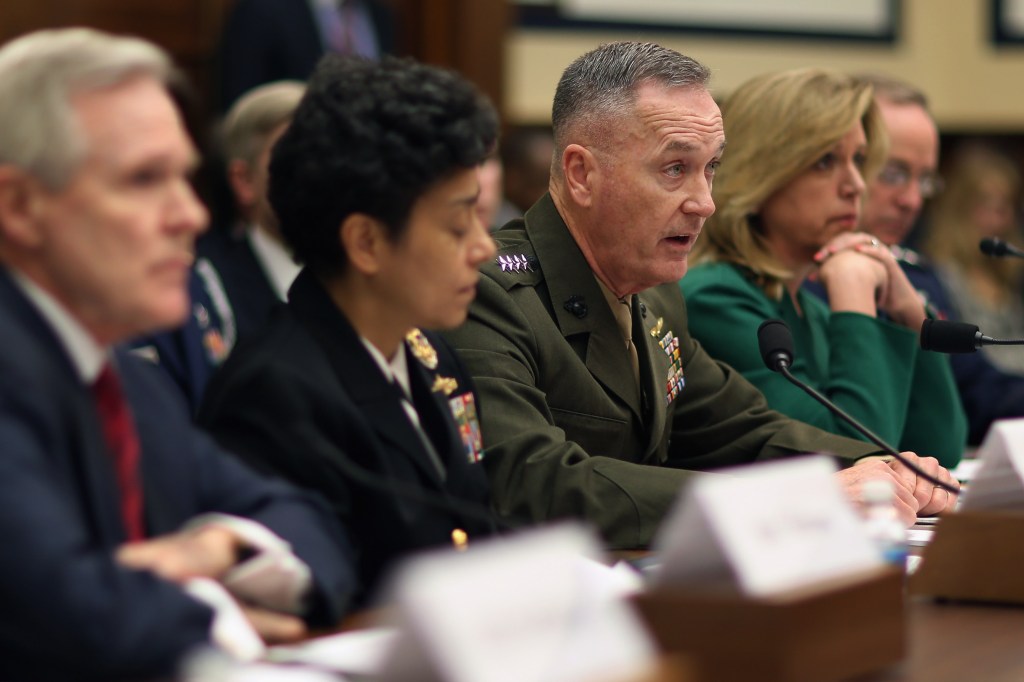
The House Armed Services Committee (HASC) in the wee hours of April 30 approved its 2016 Pentagon policy bill. The panel proposed $495.9 billion in base Defense Department spending, and another $89 billion in overseas contingency operations (OCO) funds. But during an 18-hour markup of the legislation, HASC members adopted tens of amendments. And for the sections most relevant to defense acquisition and policy wonks, many would require Defense Department or other government entities to deliver briefings, reports or investigation findings to Congress. Such reports are often met with groans by the executive branch and some good-government experts. But lawmakers and aides say they are crucial. Here’s a look at a few included in HASC’s bill.
Issue: ‘Enduring Reports’
Executive actions: Lawmakers in recent years have tried to tamp down on the number of so-called “enduring reports” — Congress-speak for requirements for information from the Executive Branch that have no expiration. That leaves departments and agencies spending lots of time each year preparing and delivering those reports to lawmakers and staffers. Government watchdogs say reports to Congress can bog down the Executive Branch, sometimes making it even more inefficient. The Pentagon in recent years has bristled at the number and cost of annual reports to Congress. And Congress just late last year resisted eliminating reports deemed unnecessary by the Executive Branch. Former Defense Secretary Robert Gates required all DoD-generated reports include the cost to produce it. Under former Secretary Leon Panetta, instruction went out to limit reports to 10 pages.
Congress digs in: Both moves drew the ire of lawmakers, including HASC Chairman Rep. Mac Thornberry, R-Texas. “That kind of arbitrary limit to me is rather demeaning of our oversight role,” Thornberry, then a senior panel member, told Fox News in July 2012. The White House’s Office of Management and Budget (OMB) last year put out a list of more than 300 reports to Congress it deemed unnecessary or redundant. The House responded with legislation in November that did get rid of some of those reports, but lawmakers trimmed the axed list to 48.
On the House floor, then-House Oversight Committee Chairman Rep. Darrell Issa, R-Calif., called the legislation “a good start.” Issa added: “We started with a much larger report list. We believe that the progress under this bill sets the tone for an annual elimination of reports that have become outdated or unnecessary.” Issa zeroed in on what many lawmakers, including some HASC leaders, see as the real culprit: mandates etched in laws for yearly reports with no expiration dates.
Issue: One-Year Reports
Data dump coming: Amendments attached to the House panel’s 2016 auth bill seemed to adhere to the push for expiration dates. Still, if the House Armed Services Committee gets its way, a slew of amendments it approved during the marathon markup will keep Pentagon and service officials plenty busy next year. Before approving the Emerging Threats and Capabilities subpanel’s section of the bill, HASC members approved a group of amendments that would require 13 briefings, reports or “assessments” from the department or Government Accountability Office (GAO). A few hours later, the panel next approved the Tactical Air and Land Forces subcommittee’s section and amendments that would require 10 briefings, reports or inspector general probes. Before the panel approved the Seapower and Projection Forces subpanel’s section, it adopted a bloc of amendments that called for still more briefings and reports.
Into the weeds: One amendment from Rep. Richard Nugent, R-Fla., would mandate a briefing from US Special Operations Command on its directed energy test and evaluation program. Rep. Tim Walz, D-Minn., offered this one: “Directs the Secretary of the Army to provide a briefing on the potential force structure changes and production programs necessary to achieve a pure fleet of M1 Abrams tanks across the Army.” And Rep. Austin Scott, R-Ga., included one that would make the Air Force secretary give members “a briefing on the potential utility of an integrated EO/IR (electro-optical/infrared) capability on Next Generation JSTARS development program.”
Rep. Jackie Speier, D-Calif., one of the panel’s more critical-of-DoD management voices, included one that would mandate a GAO briefing to members and committee staff on the Air Force’s long-range bomber program and an annual unclassified report on its “status and risks.” And Seapower Chairman Rep. Randy Forbes, R-Va., included another that would shift $60 million from Navy destroyer modernization programs to undersea warfare research-and-development efforts.