PARIS — France’s procurement office has launched a transformation plan aimed at keeping weapon systems updated based on geopolitical shifts, according to Direction Générale de l’Armement (DGA) chief executive Laurent Collet-Billon. The DGA also said it will peruse export markets and pursue technological breakthroughs to support the French military.
“The aim is to prepare for the future, set the technological road map for defense with a 10-year time horizon for 2025,” he said.
“It is important to set a convergence of the armed forces, funding, industry and technology on a permanent basis,” he said. “That might be long term for some, but for us it is very near term and a very deep transformation. It requires both a long-term strategy and the ability to act immediately,” he said.
The transformation plan, named “Immediate Anticipation,” is being rolled out to staff and senior officers of the forces. The project addresses four key factors: international, extended capability, innovation and digital.
International reflects geostrategic factors such as emerging powers, changes in Asia and re-arming around the world, he said. There is also an increasing demand from export customers for increased government involvement at all phases of a deal.
“For the DGA, it means we must be up to it on behalf of the Ministry of Defense,” he said.
Exports increasingly call for factoring requirements of foreign forces into programs right from the start. Meeting needs of the French services is the main mission, but DGA also plays a key role in the “French team,” led by Defense Minister Jean-Yves Le Drian, comprising government, military and industry in export campaigns, he said. Foreign sales are expected to help fund development of domestic programs.
France redirected a multimission frigate and Rafale fighter jets away from the Navy and Air Force to equip Egypt after Cairo signed export contracts last year. That meant short-term inconvenience; but in the long term there would be for the services a wider operator base that could share “user club” reports, he said.
In the extended capability, the aim is to optimize the global defense system by applying a “horizontal” approach, which spans a number of programs, he said. The DGA seeks gains in terms of schedule, performance and improved risk management, he added. The extended capability approach is to be shared with the joint chief of staff.
Weapon systems need more than ever to be interoperable and, therefore, more efficient, he said. The technology could also extend beyond military applications, he said, noting that information technology boosts communications between the defense systems.
The Army Scorpion program for a Griffon troop carrier and Jaguar combat vehicle will draw on that approach, with the land units plugged into a network with the Tiger combat helicopter, drones and Rafale fighter jets, he said.
The concept of defense system architecture management is at the heart of the capability approach and will test pilot cases, such as the light joint forces helicopter, he said.
DGA, Navy, DCNS and Thales are pursuing a cooperative approach to develop and build an intermediate frigate, he said. The business case for the program is expected to be presented this year to the defense minister. The warship will weigh some 4,000 tons and be equipped for anti-air, anti-surface and anti-submarine missions.
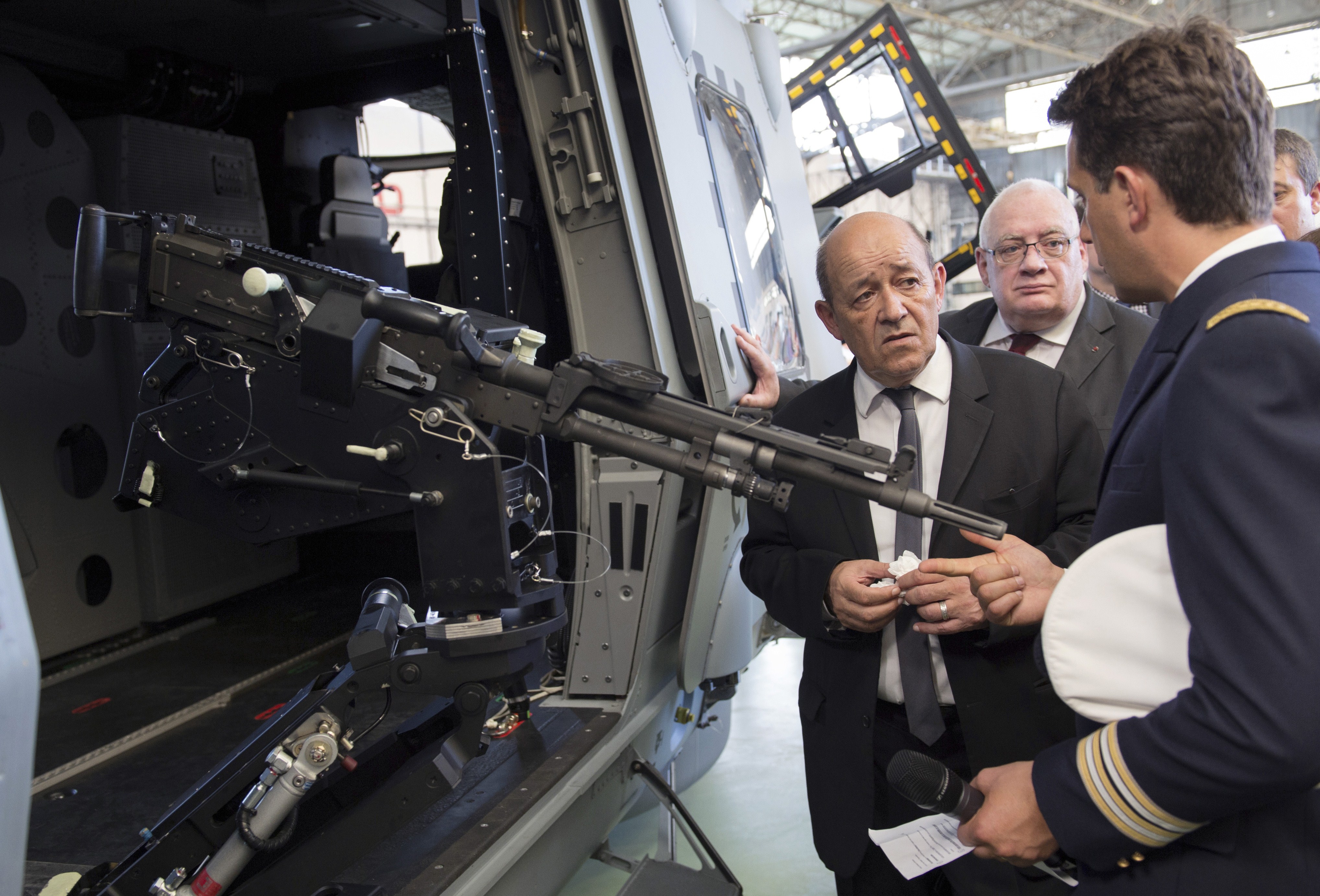
French Defense Minister Jean-Yves Le Drian, left, listens to explanations about an NH90 helicopter next to chief of the DGA, Laurent Collet-Billon, center, on June 12, 2014, during a visit at the military aerial base in Istres, southern France.
Photo Credit: Bertrand Langlois/AFP via Getty Images
That is an approach “that looks for synergy,” said Robbin Laird, of ICSA, a consultancy based in Washington and here. The next step would be to include the French Air Force in the discussions to encourage a joint-services approach.
Another factor to consider in developing a weapon is to adopt “an open system that is open to modular upgrades,” he said.
There is greater complexity; however, a greater focus on simulation, systems engineering and interfaces between systems is expected to lead to a change in industry’s engineering approach, according to Collet-Billon. That reliance on computer model simulators is expected to cut program costs. System engineering gives a clearer understanding of the requirement, saving time while improving quality of the solution.
In innovation, DGA seeks to strengthen its support through the supply chain, reaching to small and medium companies. The office is opening this year DGA Lab to ease the integration of technology in defense systems. The lab is likely to be located near the defense ministry on the southwest edge of the capital.
A digital approach reflects the world of big data, which includes data security and management and has replaced hundreds of pages of paper documents, he said.
“It is strategic. It is the DGA’s role to take into account the digital aspect at the concept phase,” he said.
That digital approach should be applied to building a tank to replace the Leclerc, with work on the next-generation vehicle updating the systems plugged into the véhicule blindé de combat et infanterie, an infantry fighting vehicle, and Scorpion vehicles, he said.
Those land units will be interoperable with a common datalink that hooks the vehicles to battle commanders.
Four DGA officials will draw up road maps, which will allow progress to be assessed under the transformation plan, he said. The goal this year is to engage stakeholders, which comprise the DGA, armed forces and industry. Young DGA engineers are similar to those in industry, steeped in digital culture and key to the transformation plan.
In Britain, the Ministry of Defence (MoD) has selected the former head of Defence Equipment and Support to assess the effectiveness of a major reform drive adopted in 2010 by the Conservative government.
“Sir Bernard Gray has been asked to undertake a technical review into the state of the procurement landscape,” an MoD spokesman said.