WASHINGTON — US House and Senate members hashing out the 2017 defense policy bill have made headway on acquisitions reform, but thorny funding questions remain unresolved, one of the top defense lawmakers said.
House Armed Services Ranking Member Adam Smith, D-Wash., said the lawmakers’ Monday evening meeting “went well. We resolved some issues and some issues we didn’t resolve.” Smith provided only brief answers to rapid-fire questions, after he emerged from the meeting, which was the second session of the high-level, closed-door negotiations.
What about the sticky issue of wartime Overseas Contingency Operations funding?
“That, we didn’t resolve,” Smith said.
What about acquisitions reform?
“We were able to make progress there,” Smith said.
Which chamber’s version of the bill prevailed, if either?
“That, I can not say,” he said.
The key negotiators — armed services chairmen Sen. John McCain, R-Ariz., and Rep. Mac Thornberry, R-Texas, as well as the panels’ ranking members Sen. Jack Reed, D-R.I., and Smith — are racing against the clock. The Senate is scheduled to be in session through Oct. 3, but Senate leaders are attempting to wrap up early.
Though an early departure would enable lawmakers to go home and campaign for the Nov. 8 election, it also adds pressure for NDAA negotiators to move faster or wait until after the lame duck session.
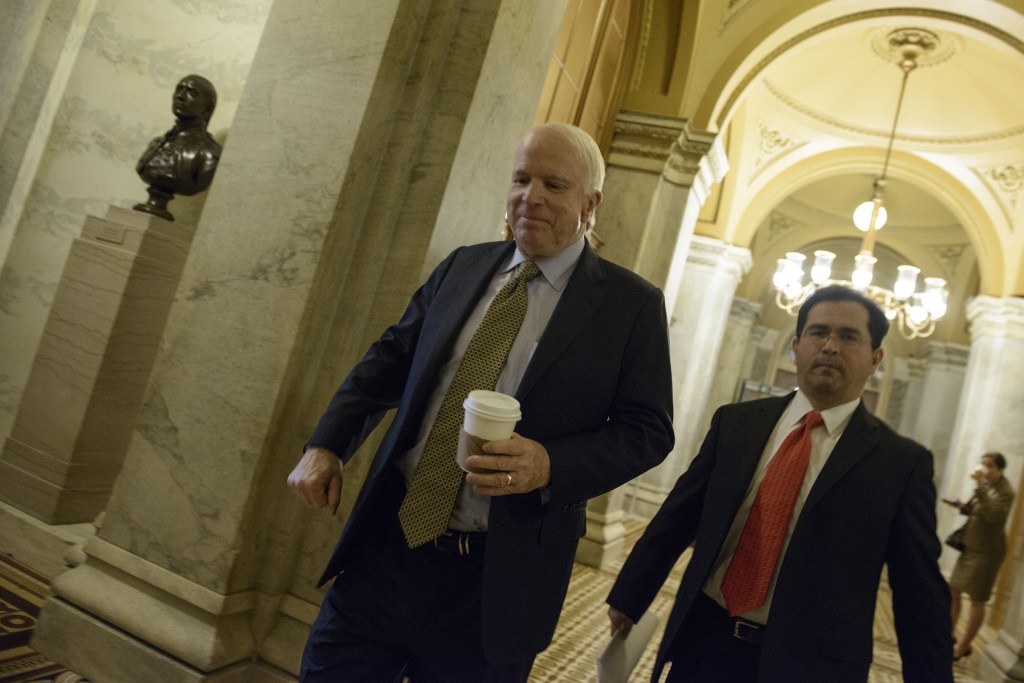
“We’re planning, we’re trying to have this thing done by next week,” McCain told reporters Monday before heading into negotiations.
Senate leaders are under pressure of their own. Senate Majority Leader Mitch McConnell, R-Ky., and Minority Leader Harry Reid, D-Nev., have said they are working on a stop-gap spending resolution to avert a government shutdown at the end of the fiscal year, Sept. 30.
McConnell on Monday said he expects to move forward this week on the continuing resolution (CR) to fund government through Dec. 9. Though some House Republicans have pressed for a CR that extends into 2017, quick passage and adjournment of the Senate would effectively force the House to adopt the Senate measure.
After returning to Congress after a late afternoon meeting at the White House with Reid, House Speaker Paul Ryan, R-Wis., and House Democratic Leader Nancy Pelosi, McConnell expressed confidence.
“We had a good meeting,” McConnell told reporters. “We talked about wrapping up the funding issue, and I think we’re all in a good place to do that on a bipartisan basis.”
According to one key Democrat, that continuing resolution is likely to include $1.1 billion to fight the disease Zika, but omit controversial policy riders championed by Republicans in both chambers. McConnell has said the bill will contain funding for veterans, but did not elaborate.
Negotiators from the armed services committees, known as the “Big Four” have struck an upbeat tone thus far, though weighty issues for the Pentagon and defense industry hang in the balance. The toughest issue is how a gap on defense funding will be resolved.
The Senate spending and policy bills support the president’s budget, while the House bills redirect $18 billion in OCO — which is exempt from statutory budget caps — for unrequested troops and equipment. The gambit spearheaded by House Republicans would leave operations in Afghanistan unfunded to force the next president to request Congress pass supplemental defense spending.
President Obama has threatened to veto the House and Senate versions of the bills — the House bill over its unorthodox treatment of OCO, and the Senate bill over its acquisition reform provisions and limits it would place on the closure of the Guantanamo military detainment facility in Cuba.
On acquisitions and Goldwater-Nichols reform, the two bills have significantly different approaches.
The Senate’s NDAA also blows up and renames the position of AT&L undersecretary — currently held by Frank Kendall — to better emphasize innovation within the Pentagon.
In a bid to shake up the Pentagon’s risk-averse culture, the House’s NDAA’s acquisition reform focus seeks to disincentivize lengthy, ambitious programs in favor of incremental, rapidly fielded breakthrough technologies.
Email: jgould@defensenews.com
Twitter: @ReporterJoe