WASHINGTON — The top US intelligence official is skeptical that a new cyber agreement between the US and China will diminish have any real affect on Chinese cyber attacks.
James Clapper, director of national intelligence, told the Senate Armed Services Committee on Tuesday today that while “hope springs eternal,” the agreement, announced last week, is unlikely to create a major change in how China attempts to access US information, including intellectual property.
Asked specifically by Sen. John McCain, R-Ariz., the committee’s chairman, if he was optimistic the agreement would produce about a lasting effect, impact from the agreement, Clapper took a dramatic pause, leaned into the microphone and very firmly replied, “No.”
“I personally am somewhat of a skeptic,” Clapper later said. “It will be our responsibility to look for the presence or absence of their purloining of intellectual property and other information.”
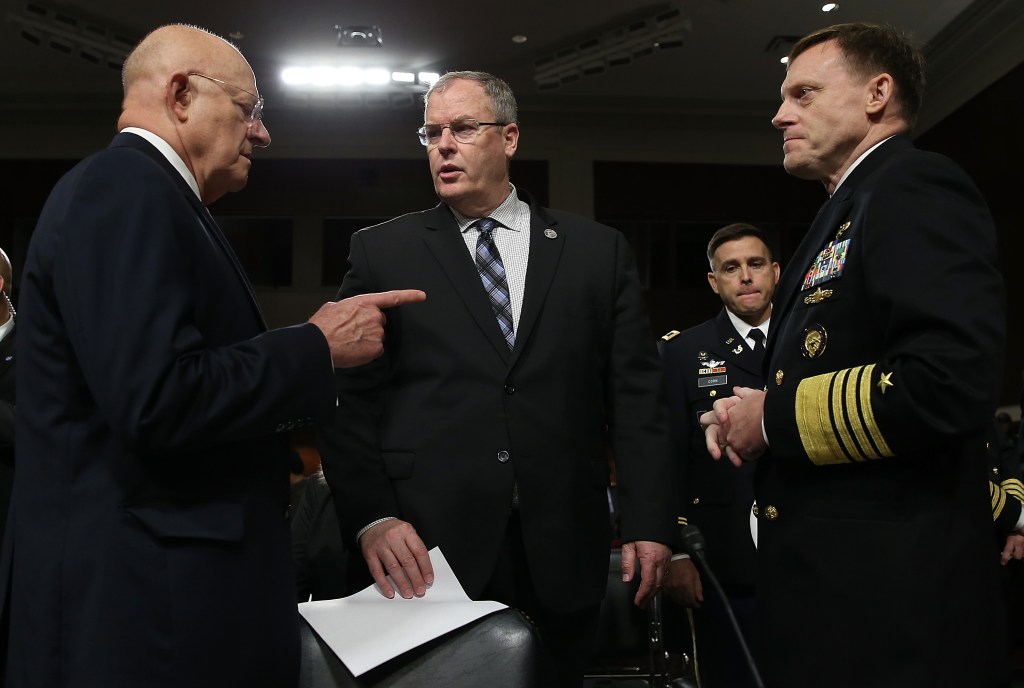
Clapper’s comments came at a hearing where he appeared alongside Deputy Secretary of Defense Robert Work and Adm. Michael Rogers, the head of US Cyber Command.
As part of the agreement, a US fact sheet said, China and the US agreed that “neither country’s government will conduct or knowingly support cyber-enabled theft of intellectual property, including trade secrets or other confidential business information, with the intent of providing competitive advantages to companies or commercial sectors.”
However, Jack Goldsmith, a professor at Harvard Law, points out that China’s own statements about the new agreement are less strict.
“Neither [President] Xi [Jinping] himself nor any other official Chinese official said what the U.S. said,” Goldsmith wrote on his blog, Lawfare.
“Xi said only that ‘China strongly opposes and combats the theft of commercial secrets.’ That is a vaguer and narrower statement than the U.S. statement. And moreover, Xi’s statement is identical to China’s longstanding position during the long period in which China has stolen (or supported theft of) U.S. IP secret.”
The announcement, Goldsmith concluded, “seemed to mark progress while at the same time allowing both sides to claim what they want to claim about what they actually agreed to.”
China has long been fingered in major thefts of intellectual property, including an April 2009 hack of Lockheed Martin. Chinese forces have since rolled out the J-31 fighter, which looks nearly identical to the Lockheed-designed F-35 joint strike fighter, as well as a radar system that appears to be based on Lockheed’s offering for the US Air Force’s Three Dimensional Expeditionary Long-Range Radar program.
Estimates for the economic damage from cybertheft of intellectual property has been estimated at over $300 billion.
“China has done those kind of activities in the past,” Work said when asked about cyber.theft. “It will be up to them to prove they will not do it in the future.”
Email: amehta@defensenews.com
Twitter: @AaronMehta