
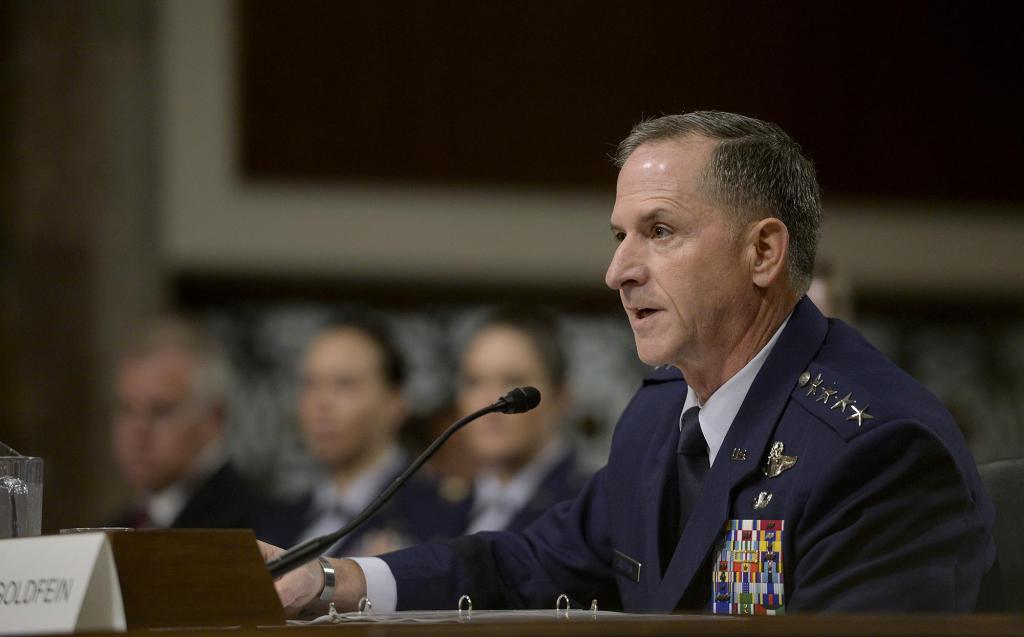
WASHINGTON — The Obama administration’s pick for the next Air Force chief of staff breezed through a confirmation hearing Thursday, with Senate lawmakers for the most part choosing not to engage with the nominee on many of the controversies that have fueled past feuds.
Senate Armed Services Committee members seemed widely supportive of nominee Gen. David Goldfein, who currently serves as the air service’s vice chief. The top Democrat on the committee, Jack Reed of New Hampshire, praised him as “highly qualified” for the Air Force top military position.
Although confirmation hearings for uniformed leaders are often tame affairs, this one held out the potential for a lively debate, perhaps led by Chairman John McCain, R-Ariz., on thorny topics such as the use of Russian rocket engines, the service’s push to retire the A-10 Warthog, and the secrecy surrounding the B-21 bomber program.
With the first two issues resolved for the moment — lawmakers agreed on language on the RD-180 engine earlier this week, and the Air Force has decided to retain the Warthog at least until 2022 — the lack of public information about the bomber’s engineering, manufacturing and development contract value remained as a potential flash point.
As McCain began his questioning on the topic, he said: “I’m having a difficult time understanding how the public disclosure of a single contract award value funded from an unclassified budget request is going to give the enemy more information on the capabilities of a new bomber than what the Air Force has already disclosed.
“All I can see is that keeping it a secret deprives the American taxpayer of the transparency and accountability they deserve. Can you explain what new information our enemy might learn from the release of the contract award value that they couldn’t learn from the information the Air Force has already released?”
In his response, Goldfein appeared to agree with McCain, but only in principle.
“Chairman, I agree with you, and I believe that if we’re not transparent with the American people on the cost of its weapons system through its elected leadership then we have a good chance of losing this program,” he said.
“Thanks so much for that,” McCain interjected before moving on to his next question.
But in written answers to advance questions distributed to lawmakers ahead of the hearing, Goldfein struck a slightly different chord, suggesting he would preserve the secrecy surrounding certain B-21 program cost data.
“Maintaining the classification of the B-21 program Engineering, Manufacturing and Development (EMD) contract value is critical in order to protect vital information capabilities of the aircraft that can be exploited by our adversaries,” Goldfein wrote. “There is a strong correlation between the cost of an air vehicle and its total weight, thus making it decisively easier for our adversaries to calculate the aircraft capabilities and develop countermeasures.”
Goldfein stated in his written responses that the Air Force remains committed to transparency with Congress on the cost of the program to the greatest degree possible, citing its public release of the $23.5 billion independent cost estimate for development of the aircraft.
When asked during the hearing about the A-10 Warthog, Goldfein said he backed maintaining the fleet for current operations and that the service would remain committed to the close-air support mission.
“I’m actually as concerned about the A-10 community as I am about the A-10 platform, because the A-10 community is actually our PhD course when it comes to close-air support,” he said. If confirmed, he would mine A-10 operators and maintainers for wisdom for what the next close-air support platform should look like.
Senators curtailed questions about the controversial F-35 joint strike fighter program today, but Goldfein’s written answer show that he would oppose the committee’s move to separate the aircraft’s follow-on modernization program from the overall program of record, as well as the panel’s plan to eliminate the F-35 Joint Program Office after a full-rate production decision.


