SEOUL — European defense clout is expanding in South Korea, which has long been regarded as a second home turf for American weapon systems.
In a sign of growing popularity of European weapons here, Airbus has clinched back-to-back arms acquisition deals for helicopters and in-flight refueling tankers.
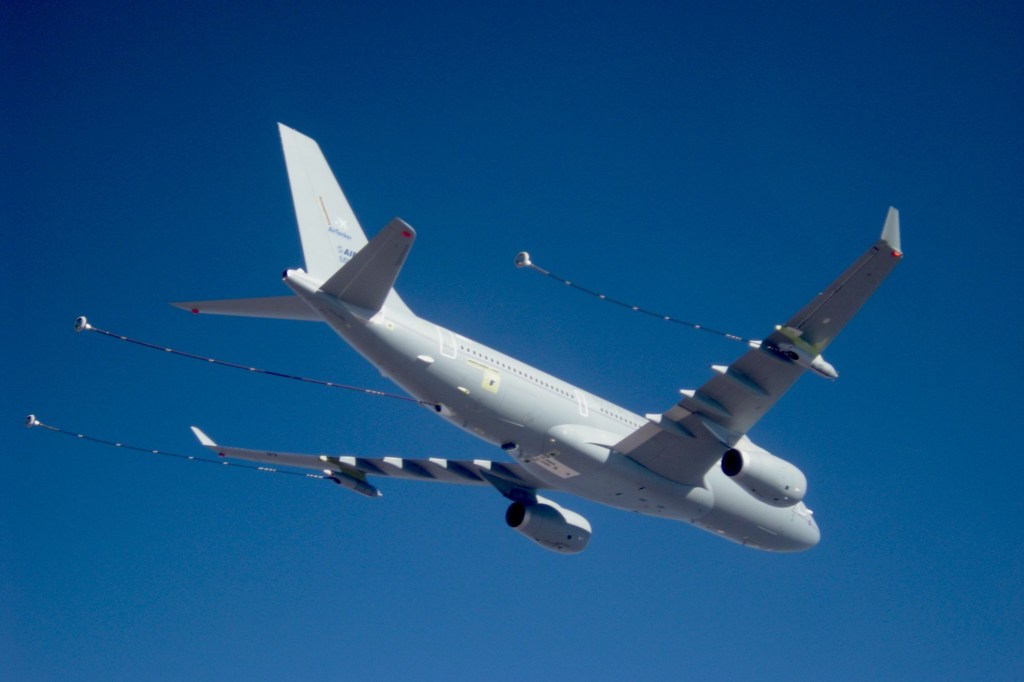
In the latest competition for four airborne refueling tankers, Airbus Defense and Space beat US rival Boeing and Israel Aerospace Industries (IAI). Under the $1.2 billion contract, the European aerospace giant is to supply the South Korean Air Force with four Airbus multirole tanker transport (MRTT) aircraft between 2018 and 2019.
“The A330 MRTT showed better performances than its rivals in terms of the duration of flight mission in larger areas and amount of refueling, as well as troop- and cargo-carrying capacity,” said Kim Si-cheol, spokesman for Seoul’s Defense Acquisition Program Administration (DAPA).
“With the deployment of the refueling tankers, our fighter jets could fly up to Pyongyang in case of an emergency,” Kim said. “It will enhance our combat readiness and facilitate our peacekeeping operations and emergency relief efforts overseas by enabling long-distance mass supplies.”
The European refueling aircraft, based on the Airbus A330-200 passenger jet, also is effective in depot maintenance since lots of countries use the same type of jet, the spokesman said. The A330 MRTT has been selected by a number of governments, including the United Kingdom, Australia, Saudi Arabia, Singapore, France and the United Arab Emirates.
What may have tipped the scales in favor of the A330 MRTT is its price and availability, according to DAPA sources.
The South Korean Air Force had wanted the planes delivered as early as 2017. Airbus offered to start delivery in 2018, but Boeing could not promise its KC-46A at least until 2019, given its development and flight-test schedules.
The recent decline in the euro against the US dollar was a factor in favor of the European company, sources said.
“Price accounted for only 20 percent of the evaluation, but it was the most important criteria for selecting the winner amid increasing budget pressure,” a source said.
The decision to acquire European refueling tankers comes on the heels of a mega-deal for light armed helicopters. In March, South Korea opted to build a 10,000-pound helicopter based on Airbus Helicopters’ H155. Korea Aerospace Industries (KAI) signed a $1.4 billion contract with Airbus Helicopters to build the light helicopter, to be used for civilian and military purposes.
A series of decisions to procure European weapon systems will open the door for more European weapon systems in South Korea, observers said.
“The South Korean government is seeking to diversify the routes of arms acquisition,” said Kim Dae-young, a researching member of the Korea Defense & Security Forum, a Seoul-based defense think tank. “In particular, South Koreans want to have more home-built weapons than before, so European firms could have more opportunities to sell their products to Korea, offering more lenient tech transfer than the US.”
The leverage of the South Korea-US alliance in arms acquisition programs has also weakened because equipment from other NATO nations has few interoperability gaps with US systems, Kim said.
He said Boeing’s waning in the South Korean market is noticeable.
Chicago-based Boeing was the reigning champion in the first two stages of the country’s F-X program, winning deals for 60 F-15K aircraft. The company also won major South Korean weapon procurement programs, including airborne early-warning aircraft and AH-64D helicopters. But it suffered successive defeats on the F-X III fighter procurement program and the refueling tanker contest.
The F-X III for 20 aircraft was awarded to US company Lockheed Martin in a come-from-behind victory. Boeing was dropped in a final stage due to what the DAPA claimed was the F-15 Silent Eagle’s lack of stealth capability.
“Boeing was a signature brand of US weapon systems in South Korea, but it’s waning definitely,” Kim said. “Boeing has now few products to meet the required operational capability of the South Korean military’s modernization programs, and the merit of the Korea-US alliance is not as strong as before in arms acquisition.”
Kim Yeol-soo, professor of international politics at Sungshin Women’s University in Seoul, said US dominance in the South Korean defense market will not be weakened shortly, but the introduction of European weapons will change the environment of a market previously dominated by the US.
“US defense firms are expected to do more to meet the Korean demands, including tech transfer and logistics services, to respond to European rivals,” Kim said. “That will make the market more balanced than before.”
Email: jsungki@defensenews.com