
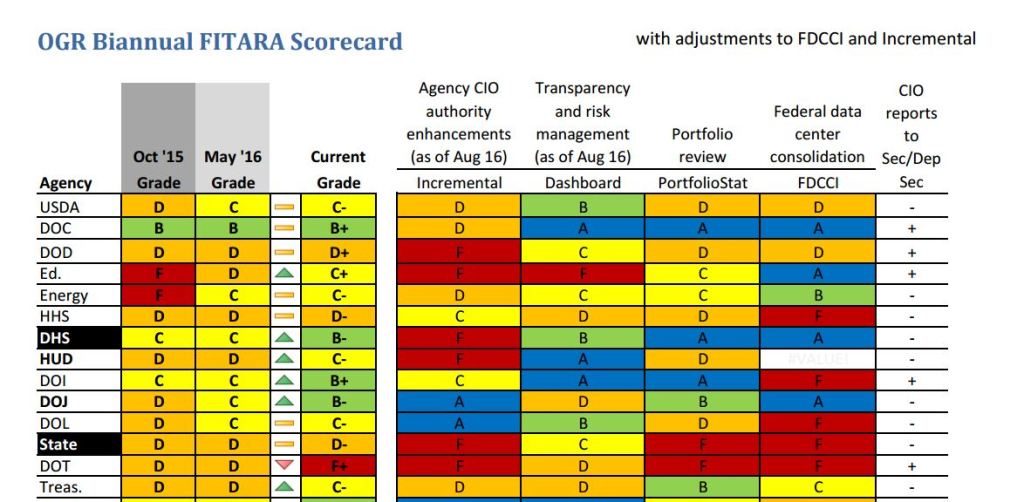
Congress last graded agencies on their implementation of the Federal IT Acquisition Reform Act (FITARA) in May, and since then all but one agency maintained or improved their score overall.
The biannual scorecard by the House Oversight and Government Reform Committee — the third since FITARA was passed in December 2014 — shows eight Bs, 10 Cs, five Ds and one F among the 24 CFO Act agencies. Twelve of those scores are improvements and 11 hold steady, while the Department of Transportation dropped further from a D to a fail.
Improving agencies include the departments of Education, Energy, Homeland Security, Interior, Justice, Treasury, Veterans Affairs and Environmental Protection, as well as the General Services Administration, NASA, the National Science Foundation and the Social Security Administration. However, the latest scorecard shows nine out of 21 agencies graded in the category measuring chief information officer authority enhancements getting an F (and four only garnering a D).
“Since we first began conducting oversight over the 24 agencies FITARA covers, we have already seen a marked improvement with several of those agencies,” said Subcommittee on Information Technology Ranking Member Rep. Robin Kelly, D-Ill., in an opening statement for the Dec. 6 FITARA scorecard hearing. “For example, since the release of our last scorecard, NASA’s overall grade went from an ‘F’ to a ‘C+.’”
“Looking beyond the grades, I am encouraged by the responsiveness of most agencies and their progress to date in FITARA implementation,” Kelly continued. “Notably, governmentwide, data center consolidations alone have realized over $1.6 billion in savings. These are all good first steps. But it’s clear that there remain obstacles to overcome in implementation. The new scorecard shows that some agencies have hit roadblocks, and that some have fallen behind in implementation.”
The means used to measure agencies’ successful adoption of FITARA remain data center consolidation, IT portfolio review savings, risk assessment transparency and incremental development. The portfolio review metric, however, was adjusted to have each agency’s total PortfolioStat savings divided by its total IT budget for the most recent three fiscal years. The resulting ratios were then ranked in tiers (like the risk assessment category), with the five highest savings ratios garnering their agencies an A, the next five a B and so on.
In addition, a plus or minus sign has been added to all agencies’ final grades. This is not a grade variant; rather, this data point indicates whether the agency CIO does (+) or does not (-) report to the secretary or deputy secretary of the agency. As of scorecard 3.0, it’s an even 12/12 split, and Subcommittee Chairman Will Hurd, R-Texas, considers the implications of the reporting structure on CIOs being empowered to make decisions and lead within their agencies to be an important talking point.
The full FITARA scorecard 3.0 can be
viewed on the Oversight Committee’s website.


